Life in the Ring of Fire Part 45: Visitors
This week's Tautu language word is “natanbong,” it means “evening.” You can combine it with “ares” from a few weeks ago to say “ares natanbong,” meaning “good evening.”
The first stop when coming into Vila from the islands is, without fail, Jill's Cafe, the only American food restaurant in town. It also doubles as the American embassy. Well, kind of. You see, Vanuatu is too small to merit its own American embassy, so we're a satellite of the embassy in PNG and Jill, the owner of Jill's Cafe, is the embassy extension worker. She doesn't exactly inspire confidence as, say, someone to go to if you've lost your passport, but she does make a pretty good burrito and once you get a couple bites into one I image whatever trouble you've managed to get yourself into wouldn't seem as pressing. We arrived in Vila after The Ship Ride From Hell (SRFH) on a Saturday, which was fortunate because Jill's has cinnamon rolls on Saturdays. We'd been fed on the ship, plates of rice topped with canned fish and vegetables, which was good because we hadn't brought nearly enough snacks to last us for the 48 hours we were on-board. The first day, the portions were generous and I had trouble finishing a plate by myself. As the journey wore on, however, we received less and less food each meal (as, I assumed, the kitchen was running out of supplies), and so I was absolutely starving when we sat down to breakfast that Saturday. I ate two cinnamon rolls and a breakfast burrito. It was glorious. The cool thing about going through an absolutely miserable experience is that it makes everything else seem wondrous by comparison. While I'm sure that a Jill's cinnamon roll or breakfast burrito would taste only mediocre when placed alongside similar fare from Austin, I exaggerate not in the least when I say that the cinnamon rolls and the burrito that I ate after disembarking from the ship were the best I've had in my life.
Wednesday was the thirtieth of July, Vanuatu's Independence day. We decided to spend the afternoon in Pango, a village just a little bit north of Vila that's home to a volunteer from our group. There was a big field in the middle of the village where a number of food and craft stalls had been set up. This is pretty standard practice for celebrations in Vanuatu. A day or so before the holiday in question, everyone realizes that they need to get their acts together and organize some sort of event, so a bunch of stalls are hastily erected using mostly coconut leaves. It's actually kind of impressive to walk by a field one day and see it completely empty, but walk by it the next and see it absolutely covered with homemade stands. Despite how long everything usually takes in Vanuatu, Ni-Vans can jump to when the situation calls for it. Anyway, it was around lunch time when we arrived, so we went in search of tuloc, a sort of Vanuatu style tamale. Usually tuloc is a cylinder of manioc lap-lap with meat stuffed in the middle (as always, the best ones have pork in them, but beef can be pretty good as well), that's wrapped in a banana leaf and then baked. I love a good tuloc, however, unfortunately, tuloc is quite variable. A lot of people that make it try and save money by skimping on the meat, thus making it turn out like particularly dry and tasteless lap-lap. A nice greasy one with plenty of meat can be quite heavenly though. After a bit of wandering around the food stands, we located a tuloc vendor with passable wares and headed to the beach. Pango is known for having the best (actually, I think the only) surfing on Efate thus, in stark contrast to my village in Tautu, the ocean was crawling with Ni-Van kids clutching anything even remotely resembling a surf board and trying to catch waves. Shortly after we sat down, however, a man with a bull horn ordered the kids out of the water and a crowd gathered on the beach. A group of women formed around the man with the bull horn, who all seemed to be waiting to participate in some sort of competition. Then a man emerged from the village clutching a live and squealing pig. Pig in hand, he waded out into the surf. He walked out until the water was almost chest height and then plopped the now terrified pig in the ocean. The bull horn man screamed “GO!” and all the women splashed out into the water. It was a race of course, the first one to swim out and recover the drowning pig got to keep it. After a few minutes one of the women started shouting and raised the pig, who was definitely having one of those days, over her head. After all the women made their way back to shore, a group of men gathered, another pig was brought out, and the process was repeated. This time, however, the guys splashed around for a while but no one emerged with the pig. Some more people from shore wandered out in what now had turned into a lost pig recovery mission. Finally, they found the pig. The men competing headed back to shore and lined up again at the starting line. They chucked the waterlogged pig back in the ocean and the race started again. This time, one of the competitors was able to locate the pig and carried it triumphantly back the beach (surprisingly, it was still alive). Towards the end of this spectacle my cell phone rang. It was my parents, giving me one last call before boarding the plane for Vanuatu.
“So, what are you up to now?” They asked.
“Well... it's a little difficult to explain.”
On Friday afternoon, my family flew in. I headed to the airport and arrived just in time to see their plane pull up the tarmac. I watched people disembarking until I spotted my Dad, Mom, and brother and then headed down to the arrival terminal to greet them. I walked through customs and passport control and settled onto a bench in the baggage claim area. Out of the corner of my eye, I saw a group of Ni-Van airport staff huddled in conversation. Occasionally, one of them would glance or point my way. Twice, one of the guys took a few steps in my direction and then scuttled back to the join the huddle, causing the group to dissolve in giggles. I was hoping that my family would come through the arrival door before one of them managed to work up the courage to ask me leave, but I didn't quite make it. One of the guys finally found the backbone to come talk to me and inform me that I wasn't allowed in the customs area. I moved to a seat outside in the arrival lounge with everyone else.
Seeing the family was great. My brother had gotten a lot bigger in my absence (although, fortunately, I was still able to pick him up), and my parents each promptly informed me that I needed a haircut. We caught a bus back into town and checked into one of those nice hotels in Vila that I could very much not afford on my own and had only been in before to illegitimately use the pool. We all got settled and they showed me the various things that they'd brought for me. Unfortunately, an assortment of sausage and beef jerky had been confiscated at customs (probably so that the customs officials could eat it), but they did manage to bring though an impressive collection of American foods and beverages, including a couple bottles of tequila, powdered margarita mix (who knew?), and Cheez-Its which, according to my Mom, had been sitting in the pantry untouched since I'd left. There was some confusion caused by some items as well, as I tended to get excited about absolutely any US products.
“Wow! Jif peanut butter! And it's only half eaten!”
“Uhh, Daniel, actually, that was just for us to eat on the plane ride over.”
Or...
“Chicken packets! Awesome!”
“Umm, I think we just forgot to take those out of our luggage after that road trip.”
On Sunday we boarded a plane for Malekula so that my two families could meet each other at last. Duncan had been calling me more or less hourly throughout the weekend to straighten out last minute details about their welcoming meal, so anticipation was high. I kind of felt like I was introducing my family to a fiancee or something. As instructed, I led my family to my house first to wait for Duncan to come and get us. When he showed up, he led us all to his house where my entire Vanuatu family was lined up, grandparents, aunts and uncles, cousins, everyone. There were probably about thirty to forty people in attendance. They hung flower necklaces on us and we all sat down to eat. Duncan had gone all out. There was one roast pig, straight out of my uncle's oven, two lap-laps, three different stews, one bunia (a collection of sweet potatoes and taro wrapped in banana leaves and baked underground), and enough rice to feed all of China. I'd warned my US family beforehand that food would be overabundant and that they would probably be judged on their ability to pack it away, and they performed admirably. After lunch we adjourned to my house so we could all pass out until kava time. This was also a moment I'd been awaiting with some anticipation. Duncan poured shells for both my Mom and Dad and I recruited one of my friends from the village to take their picture while they were drinking, hoping to catch them in mid gag, grimace, or disgusted spit. Unfortunately, they were able to take it down like (semi) pros, so I was out of luck.
Thursday, August 28, 2008


Saturday, August 16, 2008
A Picture Takes A Lot Longer To Upload Than A Thousand Words: Third Photo Edition
OK, well, guess what? It's time for another photo issue. My family from the US came to visit me in Tautu and currently all of us are in Australia. This means two things: first of all, my family took a lot of pictures of Tautu, since the place was new to them and they had no fear of appearing too much like tourists by walking around with a camera. Second, Australia has really fast internet. Like, really fast. It's amazing. You type in the address into the browser and *bang* you're there. No waiting, no loading, it's unreal. The bottom line being I have a lot of pictures for you and the means to upload them all. Hope you enjoy. Unfortunately, this isn't a themed photo issue, more of just a hodge-podge of pictures I happen to have.


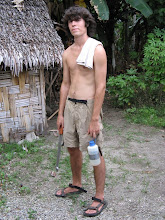
Here it is, at long last, Dan in Vanuatu, sporting the traditional native garb of shorts, afro, machete, and a water bottle. It's really all you need around these parts. I like to keep a spare shirt slung over the shoulder as well, just in case. I don't often need to wear it, but it's useful for a number of other purposes including: towel, handbag, sweat rag, and pot holder.

Here's me opening a coconut to make coconut milk. The first step is impaling the coconut on a sharp stick to remove the outer husk.

After the husk has been punctured enough, you can start to rip it off.

It's very fiberous, however, so sometimes you need to go back in for a second impaling.

Contrary to popular belief, the hardest part of coconut opening is getting the husk off. Once you've done that, you just hit the nut (the part that you can buy in the produce section of the grocery stores in the US) a couple times with the flat of a machete to crack it open.

Finally, you take the coconut halves and scratch the meat out of them using a circular metal disk with teeth around the circumference, leaving you with a bowl full of coconut shavings. You can then squeeze the shavings to extract the coconut milk (also contrary to popular belief, the liquid inside a coconut isn't the coconut milk, it's mostly just water).

Here are the infamous lap-laps, just out of the underground ovens and still wrapped in banana leaves. My host family in Tautu was very excited about the visit of my US family and prepared a grand total of five lap-laps for them over the course of a week.

A row of lap-laps unwrapped and ready to eat. Notice the white circle in the middle of the nearest one, that's a pool of coconut milk. Filling the middle of a lap-lap with coconut milk is a serving style unique to Malekula. My Mom, Dad, and brother are being good sports and digging in.

Speaking of food and drink, here's my family's first shell of kava. They were good sports about that too. Notice I'm watching for one of them to spit it out so I can get a good laugh. No kava for Nick, my little brother, however, maybe in six years or so.

Here's me tending my oven: a hole in the ground which I put an aluminum pot in and cover with hot coals. Sounds primitive, I know, but it turns out a reasonable batch of cinnamon bread.

Rounding off the food photos, here's me tending my little weber grill with my machete (all work in Vanuatu can be accomplished with a machete). Due to the lack of charcoal, I have to light a wood fire in the grill and wait for it to ember before cooking.

More grilling.
 OK, let's get some family photographs in. Here are all my siblings, from the left: Tracey, Nick, and Frank.
 Duncan and Tracey.

Myself and both my Dads.

The Moms and the kids.

Here's almost everyone. US Mom is taking the picture.

But here she is with my little brothers.

Nick socializing with the Tautu kids.

Some Vanuatu extended family working on a lap-lap.

My US family all decked out in their Vanuatu finery.

Duncan presenting my Dad with a parting gift: a model wooden canoe to grant a safe journey should they ever wish to return to Vanuatu.

Here's me in action teaching class.

And again...
 Myself and my brother at the Peace Corps Office in Port Vila.
OK, that's all I have for you at the moment. More entries to come soon, I hope.
Wednesday, August 13, 2008
Life in the Ring of Fire Part 44: Dante's Inferno
This week's Tautu language word is “mle” (see issue 42 for pronunciation). It means kava. I think that's kind of self explanatory.
Monday McKenzie and I woke up early to catch a truck back from Laura's village to Lakatoro. Unfortunately, apparently there are many more people trying to get to Lakatoro from Matanvat than trying to get to Matanvat from Lakatoro, and so we would not be getting a repeat of the nice, pleasant ride we'd had on the way up. By eight o'clock in the morning, two out of the three trucks had already passed being too full to carry us. When the third one rolled up, we quickly saw that it was even more full than the previous two had been, but we were determined, so McKenzie crammed into the cabin and I stuffed myself into the back. Literally every cubic angstrom of available space was filled by either cargo or people. The whole truck drove like an overloaded airport luggage cart and seemed ready to spill over at any moment, especially given the unevenness of the terrain. Of course, this had become so much the MO for Vanuatu that I no longer felt the least bit unsafe. It was, however, one of the most uncomfortable truck rides to date. Just a little past Elin's old village the truck broke down. I'm not really sure what was wrong with it, but it seemed to be able to be fixed with (no joke) a machete, a piece of bamboo, and a bottle of vegetable oil.
I arrived home at the school to find that, as predicted, class had been canceled in favor of volleyball. I took the opportunity to give my house a much-needed deep cleaning in preparation for my parent's visit in a couple weeks. That evening as I was drinking kava with Duncan I received a text from McKenzie informing me that Elin would be going back to the US. Kenzie told me she would try and get in touch with Laura and that the two of them would probably try to get into Vila as soon as possible to say one last goodbye, if I was interested in coming along. Laura was down in Lakatoro the following day and that evening we all got kava in Lakatoro to discuss plans for getting to Vila. I already had a plane ticket to Vila, as I had been planning on going in about a week to meet my parents, and so I could easily change my departure date to get in earlier. The two girls, however, were interested in conserving money and thus wanted to take a ship. We called the Fresh Cargo, the new ship providing faster, more reliable, service between Malekula and Vila. Unfortunately, they weren't scheduled to depart until Saturday, and we were looking to get in sooner. Laura had gotten word that the Moaika, a typical cargo ship, was supposed to be arriving the following day, Wednesday, in Litz-Litz and should be getting to Vila Thursday morning. This sounded as good an option as any and Laura agreed to come down to Tautu the next day to help me pack up Elin's stuff and get it to the ship to deliver it to her before her departure for the US. True to her word, Laura was at my house in the morning and the two of us chartered a truck and loaded up with Elin's baggage. We had just dropped everything off at the dock when we were informed that the Moaika would be delayed and would not be in until Thursday early in the morning. We were not particularly surprised by this, being Vanuatu veterans, and so McKenzie and Laura moved Elin's stuff to McKenzie's house for the night and I went back to Tautu to have one last kava with Duncan.
The next day, Thursday, I was literally shocked to receive a call from Laura at around 6:30 in the morning. “The Moaika's here,” she informed me. “W-What?” I said, not really believing my ears. “The Moaika's here,” Laura repeated, “get down to Litz-Litz as soon as you can.” I rode my bike down to McKenzie's house and the three of us boarded the ship. At this point, we were feeling optimistic about our situation. The ship had actually come, which was miracle enough, and it was only a day late. The captain assured us that'd we be making only three stops on our way to Vila: Rensari, Lemap, and Akam, and should be reaching Vila by Friday morning. We watched the crew load the largest collection of watermelons I'd ever seen, an entire lorry-full. I found this comforting, as I knew that if we should become lost at sea, we could survive for years off of this stockpile of watermelons. We set off from Litz-Litz wharf at about 9 o'clock in high spirits. It was a gorgeous morning, the ocean looked beautiful and inviting, the gentle rolling of the boat was calling up pleasant memories of sailing in college, and we were all happy to be embarking on our first extended boat journey in Vanuatu. We should have known better. We really should have. Writing this now, I want to shout back at my previous self. “Don't do it! FOR THE LOVE OF GOD NO! GET OUT! GET OUT WHILE YOU STILL CAN! JUMP OFF THE BOAT AND SWIM BACK TO SHORE IF YOU HAVE TO!” It wasn't as if we weren't warned. Every old volunteer you meet has one, and only one piece of advice to offer you, and that is “Don't get on a boat.” During our first few months we found this quite obnoxious. There we were, starry-eyed newbies fresh from the States, eager to get helpful pointers from our older, wiser brothers, and that's all they'd give us. “But what's it like learning the language?” We'd ask. “Don't worry about that, just DON'T GET ON A SHIP!” “Right, OK, but what about integrating into the...” “DON'T GET ON A SHIP!” The sad fact of the matter is that no one can warn you enough. “How bad could it really be?” You find yourself asking, “I'm a tough guy, I'm sure I can succeed where others have failed.”
Well, actually, this optimistic, can-do attitude persisted throughout most of the first day. We didn't get seasick and there weren't that many people on the ship, so we had plenty of room to stretch out. We motored along for about an hour before making our first stop. It was Rensari, just as promised. Now, most villages in Malekula don't have wharves deep enough to allow a cargo ship to come up and dock at them, so what ends up happening is that the ship will idle a little ways off shore while a couple of the crew put out in a little motorboat for shore. They load up the little boat with cargo and passengers and bring them back to the ship, unload and, if necessary, head back to shore to pick up more stuff. The people of Rensari also had a large collection of watermelons that desperately needed to go to Vila, so the boat had to go out three times to pick up everything. This took about an hour, which was a little frustrating, but Rensari was a pretty good ways down the coast already, so I still felt like we were making good time. After Rensari, we motored for another half hour before once again stopping so the motor boat could bring in cargo. After that, things went exponentially downhill as the stops grew more and more frequent and the amount we moved between them grew less and less. By the end of the day things had fallen into a pattern of moving for approximately fifteen feet followed by stopping for about twenty minutes to allow the motor boat to go out come back carrying, say, a yam that someone was sending to a relative in Vila. I began to get pissed off at the number of ridiculous stops we were making to pick up a single piece of produce. “You don't need to send a freaking yam to Vila!” I wanted to shout. There are yams in Vila already, OK. I promise. In fact there's loads of yams. Too many yams. You know what? I'll buy you one. I'll buy you four. JUST PLEASE FOR THE LOVE OF GOD STOP MAKING THIS SHIP STOP TO PICK UP YOUR GODDAMN VEGETABLES. Or, how about this, if you REALLY need to get your yam to Vila, why don't you and all of those with similarly idiotic root-crop transportation needs in all the nearby villages get all your yams TOGETHER in ONE PLACE so that the ship only has to stop ONCE. Is that so hard? For the life of me, I couldn't figure out how the crew of the ship could possibly be making money on these cargo expeditions. The ship's motor was never shut off, so it was constantly burning fuel, and the motor boat was obviously burning a lot fuel, which isn't cheap in Vanuatu, and they were really only getting about $2 a pop to go in and pick up someone's yam. Go figure.
By nightfall we had made it to Lemap, on the southern point of the island. Although we didn't know it at the time, this was to prove to be the highlight of the journey. Lemap actually had a wharf, in a manner of speaking. There were three parallel, horizontal concrete beams running out from the shore that the boat moored to. It looked like there used to be wooden planks laid across these concrete beams to make a dock, but most of the planks had either rotted or were missing. Thus, in order to reach shore from the boat, one had to walk across one of these slippery, 6-inch wide beams for about 50 meters. We were actually told later that the Lemap wharf is known for an unusually high incidence of shark attacks, due to the fact that there used to be a meat packing plant nearby. Regardless, after a whole day on a boat we were all eager to spend a couple hours on shore, so McKenzie and I disembarked and headed out to try and find Jack, a volunteer from our group stationed in Lemap, as well as some kava. It was about a fifteen minute walk into the village where, after a bit of asking around, we located Jack's house. He actually had quite a nice setup. He'd set himself up a solar lighting system and crammed his house full of more western goods than I'd seen in a long time. There were crates of soy milk, soda, canned iced coffee, snacks, instant noodles, and electronic equipment. The three of us went out and had a few shells of kava. We'd been told by one of the crew that the ship would be departing around midnight, so after kava we headed back to the ship and I stretched out on one of the benches and fell asleep. I woke up the next day at around 9am (that's 24 hours in transit so far) to find that the ship was still moored in Lemap. I really should have known better, but I was still clinging to hope at this point. Lemap's at the very south of Malekula, I reasoned, and there's really only a few small islands off the southern coast, so, really, there's only a couple more stops that it would even be possible to make before heading out to Vila. Man was I wrong.
The second day was a complete repeat of the afternoon of the previous day: move eight feet, spend half an hour loading a watermelon, move eight more feet, etc. I began to dread the sound of the ship engine powering down to idle like a tortured prison inmate fears the approaching footsteps of his captor. Every time that devilish little motorboat headed out towards shore, it took a little piece of my sanity with it. I began to develop a nervous twitch every time I felt the ship slowing down. My shoulders and fists were shore from being clenched and tense, but I was unable to relax. I lost my ability to communicate, unable to answer questions and comments directed my way with anything other than a dirty look and a scowl. I began to fantasize about strangling the supercargo (the person responsible for driving the speedboat to shore to load cargo) or about beating up random passengers and throwing them overboard. In other words, I was well and truly going insane. By evening I was at the absolute end of my leash. We'd been on the ship for almost 40 hours and still hadn't left Malekula. I was a tense, nervous wreck. It was a good thing there weren't any firearms on board, because I honestly probably would have started shooting people. The only thing holding me together was the fact that we'd finally made it to Akam, which the captain still insisted was to be our last stop before Vila. The Akam villagers had a lot of cargo, and the crew was rushing to bring it all in before they lost daylight. They probably made four or five runs in the motorboat to get everything, but finally it was over. It was almost totally dark, the faint outline of the shore only dimly visible in the darkness, but it was done. The crew tied up the motorboat and we started moving in earnest. It was about half and hour later, just as I was finally starting to relax, that I heard it: the engine was slowing down. I started crying. I mean, I literally started crying. “Where the f%$@ are we?!” I demanded of the surprised passenger sitting next to me. “Southwest bay,” she replied. We were going completely the wrong direction, working our way back up north on the western coast of Malekula. I snapped. I started screaming random profanities at the coast, now invisible in the darkness. I pounded the benches and punched my fists wildly in the air. I don't really know what happened next. I think I passed out from anger and exhaustion because the next thing I knew I was lying on a mat on the deck of the ship and we were moving again. McKenzie and Laura were discussing plans for what to do once we reached Vila, and I gathered we'd been moving continuously for a couple hours. I still don't know how the captain was navigating in the dark. I was pretty sure he didn't have a GPS. It was cloudy and the stars were barely visible. The ship didn't even have bow lights to spot shallows.
So we were on our way to Vila, and that was good. The end was in sight. Still, the powers that be weren't about to let us off that easily. Midway through the second day, Laura had decided that the ship, Moaika, that we were on should be renamed Dante's Inferno. Because if you're trying to decide whether to take the Moaika or an airplane to Vila, the correct choice isn't necessarily obvious. However, if you're choosing between an airplane and DANTE'S INFERNO, well, things are a little bit more clear. Now, I don't know what cardinal sin I'd committed which doomed me to end up in whatever circle of hell is home to miserable ship rides, but there were a few more torments I had yet to undergo before my sins were atoned for. For starters, the ship had gotten a lot more crowded. We'd picked up a good number of passengers over the past many hours and now space was no longer plentiful. I was squeezed in amongst a number of mamas, screaming little kids, and various parcels and luggage. I had essentially be locked into the same position for the past few hours as movement had become impossible due to crowding. It had also turned cold and rainy. Having been in Vanuatu for too long, none of us were equipped for the cold as we all sort of assumed it would always be hot. Thus, we were reduced to rummaging through Elin's bags looking for t-shirts that we could wrap around our legs and arms for warm. The rain started just a couple hours out from Vila. The deck we were on was covered, but open, so it wasn't exactly watertight. There were a number of leaks and rain was blown in the sides by the wind. Soon we were all soaked and even more freezing. Finally, there was the bathroom. Midway through the first day, someone had had an accident or something had sloshed over the side, leaving about an inch of urine-water mixture covering the floor. The bathroom was also located right next to the kitchen, and so all the waste heat from the stove was vented into it, quickly raising the temperature to that of ground zero of an atomic blast. This caused the standing urine on the floor to evaporate, filling the tiny enclosure with ammonia vapor and creating fumes potent enough to be outlawed by the Geneva convention's ban on chemical weapons. We all stopped drinking all fluids to minimize trips to the bathroom and each time one of us got up and began to make our way below decks, those remaining gave them a mournful look.
Towards the end, I'd been on the ship so long I'd forgotten where I was going. I just assumed I'd be on the ship forever. For some reason I thought back to our friend Louis, back when we'd first gotten to site, who would always show up miraculously to bails us out of whatever ridiculous situations we'd get ourselves into such as, say, deciding to walk to the LTC from Tautu in the blazing summer sun. I started having visions of Louis motoring up behind us in a luxury yacht and inviting us aboard to enjoy steaming mugs of hot chocolate spiked with peppermint schnapps and comfortable, spacious sofas. When we finally pulled in to Vila harbor it was 9am on Saturday, almost 48 hours on the dot since we'd left Malekula. I think I can very safely say those were the worst 48 hours of my life up to that point.
Given all the trials and tribulations we'd gone through to get to Vila, we'd almost forgotten why we'd wanted to come. However, as if to add insult to injury, we were quickly informed that Elin had already left for the States on Friday morning, almost 24 hours before. I think the most distinctive thing about Elin was always her eyes. She had the most ridiculously huge doe eyes I've ever seen. And she had the sad puppy-dog look down to a science. When she first got to Malekula, she didn't have much experience cooking and so either McKenzie or I would end up cooking for her a lot. At a certain point we decided that that couldn't go on for two years and that she needed to learn how to cook and we needed to stop making stuff for her. Nevertheless, one of us would always show up at McKenzie's house to find the other presenting Elin with, say, a pumpkin pie. “What happened?!” We'd ask each other. “I don't know. It's those eyes man!” “Oh god, I know! Those eyes are killer!” During the Christmas holidays she was down in Lakatoro a lot and would always walk around with her guitar over one shoulder and a giant handbag over the other, looking for all the world like a wandering musician. Elin was perpetually out of money and, probably on a related note, could have gotten a frequent shopper's card at the Lakatoro used clothing store. She was also the only person I've ever seen actually use the Wester Union money transfer service at the post office. She had a deep and abiding hatred for the bands Guns & Roses, AC/DC, and Metallica and once swore to us that she would never date a guy who liked any of these bands, which I believe disqualifies most people on the planet. She had an iPod that actually had a pretty impressive collection of music on it, a fact that I didn't find out until about seven months into service because she would always play us the same playlist with the same twenty or so songs on it. She had this really infectious open-mouthed, full body laugh which was accompanied by a slap on the shoulder and a “you're killing me” for particularly funny jokes. Unfortunately, she kind of got tossed around a lot here in Vanuatu. Peace Corps changed her site assignment at the last minute to send her to Malekula to a village that didn't really want a volunteer. Her house was broken into a number of times, which would leave a bad taste in anyone's mouth, and thus went back and forth a lot about going back to the US. McKenzie and I both agreed that the most frustrating part of the whole situation was that Peace Corps asked her to leave just as she'd found the resolve to stick it out and make things work. At any rate, Elin, I wish you luck in all future adventures and I hope at some point you finally get a chance to watch “Arrested Development.”
Life in the Ring of Fire Part 43: Sudden Changes
*NOTE* I'm going to have to apologize for my lack of blog entries for the past few weeks. Things have been pretty hectic and I've been getting into more adventures than usual, and so I haven't really had time to sit down and write. I'm in Sydney right now, so I don't know how much time I'll have in the near future to finish catching up, but be patient, I haven't forgotten about this project. Here's two entries to tie you over.
This week's Tautu Language word is “Er-pese” (see issue 42 for tips on pronunciation). It's probably best translated as “what's up.” It can be used as a greeting to mean “how are you?” or as a more general question meaning “what's going on?” or “what's the deal with this?”
Monday we started a fun new game at school called “Watch What My Headmaster Considers More Important Than My Class.” July is host to two of the most important holidays in Vanuatu, which occur basically back to back. The first is Children's Day on July 24th and the second is Independence on July 30th. Children's day is sort of a combination of Christmas (which is a non-event here) and a Birthday. It's kind of like instead of celebrating your kid's birthday on the day they were born, you just celebrate every kid in the country's birthday on the same day (this I guess kind of explains why no one ever knows how old they are, especially the older people. I'll ask an old man in the village how old he is and his first answer is usually something like 150. Then I'll tell them that, no, that really isn't possible, so they'll knock it down to 95. Upon further skepticism on my part, they'll finally settle on something like 76, which I'll consider to be at least ballpark accurate). School's canceled and parents get all of their kids gifts and there are parades and sporting events and various other activities. Independence, as I've explained in a previous entry, celebrates Vanuatu's independence and is supposed to be an absolute mess. As part of some of the children's day activities, the kids from my school were expected to perform various songs and participate in a number of sporting events which the headmaster felt required the use of class time to prepare for. Thus, on Monday my class was canceled in favor of singing lessons. Tuesday was spent digging and filling a sand pit for a long jump court followed by long jump practice. Wednesday was volleyball.
Wednesday night I was waiting for McKenzie to join me for kava when I got a phone call from Elin (now possible thanks to the new cell service). She frantically told me that she needed to get to Lakatoro that night with all her stuff in order to catch a plane to Vila in the morning. It was about five o'clock in the evening, and so I knew that no service trucks would be running regularly between Elin's village in the north and Lakatoro. I told her to try and find a truck in her village to charter to come down and that McKenzie and I would cover the cost until we could get Peace Corps to reimburse us (because Elin is notorious for being short of cash). Elin said she'd try asking around and call me back. About half an hour later I got another call saying that she'd chartered a truck and would be arriving in our area about eight or nine o'clock and would have the truck come and find us at the nakamal and take us all back to my house. Shortly after, McKenzie arrived and we drank a couple shells together. The kava must have been especially strong that night, because we were soon totally out of it and, while vaguely aware of the fact that Elin was supposed to be meeting us at some point in the future, we were confident that we would not have to worry about dealing with such matters for some time yet. Thus, when there suddenly appeared a figure standing over us telling us to hurry up and get in a truck, it took a bit of time for use to process that it was Elin, who'd managed to make it down earlier than expected.
We piled in the back of the truck and were surprised to see a large collection of Elin's stuff as well as about eight people from her village who'd followed her down. “What's going on?” I asked. “I'll explain when we get to your house,” Elin told me. When we arrived in Tautu, I recruited some of the boarding students to help move Elin's bags into my house and those Ni-Vans that had come down in the truck with her took turns giving her hugs and I slowly realized that everyone was crying. The truck left and McKenzie, Elin, and I walked into my house, where we finally got a full explanation of what was going on. For the past few months, Elin had been having trouble at her site. Her house had been broken into several times and a number of her belongings stolen. For some reason, both her village and Peace Corps had been surprisingly slow in responding to the situation, which was surprising because Peace Corps is usually very (sometimes overly) sensitive to volunteer safety issues. However, after many months of inaction, the Peace Corps Office had suddenly called Elin and told her to pack up her house and get to Vila immediately. “What should I tell my village?” She'd asked. “Tell them you're leaving and not coming back,” they responded. This had led to the frantic phone call I'd received earlier in the day. “Where are they sending you?” McKenzie and I asked. “I don't know,” she told us, “if I can't get another site, I might have to go back to the US.” Thus, it was apparent that that night was certainly Elin's last at her site in Lavasal, would probably be her last in Malekula, and could possibly be our last night with her in Vanuatu. I headed over to Duncan's and explained the situation and he was happy to provide me with some beers for the occasion. We stayed up most of the night talking and then were up again early in the morning to take Elin to the airport. She boarded the plane around eight in the morning, taking with her only a small portion of the belongings she'd brought down to my house the previous evening. McKenzie and I stood on the tarmac and watched the two-engine prop plane taxi its way down the landing strip. “I feel like this is the last time I'm going to see her,” McKenzie said. I nodded. “It sucks being left behind,” she continued “sucks just as much as leaving.” I nodded again. There wasn't much else to say. We both knew that, even if Peace Corps were to find a new site for Elin, it was unlikely that it would be anywhere in Malekula. On top of that, we both had a sinking feeling that Elin was probably on her way back to the States.
I headed back to Tautu and found that my class had once again been canceled in favor of milling around doing nothing. Having had enough, I decided to accept McKenzie and Laura's invitation to go up to Laura's village, Matanvat, and take a weekend to hike around the northwest of the island. I met up with McKenzie in Lakatoro and the two of us boarded a truck headed north. A few months ago, when I'd taken the hour-long truck ride put to Elin's village, I'd been crammed into the back of a rickety pickup along with about forty other people, a lot of yams, chickens, and such luggage. Needless to say, it was quite an uncomfortable ride. This time, however, the truck was carrying only four people and a few bags, so there was plenty of leg space and it was actually kind of pleasant. This was good, because the ride took about two hours. We jumped down in front of Laura's house, which McKenzie recognized from a previous trip. Laura was off doing something when we arrived, so McKenzie and I headed down to the beach to catch the sunset, now possible seeing as we were on the west side of the island. It proved to be an especially excellent sunset, with just the right amount of clouds, enough to provide some interesting lighting effects, but not too many as to block out the sun's descent. We even saw that little green flash that occurs just as the top tip of the sun vanishes beneath the watery horizon and, even though I am in Vila writing this and thus could theoretically look up the actual name for this phenomena on the internet, I'm not going to, just for added authenticity. Laura found us on the beach and brought us back up to her house. We cooked couscous for dinner, another one of those foods about whose existence I'd totally forgotten, which was really good.
The next day we were set to hike about two hours to another village further down the road, but we weren't set to depart until the afternoon, so in the morning we got a chance to walk around Laura's village and marvel at how unbelievably nice it was. The EU had just donated a huge chunk of change to the school, which had allowed them to build an enormous new school building complete with solar power which would have looked right at home in the US. The village was also very clean, not littered with various wrappers and other plastic waste like Tautu is, and still sparsely populated enough that the grass hadn't been all trod down and a lot of the trees were still standing, not cut down in favor of buildings. There were also an abundance of fruit trees, allowing one to walk around and feast on such things as grapefruits, tomatoes, lemons, and coconuts. We all mused on the fact that the more developed villages became, the more they began to look like ghettos. While the primitive villages looked quaint and pristine, with their bamboo and thatch buildings, the more modern houses are made using cinder blocks and corrugated tin which, while they appear affluent to the Ni-Vanuatu, tend to look poor and dilapidated to us westerners.
Digicel was also now providing cell service to Matanvat, so we were able to call into the Peace Corps office to check on Elin. We were all pleased to hear that she seemed determined to stay in Vanuatu and had already had once meeting with the staff, who seemed willing to work with her to find her a new site in the country. Around one o'clock in the afternoon, a Ni-Van came by Laura's house and asked if we were ready to start out hike. He was headed for a church conference and so wanted to accompany us on our journey. It was a fairly pleasant day for hiking, not too hot and with plenty of cloud cover to keep the sun off. We walked through villages and coconut plantations for a while, occasionally catching inviting glimpses of the coast through the foliage. After about an hour we arrived at a large river cutting across the road. It was honestly one of the most beautiful things I'd seen in a long time. It was deep, clear, wide, and inviting, just perfect for a day of swimming and lounging by the water. It emptied out in the ocean a little ways down stream and a sort of triangular sandbar had formed at the mouth, with the river bifurcating and running along either side. In other words, it was an absolutely perfect place. However, we needed to reach our destination before dark and so we made a note to stop in for a nice, extended stay on our way back through. McKenzie also was trying to get a little work done for her organization by collecting samples of cocoa beans from the farmers in the area to take assess if they were good enough quality to be exported. This is a more difficult task than you might think, however, because Ni-Vans are incredibly useless at providing information. You could spend hours asking locals where, say, a cocoa drying bed is located and have them all swear that they've never heard of any such thing existing, especially not in their village, but have you tried the village up the road? After much frustrating questioning you'll finally spot a cocoa bed about fifteen feet from where you're standing and ask “Well, what's that?” To which all of the previously questioned villagers will respond “Oh, that's our cocoa drying bed.” Similarly, we spent about half an hour asking around about people growing cocoa, only to have everyone tell us that no such activity goes on around these parts. Giving up, we sat down next to the river to rest and started chatting with some of the villagers and at some point in the conversation one of them casually mentioned that he grows cocoa and currently has half a ton ready to sell. Ready to beat her head against a tree, McKenzie promised to stop by on her way back to take a sample.
Another half an hour of hiking brought us to Milanavet and Tenmaru, two villages located essentially on top of each other to form a sort of twin-village area, which was our destination. Milanavet, which we came to first, sported a gorgeous black sand beach, which had the unusual property of not having any other islands visible from it (most parts of Malekula I'd been to have at least one small island visible from the coast). Looking out across the harsh uniformity of the ocean, which disappeared abruptly over the horizon, it was easy to see how one could mistake the world for being both tiny and flat. What looked liked a nakamal was located right on the beach and McKenzie and I instantly decided that we would have to return to it later that evening for kava. After a short pause, we proceeded to Tenmaru, where Laura knew a family that she thought would be willing to put us up for the couple of nights that we were there. The wonderful thing about traveling on the islands is that you never have to worry about food to accommodation, as everyone is always happy to have guests. This was proven overwhelmingly as, instantly upon our arrival, there were two families fighting over the right to host us. To prevent civil unrest, we agreed that we would sleep with one of the families, while eating the majority of our meals with the other. Even so, we ended up having to eat several meals twice, once with one family and again with the other, to keep the peace.
After we'd arranged where we were going to sleep at eat that evening, we headed back to Milanavet to patronize the beach nakamal we'd seen on the way in. We arrived and found it disappointingly closed but, not to be so easily deterred, we headed up into the village to try and seek out the proprietor. We soon ran across a young man, and I asked him where the nakamal owner lived. He told me that he would try and go find him and would be right back. A few minutes later he returned and explained that the owner had gone to another village to drink kava there but, if we wanted kava, he would be happy to go purchase some at the neighboring village and bring it back and work it for us. We gave him a 500 vatu note (about $5) and he cycled off into the night. A few minutes later, we began to consider the possibility that we'd just been had, and would be out $5 but, not ten minutes after, the guy returned with a bag of kava and began grinding it for us. Not much later, a small bucket of kava had been prepared for us. Not for the first time, we marveled at a culture so willing to go so far out of their way for total strangers. The guy who'd set aside his evening to serve us refused both cash and a portion of the kava he'd made for us.
A healthy portion of the kava drunk on Malekula comes from the Northwest of the island, where we currently were, and their kava honestly is worlds better. I really have no idea why, but the taste isn't as strong, and it fades quickly from your mouth, and it never seems to make me nauseous, not matter how much I drink. I'm not sure if this is a function of the kava being fresher or of the style in which they make it, one shell at a time, not mass-produced, like in Lakatoro, but it does make a big difference. It was a pleasant evening watching the stars and the ocean, with the full moon acting like a spot-light coming over our shoulders and lighting everything up pleasantly.
We spent Saturday milling around on the beach and walked back to Laura's village on Sunday. The walk back was equally pleasant and we had time to stop for several hours at the river we'd walked by on the way up. As an added plus, we got to practice our bush survival skills by finding our own lunch in the form of coconut and papaya. McKenzie collected her samples, which she quickly realized were not suitable for export and thus were, essentially, useless. Not to let something like cocoa beans go to waste, however, we decided to make hot chocolate when we got back to Laura's. We shelled a bunch of cocoa beans and smashed them as fine as we could with a bottle. We then mixed the powder with powdered milk, hot water, and some sugar. The result was a beverage at least halfway resembling hot chocolate, which we considered to be a success. I vowed to look into an automatic coffee grinder during my upcoming trip to Australia to aid in future hot chocolate production. It had been a fun trip, and I was happy to be expanding the number of villages I'd been to on Malekula. We went to sleep and set alarms in order to wake us up in time to catch the trucks back to Lakatoro the following day.
Tuesday, July 15, 2008
Life in the Ring of Fire Part 42: Why Shouldn't Kids Play With Knives?
Tuesday I decided it was high time I started making a concerted effort to learn Tautu's local language. Almost everyone in my village speaks a very old, obscure, unwritten language that predates the arrival of Europeans to Vanuatu. Because of its disparate geography, Vanuatu has a lot of these native languages spread out across its 80-something islands and some of them are spoken by only a few people. Vanuatu, I believe, has the largest number of languages spoken per capita of any country in the world. Because of the communication difficulties this causes, almost everyone speaks Bislama as well, a pidgin of English and French that's ridiculously fun to speak, but also almost impossible to express yourself in. Peace Corps taught us Bislama during our training, and I've been pretty lucky live in a village where it's the main language of discourse (in some of the more remote villages, Bislama isn't spoken on a daily basis), thus making it easy for me to communicate and understand people. It's also been kind of a deterrent to learning the local language, as Bislama is so easy and effective. I'd been wanting to learn Tautu's local language for a while, both because it would make me a more integrated and respected member of the community and also it would be cool to show off at parties in the US that I can speak an obscure language spoken by only a few hundred people living in the north-eastern region of the small island of Malekula, and hopefully get people to buy me some beers. So, Tuesday afternoon I took a notebook and sat down with Linda and grilled her on language. It was (and still is) a little overwhelming, but by the end of the week I was beginning to get a very, very rudimentary hold on it, but a hold nonetheless. It is challenging for several reasons. First of all, there are no texts that you can refer to for definitions and pronunciations, meaning that you have to rely on asking people, a very uncertain method, as everyone has a slightly different take on how to say words and what they mean. Second, the lack of a written form means that standardization is a little lacking; you get different answers to your questions about the language depending on who you ask. Third, the sounds are quite different; they don't distinguish certain sounds that we do and do distinguish ones that we don't. For example, “no,” “na,” and “ne” all seem to be taken as the same sound, but there's a huge different between na and nga. Finally, you have to conjugate verbs, something I'd gotten used to not doing in Bislama. Anyway, I'm hoping that I'll stick with the project and be fluent by the time I finish my service, but we'll see. In the mean time, I'm going to start putting up words of the week in language on the blog for my amusement (that's right, my amusement, not yours). Unfortunately, I can't pronounce them for you in writing, but I'll be using the same transliteration system that they us for Bislama, which works as follows:
1)All consonants make their basic, English sounds. Consonants don't change sound because of spelling (ie. ci would make same sound as ki, the c doesn't become soft because it's next to the i). The only exceptions to this are “ch” and “sh” diphthongs, which aren't in Bislama, but I'm going to keep them because I like them.
2)Each vowel makes only one sound. “A” makes the short a sound, like in “apple.” “E” makes the long a sound, so “shake” would be spelled “shek” or “bake” “bek.” “I” makes the long e sound, so “meat” becomes “mit” and “greet” becomes “grit.” “O” makes the sound of its name, so “coat” would be “cot” and “boat” “bot.” “U” makes the double-o sound, so “boot” becomes “but.”
3)There are four vowel diphthongs: “ei” makes the “ay” sound, so day is spelled “dei.” “oe” makes the “oy” sound, so boy is spelled “boe.” “ae” makes the long i sound, so time is spelled “taem.” “ao” makes the “ow” sound, so now is spelled “nao.”
OK, the word of the week this week is “ares,” which means “good.” It's very versatile, however, because it can also be used to mean please, thank you, yes, cool, OK, fine, etc. Use it around town.
Wednesday I got a call from a number I didn't recognize while teaching class and was left with a mysterious, incomprehensible voice mail. Brushing it off as a wrong number, I went about my daily business. A couple hours later, they called back and I picked up. Like I've mentioned before, Bislama is a difficult language to communicate in if you don't have any context, which makes answering the phone particularly difficult, because you don't really have anything to go on to form an understanding of what the person on the other end is trying to communicate. Thus, I patiently listened to the guy on the phone ramble on about something involving water, not really having any clue what was going on. After a good ten minutes of back and forth, I was able to hammer out that he'd gotten a hold of a grant application from the EU for building rural water systems and that it somehow required the involvement of a Peace Corps volunteer so he wanted me to come to his village for the evening for some vaguely related reason. Not sure if I was up for picking up and heading to some random village for the night, I told him I'd call him back. After about ten minutes, however, I realized I didn't really have anything else to do and the idea of an adventure sounded pretty appealing, so I called back and told him I was in. He asked me to meet him at the LTC, and told me to describe myself so he'd be able to recognize me when I arrived. I told him that it really shouldn't be a problem because I'm likely to be the only white person at the LTC.
It ended up being a very uncomfortable three-ish hour truck ride to the other side of the island to a small village called Leviamb. I had to admit, they'd chosen a great location for a village. Right on a spacious river, with a long stretch of sandy beach conveniently placed on the west side of the island so that you could catch the sunsets. Unfortunately, they'd totally trashed the place. All the grass and other greenery had been removed or trodden down, so the whole place was dirt. Discarded cans, wrappers, bags, and other junk was littered everywhere. In other words, they were in serious need of a village beautification program. The guy who'd called me, Wilfred, filled me in on the situation during the drive. They were looking to get some grant money to repair their village water system which had been broken for a few years now. He seemed to be pretty on top of things, which was a surprising change, and, as far as I could tell, all he wanted from me was my signature on the grant form and for me to be signatory on the bank account they were going to set up to receive the grant money, which left me kind of wondering why they were driving me halfway across the island to see their village. He seemed to think it very important that I witness their broken water system for some reason.
We had a quick snack upon arrival and then the two of us began hiking up to their water source. Just before we cleared the village, I heard someone calling out my name. I turned around and saw someone waving excitedly, but he was too far away for me to make out his face.
“Do you know him?” asked Wilfred.
“I don't think so,” I replied as I waved back, but then he began walking towards us and I realized I did know him. If you'll remember, back in issue 36 of the blog, I ran into some guy I didn't recognize in Lakatoro who seemed to think that we were old friends and who insisted that I meet him the following Friday for something involving kava and then didn't show. Well, guess what? It was THAT GUY. I still have no idea how I knew him from before, but I definitely recognized him as the random kava dude. We exchanged pleasantries. I established that he lived in Leviamb, but frequently came into Lakatoro to sell copra. He invited me to drink kava at his nakamal that evening and I accepted. As Wilfred and I hiked on, Wilfred, showing himself to be the first Ni-Van I'd ever met to appreciate the fact that it's freaking impossible to remember everyone's names around these parts, filled me in that random kava dude's name was Sake and that he owned the main village kava bar.
We toured the village water system, which seemed to be in pretty good shape except for the fact that their water tank could use a little maintenance. They had a pipe that carried water, through the use of gravity only, from a pool at the base of a waterfall up in the bush down to a collecting tank on a hill just above the village. From there it ran down into the village and was distributed to a number of faucets at people's houses. The problem, as Wilfred explained, was that there were rocks growing in the pipes. I was puzzled by this for a while. Initially I thought he was trying to say that the pipes were clogged by dirt and sediment from the stream, but he insisted that this wasn't the case. It wasn't until we hiked up to the source that I realized what he was talking about. I noticed that stalactites were growing down the face of the waterfall that fed the pool, meaning that the water had limestone in it which was depositing on the interior of their pipes causing, as he put it, rocks to grow. I agreed to look into a way to combat the problem
That evening I joined Sake for kava at his nakamal. Unlike in Lakatoro and Tautu, where kava roots have to be imported from other parts of the island to make the drink, Leviamb grows their own kava, thus meaning it was about half as expensive and twice as good. Although there's no getting rid of the horrid kava taste, theirs wasn't as pungent and you could drink a shell without needing to spend the next five minutes removing the taste from your mouth. It was also possible to drink a lot of it without feeling sick, which was good because everyone in the village wanted to buy me a shell, so I was in for a bit of a rough night. It was fun though, as I was very much the center of attention because, as they explained, they usually only get one white man through per year. I was proud to be filling their quota. It was also a nice reminder of how much I've become at home in Vanuatu. I remembered back to my trip to Southwest bay with my uncle, Jonasi, more than half a year ago and how uncomfortable I'd felt from the very start to be away from Tautu and how difficult it was to socialize with people. Now, after being in Leviamb for all of three hours, I was totally comfortable chewing the fat with the guys at the nakamal. The next morning, as promised, I was awoken early and driven back to Tautu in time for me to teach my morning class.
Saturday I followed Duncan to the garden to help him dry copra. On the way up, I passed a group of boys, who looked to be between the ages of seven and twelve, clearing bush with machetes. I'd grown so used to seeing small kids wielding giant knives that it hardly gave me pause, but it made me think about the difference between the way kids are raised in Vanuatu and in the States. Here, pretty much from the age of five, kids are making and tending fires, preparing food to cook, working the bush with machetes, chopping firewood, holding their parent's rifles, going spear fishing, scaling trees for fruit, and pretty much doing every single dangerous task you can think of. Compare that to “OH MY GOD! Little Johnnie has a PLASTIC BAG! Get that away from him! Call the paramedics!” It makes us look kind of pathetic, doesn't it? I mean, we can send robots to mars, but we have to worry about our kids asphyxiating themselves with grocery bags. Kind of weird, don't you think?
I closed the week with another grilling experiement, this time for Duncan and my host family. It went over quite well, with both hamburgers and fajitas. It's difficult to predict what kind of American food they'll like sometimes, as evidenced by the fact that the biggest hit was the salsa I made, which they ate by itself with spoons. Not quite the point, but you take what you can get.
Life in the Ring of Fire Part 41: Cheers to American Independence
Monday was one of those glorious moments in a Peace Corps volunteer's service when he receives TWO packages from the US on the same day. It was amazing. One was from my family and contained a lot of snack food, which was awesome, except that I realized the problem with getting snack food as opposed to candy is that I can sit down and eat the entire package in one sitting, whereas with candy I'm limited by the fact that if I eat too much at once I get sick. Oh well, the mustard pretzels were glorious for the eight seconds that they lasted. The second package was a little more mysterious. It was from a couple of good friends of mine from college. It was large and had been packed into a beaten-up looking Weber grill box. At first, I assumed that they'd simply recycled an old box they had lying around the house to send me something, but then I noticed that the customs declaration (those things really take the surprise out of getting a package, by the way) listed the contents as a charcoal grill. I was still skeptical, thinking that, really, there was no way that they'd sent me a BBQ all the way to Vanuatu. It was only when I opened it and saw assorted pieces of metal and screws that it finally dawned on me that, yes, I had received a Weber grill. I was pretty stoked about this, mainly because the forth of July was coming up on Friday and I was looking forward to rolling in to our Malekula forth of July party sporting a legitimate BBQ. Duncan was also excited about the grill. He's very much aware of the fact that, when I leave Vanuatu in about a year and a half, I'll be leaving most of my belongings behind and that, more than likely, he'll be the one that they're given to. Thus, he tends to look at anything that I get as something that will be his in the near future. It makes me fell kind of like a really rich dying relative that everyone is nice to in the hopes of being included in the will. It is kind of nice, however, as having a large and intimidating man with a vested interest in your belongings makes them a lot less likely to be stolen. I'd described the concept of BBQing to Duncan previously, and he'd been intrigued by it, especially by my claims that one could preserve meat for long periods of time by smoking it, and that smoke can be a powerful meat tenderizer, capable of transforming a cheap, tough, and chewy cut of beef into a soft, juicy delicacy.
On Tuesday I swung by the Digicel office in Lakatoro to pick up a new SIM card so I could try out the new mobile phone service. Can I just say that our cell phone system in the US is completely and totally insane. Two year contracts, night and weekend minutes, an allotted number of replacement phones, rollover, roaming, insurance, family plans, unlocking codes, all kinds of random garbage. Ni-Vanuatu may not always be the best at finding the area of triangles, but they've really got this cell phone thing down. If you already have a phone, you pay about five bucks for a SIM card to stick in your phone. You buy refill cards with codes on them to type in to add money to your account, which is used up when you make calls. If you don't have a phone, you can pick one out to buy. They have models available from $20 to $200. No contract, no monthly bills, you don't even have to give them your name. Anyway, I was interested in trying out the new service because you can use it to send text messages to the US, which you were not able to do with the old company. I got my SIM card and immediately realized that, except for my parents, I had absolutely no one's cell number from the States written down anywhere. After about forty five minutes of trying to load people's Facebook pages, I also realized that almost no one had their cell numbers listed on Facebook. Still not a total loss, however, as I could text my parents, although I soon realized that they couldn't text me back. Thus, the whole thing was of somewhat limited usefulness. However, if any of you Stateside are interested in receiving random texts from me which, given the time difference, will probably arrive at really inconvenient times AND that you won't be able to respond to, feel free to email me your cell number.
Friday was forth of July. Or, as the Ni-Vanuatu refer to it, American independence. I have yet to be around to witness it, but everything that I've heard seems to indicate that Vanuatu goes absolutely crazy for their independence celebration (on July 30th). Perhaps it's just since it happened so recently that it seems like a bigger deal, but “namba tirti julae” (number thirty July) is, by far, the biggest holiday of the year, easily overtaking Christmas, New Years, and all other contenders. They go more for independence week, as opposed to independence day. And they naturally assume that, since Vanuatu independence is such a big deal, US independence must be HUGE. I didn't really have the heart to explain to them that, in the US, 4th of July is pretty low key. Most people just have small, family BBQs during the afternoon and then sit on blankets to watch fireworks which, because of city regulations, can only be set off by certified officials in the presence of the entire fire brigade and aren't allowed to run past 7:30 at night for fear of keeping people awake. I also, actually, couldn't really think of a good explanation for why the 4th of July is so lame in the States. I mean, come on, we make a bigger deal about the Super Bowl. This is our independence, man, we should be ROCKING it. At any rate, we volunteers realized we couldn't allow Ni-Vans to be more excited about the 4th than we were and that we'd somehow gained a reputation for throwing sweet independence day parties which we would now be forced to live up to. Also, the fact that it was American independence seemed to be taken as an acceptable excuse for us to do basically anything. My headmaster was surprised and a little concerned that I showed up to teach my class on Friday. I ordered a couple of cases of beer from Duncan and he expressed his worry that we wouldn't have enough. People saw me walking around Tautu in the morning and reminded me that I needed to get to Lakatoro to celebrate with the other volunteers. It ended up being a lot of fun, and I highly recommend that everyone reading this blog make it a point to totally cut loose for the next 4th of July. We're going to start a trend here. It's going to be epic.
Our 4th of July party was also my first attempt at using the grill I'd received on Monday. It was an interesting experience, as I lacked such things as charcoal, lighter fluid, BBQ chimneys, and other such tools that make grilling so straightforward in the States. Fortunately, Vanuatu also lacks such hindrances to grilling as fire regulations, so you can basically start a fire anywhere and burn anything you want and no one will say anything. I ended up getting a fire going on the ground first, letting it burn down a bit, and then transferring some of the embers to the grill. It worked... OK, although future attempts would definitely require some refinement of technique. It was also a funny reminder of how inept I am at working with fire. Ni-Vanuatu are masters of the element of fire. They don't have a choice. I'd say about 99% of the country has to start a fire every day just to cook their food, so they get a lot of practice. It's pretty amazing actually, it could be raining for three months straight and Duncan or Linda (or, like, a six year old) will sit down to get a fire going, stack some soaking wood and leaves and stuff together, light a match and, before I can even blink, there's a giant roaring fire which, somehow, manages not to burn down the bamboo and thatch house it's made in. I, on the other hand, take a stack of bone-dry wood and paper, spend half an hour putting a lighter to it, and end up with a pitiful little blaze that goes out in about twenty seconds and only serves to give me a face full of smoke. In the end, though, I did get a fire going for the 4th. I'd forgotten how nice it is to bite into a nice, smoky, BBQed burger. I'll definitely be busting out the grill again in the future, but maybe after Duncan has given me some fire-starting lessons.
Sunday, July 13, 2008
Life in the Ring of Fire Part 40: It's a Slightly Smaller World After All
Monday Duncan requested that I go up to the bush to hunt with him after may class was finished, so midway through the morning I boarded my bicycle and pedaled up the road leading to our garden. I found Duncan, Kalo, and Kingsley waiting for me near the turnoff that led into the bush. Kingsley had brought a pot of rice and the plan was to shoot four narwimba before lunch time, roast and eat them along with the rice, and then hike up to a nest of flying fox located on top of a hill deep in the bush. We fanned out along the river which I knew from our trip hunting prawns, keeping our eyes peeled. Narwimba are small birds that very closely resemble the common pigeons you find in larger cities. In fact, they so closely resemble them that I was beginning to suspect that they are, in fact, the same bird, except, since there are no cities on Malekula, that they instead live in the woods here (an animal living in the woods, imagine that). Regardless, since they live in the bush and eat mainly fruit they're OK to eat and actually taste quite good. They've got an unusual amount of fat on them for a game animal and, in a country where nice, fatty meats are hard to find, that makes them pure gold.
I'm just going to go right out and say it: I suck at hunting. It seems like something I'd be good at. I like being in the woods (a common place to find animals), I like meat of all varieties, including game meat, I have no ethical problems with killing animals to eat them, and (perhaps most importantly) I have absolutely no problem carrying around bloody animal carcases, and I can spend half an hour de-feathering (or de-furring, depending) said carcases, skinning them, removing their innards and still be excited to eat them when they're done cooking. Of course, I don't really know how to handle a gun, which is part of the problem, but I'd say really only 10% (or less) of hunting actually involves shooting. The hard work and, at least it seems to me, the skill comes in the lead-up. You, see you have to first FIND the animals before you can shoot them. Thus, the real skill comes in being able to locate the animals, not in the actual shooting of them, and this is what I'm really awful at. Duncan had been up to this particular part of the bush a few days before and had reported that it was “stacked” (actual Bislama word) with narwimba. After our expedition that day, both Kalo and Kingsley agreed. Myself, I didn't see a single one that wasn't already dead. The bush on Malekula isn't like the woods in the States. Most of the forests in the US aren't really *dense*. Oh sure, there are a lot of trees and other plants and what-not, but they're generally at least somewhat spaced out. They almost look downright orderly compared to the bush here. We're talking solid wall of green: trees, vines, creepers, and bushes taking up every bit of available space. The soil's rich, there's plenty of sun and water, so things grow fast and they grow big. This is the kind of forest that, as you look at it from the edge, you think, there's absolutely no way I'm even getting six inches into that without a chainsaw, simply because there physically isn't any space for me to move through. Occasionally you run across a patch of bush that is only marginally impenetrable, something akin to the wilderness in the US, a lot of trees and plants but not so many that you can't pick you way through them. These patches are people's farms and gardens, or places where people used to have farms and gardens. Anyway, in order to hunt narwimba, you have to somehow, out of that tangled mess of bush, pick out a bird the size of a small pigeon. Really the only thing you have going for you is that, every once in a while, the narwimba will call out to each other (a tune which, to me, sounds pretty much like the noise made by every other bird in the bush, but I guess that's why I'm no good at this), thus giving away their position to the observant hunter. To me this seems like an impossible task. I followed the others through bush, eyes and ears peeled as much as humanly possible, but not once did I spot a single narwimba. I guess I'm just not patient or observant enough. Duncan, as it turned out, was the master, somehow adept at picking out little patches of gray amongst the sea of green, and after about twenty minutes we had four downed narwimba. I was impressed.
We got a fire going by the river (which, as it was now dry season, had been reduced to stream status), and we got to work plucking our respective birds. I remembered when I first had to pluck a chicken back in training and it was a huge pain in the ass. Now, who knows how many chickens and narwimba later (although I haven't gotten any better at actually catching either of them), it came naturally. I had mine cleaned in just a few minutes, right along with everyone else. We spread-eagled them and stuck them on sticks to put over the fire. As mine cooked, I watched the melted grease pool in the little wells formed by the bird's broken rib cage. After it was done cooking, I lapped up the grease greedily (trust me, it doesn't seem that weird when everyone else is doing it too). When we'd all finished we regretted our plan to continue up the hill to the flying fox nest, as we were all full of rice and meat and ready for a nap. Duncan however, his eyes still on his goal of shooting 200 flying fox, pushed us onwards and soon we were hiking again. The section we were hiking through was part of someone's garden, so they bush wasn't as dense as it could have been, but none of my bush walks have ever borne any similarity to any of the hiking I've done in the US. There are sometimes trails to walk on, but they're usually only barely discernible from the rest of the bush, and often Ni-Vanuatu don't both to follow them. You really are bush walking. There's no guidance, no path to follow, usually not even any sign of other humans haven been through before. You're just wandering through the bush. Needless to say, if I hadn't been with Duncan and the others, I would've been hopelessly lost. After a little bit of a walk, we found ourselves at the base of a steep hill. The weather had been relatively dry for the past couple of weeks, but the bush never really seems to dry out, no matter how little rain there is. Thus, the hill in front of us was not only steep, but also covered with mud. Not to be deterred, we started up it. I was quickly brought to all fours, and pretty soon all of us were using roots and vines as hand holds to progress up the hill. We made it to the top covered in muck and grime and sweating profusely. After a brief pause at the top to catch our breaths, we set off down the other side and immediately were able to smell flying fox. Flying fox have a very distinctive musky oder that absolutely drives dogs insane (they'll go to great length to get at a flying fox that's been injured or killed), and is actually strong enough that humans can find them by scent fairly effectively, which is kind of cool. A few more minute's walk and we were standing under a tree with a large number of black bulges hanging from it. Duncan let loose with his .22 and downed five before the noise of the gun woke up the swarm and the woods were awash with circling, crying flying fox. After a few minutes, they settled down on a tree a little farther down the hill and Duncan started shooting again. We spent the better part of two hours herding them down the hill like this. By the time we reached the bottom, dusk was beginning to fall and so most of the flying fox abandoned their roosts to go out and find food. We made our way through a coconut and cocoa plantation, eyes searching the coconut trees of feeding flying foxes.
After shooting a few more we paused to rest and snack on some fresh cocoa. To borrow a phrase from a favorite novel of mine, fresh cocoa tastes almost, but not quite, entirely unlike the processed cocoa you're used to eating (ie. chocolate). Cocoa grows in little egg-shaped pods about the size of your fist. Oddly enough, the pods grow mostly on the trunk of the cocoa tree as opposed to the branches, like with most fruits. When the cocoa ripens, the pods turn bright orange. You can crack them open against a tree to reveal a cylindrical clump of seeds held loosely together by a stringy membrane and covered in a white mucus. If you have a dryer and a grinder you can dry the seeds, roast them, grind them, and mix the resulting paste with cocoa butter and sugar to make chocolate. In a pinch, however, the membrane and mucus can be eaten without additional preparation. You simply grab a handful of seeds, suck off the mucus, and spit them out. The mucus has a sweet, tangy, citrus-y taste, kind of like a sweet tart. Ni-Vans claim it's good for cleansing your digestive tract but, since these are the same people who claim that taking Tylenol keeps you from feeling cold, I'm a little skeptical of this claim. It was dark by the time we made it back to Tautu with our catch, totaling somewhere in the neighborhood of thirty flying fox. We stuffed them in plastic bags and put them in the freezer along with the previous night's haul, meaning that Duncan's freezer was now almost halfway full with bloody, black, furry balls. Delicious.
On Wednesday the world got a little bit smaller. I'm sure you've heard the expression “it's a small world.” Well, that's a lie. The world is not, in fact, small. The world is enormous. People who say otherwise probably grew up on Pluto. Of course, most will argue that the small world expression refers not to the Earth's physical size, but to the fact that things like phones, the internet, Google Earth, etc, make it possible for us to find out information about and communicate with all corners of the globe whilst sitting in our houses. This is also untrue. Before coming to Vanuatu, I'd firmly held to the belief the any and all information that one might seek to find is available online. And so, when I got my Peace Corps assignment package telling me I'd be spending my next two years in Vanuatu, I Googled the place. Guess what I found? Well, basically, nothing. Yeah, there's a Wikipedia page that has some general history and basic statistics. There are a few photographs, most of them aerial, showing some islands in the middle of the ocean. There are even a few blogs belonging to various other Peace Corps volunteers. But, honestly, not much at all. Even Google Earth could only resolve Vanuatu to the level of a green, pixel-y, blob. Take a minute and appreciate how cool that is. Choose any place, ANY place, in the US (or any western country) like, say, Bloomington, Illinois, and, after a few minutes of poking around on the internet, you could tell me its exact population, the current weather conditions, the phone number of every local heat and air conditioning repair company, and the best place to get a burger. You could print off pictures of the high school football team and give me directions to the local Kinko's precise to within a few hundred feet. Now try this: Google Tautu. Tell me its population. Tell me what the weather's like here. Find me pictures of it (besides the ones on this blog). Tell me what “kupan ape” means in the local language. Tell me how many nakamals there are and which ones have the best kava. Well, here's the thing, you can't. To the rest of the world, Tautu is a blurry, pixelated green blob. The only way to find out about it is to get your butt over here and see for yourself (no, I'm not answering any of the questions I posed for you. I happen to think a little mystery is a good thing).
Of course, what is true is that the world is getting smaller. I realize I'm part of the process. Every word I write here about Vanuatu is slowly bringing the place more into focus. Sometimes I feel like perhaps I should be leaving more to the imagination, so as not to spoil it for you guys, but what good is having adventures if you can't tell people about them? At any rate, ever since I've been here, there's been a cell phone company working to build cell towers all over the country (Luis and our other Bolivian friends were contracted to work on this project) and open a new mobile phone service offering coverage to something like 70% of Vanuatu (as opposed to the, maybe, 15% currently covered), and on Wednesday they finally had their launching. Digicel, as the company is called, now covers the entire eastern coast of Malekula and is offering cell phones for about $20 a piece, which come complete with solar chargers for those living in areas without electricity. People from all over the island were coming into Lakatoro to buy phones. People who use drums to announce village meetings and don't have a written language now had caller ID. It's nice for us, as volunteers, I suppose. Elin and Laura have cell phones now so, whereas in the past I've spent hours working to get messages to them to warn them of approaching cyclones, I can now text them to let them know that I happen to be eating an especially delicious papaya. Still, I felt a little sad. I wasn't entirely convinced that a little blurriness is all that bad a thing.
As part of the opening, on Thursday the Digicel truck came to my school. Digicel had rented a lorry and done it up in red and white banners and signs. They'd set up a generator in the back hooked up to a speaker system and had hired a guy from Vila to stand up with a mic and DJ and give promotional speeches. They parked in the middle of my school's courtyard during morning break and gave a little rally, handing out free candy and pamphlets to the kids. It was kind of like running into the Snapple truck in New York City, except a lot more of the nearby building were made out of bamboo (and, unfortunately, they weren't giving out free cold drinks). I secretly sort of hoped that some of my students would purchase Digicel cell phones and try to fiddle with them during my class so that I could confiscate them, as I'd always thought that confiscating stuff would be one of the more fun parts of being a teacher and, as of yet, I haven't had a chance to do it. I was also looking forward to trying out the new service myself, as I hear that you can use it to text to the States, but, as of yet, the lines at the Digicel store have been prohibitively long, so stay tuned.
Subscribe to:
Posts (Atom)