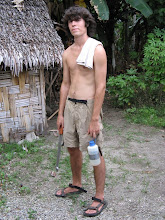
I usually teach in the mornings. Despite my general disdain for mornings, this is actually a good thing. Even in the thick of the hot season, the hours before 9AM are generally tolerable. It becomes difficult to teach a class when you can't even see what you're writing on the board because there's too much sweat dripping into your eyes. Heat also makes pretty much everyone want to be somewhere besides a tin-roofed classroom. Hence, morning classes are the way to go. Mondays and Tuesdays I get the prime 7:30-9:30 slots for my math class and so I get to check out and go sit in front of my fan as heat of the day starts to set in. Wednesdays and Thursdays I get the 10:00-11:30 slot, which is not as ideal, but still better than an afternoon class. Fridays is a half day and so I only teach from 7:30-8:30. I have one afternoon class on Tuesdays 1:30-2:30, which is invariably my most unpleasant and the one I'm most likely to curtail in favor of some small assignment for my kids to work on outside. At first glance, a school in Vanuatu may seem to be only a few steps away from total chaos. Upon closer inspection, however, it's revealed to actually be total chaos. Accurate timekeeping is important in maritime navigation as it allows you to determine your longitude by measuring the difference between the local time where you are and a reference time. Similarly, accurate timekeeping is important for maintaining an orderly school environment as it lays a groundwork upon which one can build things like schedules and lesson plans. Unfortunately, Vanuatu lacks a method of accurate timekeeping. It's not so much that accurate timepieces are unavailable (actually now, thanks to Digicel, almost everyone has a cellphone with a built-in clock), but rather that the numbers read off of a timepiece are not connected to reality in any meaningful way. So, while a person may be able to glance at their cell phone and determine that it is, in fact, 7:30, the connection isn't always made that school starts at 7:30 and thus they should be at school as opposed to still hanging out at home. Actually, the problem isn't so much of with the students as it is with the teachers, which isn't to say that the kids are always timely and punctual, but rather that since none of the teachers are timely and punctual, the student's punctuality is irrelevant. It's very much a top-down problem. Since not every kid can be counted upon to have a watch at home, the beginning of school is announced with three bells (which are the bane of my existence), one at 6:30, one at 7:00 and one at 7:30. This seems reasonable, except that the bell must be rung manually and thus ends up being rung whenever the headmaster thinks of it instead of being on a fixed schedule. Some days the bells are only a couple minutes off, some days they're half an hour off or don't happen at all. Mondays are especially patchy and we often don't get the last bell until 8 or 8:30.
How good the teachers are about showing up on time seems to be proportional to how far away we are from a weekend. Wednesdays almost everyone shows up at a reasonable time, Mondays almost no one does. Students tend to mirror this behavior, and it's hard to blame them. If their teachers don't show up, they just get to goof off outside anyway. On Mondays and Fridays we don't even get to start right away as there's an assembly. Everyone gathers in the sixth grade classroom (the largest classroom) and all of the teachers who've showed up sit down in front of them. We start by greeting each other. One by one the teachers stand up and say “Good morning everyone” and all of the kids chant back “goodmorningmister(or Miss) – (whatever the teacher's name is)” in a monotone that makes the robot on automated voice mail messages seems surprisingly lifelike. Then they all sing a few church songs and the teacher on duty, which changes every week (but is never me because I declined to be put on the duty roster), gets up and recites a bible passage and tries to relate it to a valuable life lesson. Now, it seems to me that there are a lot of very famous bible passages with a lot of very famous life lessons attached to them from which to choose, but most people seem to just pick a passage at random because they're always a really obscure verse from some really obscure book that no one ever talks about and generally seem to be, like, description or background information as opposed to an actual teaching. They then have to come up with some really convoluted explanation to draw a valuable lesson from a passage that goes something like “Then Jesus walked from one town to another.” Full points for creativity, I suppose. Finally, we come to headmaster's announcements, which is always the longest part of the assembly as the headmaster likes to expound at length about the importance of wearing uniforms and being on time to school. When we finally actually start school it's usually something like 8:15 or 8:30 (my class starts at 7:30 on Mondays, remember?) because the assembly for some reason isn't written into the school schedule. So, bottom line, when I walk into my class somewhere between 45 minutes and an hour after it was supposed to have started to give my lesson, I feel like I'm working at a fairly huge disadvantage. Assigning punishments to kids who walk in tardy (and yes, some kids still do manage to be late to class despite the fact that they've had an extra hour to get to school) seems just a little bit ridiculous and besides, if I punished everyone who was late, I'd pretty much be punishing everyone. It's also kind of difficult to call a class to order when half the school is still running around outside screaming because their teachers haven't showed yet.
On non-assembly days starting class is a little easier, but you never really get to walk into a classroom with all of your students calmly waiting inside for the lesson to start (don't confuse calm with quiet. I don't expect kids to wait quietly. Everyone likes to talk. I'd settle for there not being any brawls going on when I walk in the door). Grade Eight, which I teach, does not have one teacher, but several, each teaching different subjects. So at several points during the day, we have to change teachers. Except, since there's no one keeping an accurate schedule, there's no telling when this will happen. Sometimes the stars will align and one teacher will be leaving just as the next one is showing up, but more often one teacher will leave and it will be a good half hour before the next one comes. Or sometimes one teacher will come to find that the previous one hasn't finished yet and so head back home. Understandably, the kids don't wait in their classrooms for the teacher, the spread out to various corners of the school yard and do whatever it is kids do to amuse themselves. When it looks to them like a teacher's about to be entering a classroom, they start meandering back over. This takes a while. The school yard's not that big, but hurrying isn't really a concept here, so there will often be a long delay between receiving the visual information that a teacher is in the classroom and activating the motor skills needed to walk back inside. Simply walking into a classroom and starting a lesson tends to generate confusion, so I try to give the kids as much time as possible. I slowly walk from my house across the schoolyard to the office to get chalk, thus signaling to everyone that class is about to begin. I then go back to my house and putter around for a few minutes inside, pretending to get my things together. Then I walk into the classroom and put my stuff down on the teacher's desk, do a survey of the classroom, sigh and, pretending to have forgotten something, walk back to my house and return with a piece or paper or a pencil or a similarly school-related, yet unnecessary object. Then I pick up the eraser (actually just a piece of cloth) and start slowly erasing the board, which actually does take a while as cloth isn't the ideal board wiping material and our blackboard is especially sticky or something and thus is a real pain to wipe down. Even if the board is already pretty well erased when I enter, I pretend that the previous eraser did an unsatisfactory job and go about touching it up. By this point usually about 90% of the students who came to school that day have made it inside (on a given day I'll have 1-4 kids out of 32 absent, which is actually pretty good for Vanuatu). Finally, I write a warm-up exercise on the board, usually consisting of about five questions, to give the students who've made it to class already something to do and students who haven't a few more minutes to get inside.
Most of the lower grade's classes seem to be largely chant-based. When I finally get my kids quieted down a bit and working I can hear the other classes in progress around the school. “bananasareafruitfoundmostlyintropicalclimatestheyrequirelotsofrainandlotsofsunlighttogrow,” that's probably an agriculture class. “australiaisthesmallestcontinentintheworldandishometoonlyonecountry,” social studies. “threetimesthreeisninethreetimesfouristwelve,” math. “blahblahblahblahblahblahblahblah,” that's French. By the time they hit Grades 7 and 8, however, they've advanced from chanting to copying. When I come into class right after another teacher has left, I generally find the kids hard at work precisely copying a blackboard full of text into their notebooks. They've grown somewhat comfortable with my science class, as it to requires at least some amount of copying from the board, but they're still flummoxed by my math course, during which I write relatively little on the board. Instead, I expect them to solve math problems, an expectation that some students have obviously never had a teacher expect of them. A healthy portion of my kids still try and translate math problems into copying problems. They try and spend most of the time I allot for solving a problem transcribing the problem into their workbooks. They use a ruler and red pen to draw nice, red boarders around each of the pages, then switch to a blue pen to write any words (if I'm giving word problems) and the problem numbers. Numbers and math symbols in the problem are written in red and then the solution is written in pencil, and all problems have to be copied before work can begin on the first one. Generally they'll copy one question and then leave just one ruled line blank to work the problem and write the answer in. This works fine if the question is something like 4x8, but doesn't really pan out as well for things like decimal division. Also, there's about 1 red pen, ruler, and blue pen to every six students so this procedure is significantly lengthened by the fact that they have to spend a lot of time shouting at/hitting their friend to get them to pass the pen/ruler and recovering the pen/ruler from outside when it is accidentally chucked out a window during the passing process. I always spend a lot of time emphasizing the fact that I'm not handing out any points for neatness and that 1) they should choose one writing implement and stick to it, 2) rulers should really only be used when measuring the length of something and 3) they should finish working out one problem before copying the next one into their notebooks. Actually, that last point is one of my very few class rules. Unlike other teachers, I don't care if they speak Bislama or wear their uniforms everyday (a problem because you can't exactly go to the uniform store around here) or curse or sweep the classroom at the end of the day. All I really want is for them to attempt to do some math as opposed to copy stuff from the board. Some kids do take my advice. They write only in pencil, forgo the ruler, go through the problems one at a time, and finish my exercises in record time. Others I think have yet to finish an in-class exercise.
Unfortunately, a lot of students spend all their time copying things incredibly neatly into their books not because they think that their teachers require it of them, which was my original theory, but rather because copying is really the only part of the class they're comfortable doing. This also leads to a lot of cheating. Interestingly though, a lot of teachers put work on the board and then leave the classroom as the kids work on it, even during exams. This means that most kids are horrible at cheating because they've never had to be subtle about it. There's never been anyone watching them. Thus, I tend to be angered by their cheating, not because of any ethical or moral stance on my part, but rather because I feel insulted that they think I'm dumb enough not to notice that they've got their head on their friend's shoulder and are copying his answers, or that they have their notes open next to them on their desk.
As an education volunteer, I'm supposed to be working to improve the quality of education in Vanuatu. Often I feel like this is kind of like trying to repair a car that's spent eight years sitting on the bottom of a lake: it doesn't seem like repair is really the appropriate solution, rather replacement sounds like the way to go. Sure, some problems are small and seem solvable, like shortages of school supplies, old or poorly maintained buildings and facilities, or insufficient curriculum materials. But many problems are far more entrenched and systemic, like the language of instruction being a language that many students and even some teachers do not fully understand, or the fact that teachers are employed by the ministry of education, not by the schools, meaning that headmasters do not have the authority to fire their teachers or even dock their pay for not attending. And some problems even stem into the cultural realm, like a drastically different conception of the meaning of time or the importance of education. As just one recent college graduate (in a field having basically nothing to do with education, no less), here for just a couple years, the idea that I'm going to somehow fix this system seems a little ridiculous. I usually de-scope this goal and instead see if I can offer a slightly better math course to a few kids than they would otherwise receive, although whether or not this would even be all that beneficial to them in the long run is anyone's guess. Bottom line, I guess, is that the best way to procure a top-notch western education in Vanuatu is to go to Australia. Fortunately, top-notch western educations aren't usually a prerequisite for enjoying a nice beach.
Sunday, June 14, 2009


Tuesday, June 9, 2009
Yu No Kick Part 12: Musical Interludes
When I came to Vanuatu, I tried to come prepared. I knew from time spent backpacking and doing other wilderness activities the importance of music for maintaining one's sanity. It's not so much that listening to music is a pleasant way to pass the time (which it is), but rather that, in the absence of an external source of music, my mind has this tendency to provide it's own soundtrack for my life. This can be pleasant if, say, you've got a good selection of Beatles constantly rolling around in the back of your head, but it can be maddening if you're stuck with the Meow Mix song. Thus, it's important to have music of your own to counter with in order to flush out the old internal soundtrack every once in a while. When I left the US, I carefully put together a music collection on my laptop consisting of a few thousand songs that I thought might come in handy. I tried to be as broad as possible, throwing in as many different genres and artists as I could because it's hard to predict what kind of situations are going to arise, and so it's best to be prepared. And we really do have a staggering amount of music to choose from in the States, and all of it so different. It's kind of mind boggling. In Vanuatu things are a lot simpler. Going along with it's lackluster cuisine, Vanuatu also decided that it would be best if they skipped the whole music phase of their cultural development. As far as I know, there are only a couple instruments that are native to Vanuatu. The first is the tam-tam, a wooden still drum, so basically a log that's been hollowed out and is beaten with a stick to produce sound only slightly more pleasing to the ear than banging two sticks together (and there are a couple custom dances I've seen that incorporate the banging-sticks-together instrument). Well, that might be a little harsh. Tam-tams do make a nice, dense, natural, wood-like sound, which is kind of cool, but just not particularly interesting. I mean, I can't envision a lot of online lists of people's top ten all time favorite tam-tam solos. Actually, for the most part, tam-tams are used as like bells to get people's attention for meetings and such, a much more pleasant alternative to banging on an empty metal acetylene canister.
The second all-Vanuatu instrument is the heart of what's called a string band, which is the closest thing Vanuatu has to its own style of music. I'm not even sure what the instrument is called, or if it even has a name, but it's a large wooden box with a hinged stick protruding from one of the top corner. A cord connects the end of the stick with the center of the box. The musician uses the stick to adjust the tension in the cord and plucks it to make music. In a string band, the box player is accompanied by a couple guitars, maybe some keyboard synth, a few guys with rattles, and a singer belting it in Bislama. Traditionally, all the band members are supposed to dress up in matching, overly colorful Hawaiian shirts. The thing about string band is that there's only so many different notes you can make with a string tied to a box, so all the songs tend to sound the same. I mean, like, really the same, not like how old people say rock music all sounds the same. Literally, the tune of every string band song is almost identical. The only real difference is in the lyrics. When I first got to Vanuatu, I spent a day with my training group in a pool at a resort in Vila. The entire day we kept hearing the same song repeated over and over again, and most of us just assumed the resort had a single CD on infinite repeat. It was only later that we discovered that it was actually a live band playing, and that they were actually playing different songs, it's just that all their songs sounded alike. There are also string band music videos, most of which were very obviously made by some guy who'd only just downloaded Final Cut Pro off the internet a few days prior and usually feature the lead singer superimposed a slide show of various pictures from around Vanuatu.
Another common musical genre in Vanuatu is church songs, which one tends to get exposed to at least three or four times a day, independent of whether or not you happen to be at church. My school, and, I think, most schools, are big on the church songs and most classes get kicked off with a chorus, as they're called. Some of these choruses are in English and this, combined with the fact that a lot of the people singing them are horrendous singers and have only a very limited command of the English language, means that they mostly sound like total gibberish with the word “Jesus” occasionally mixed in. Other choruses are in Bislama or, even better, a mix of English and Bislama, which renders them slightly more comprehensible because the people singing at least understand what the words to the song mean. A personal favorite of mine, and probably every Peace Corps volunteer in Vanuatu, is a chorus called “Jesus is the Winner-man,” winner-man being an English-Bislama-ism meaning someone who always wins at everything, or is just generally awesome. The thing is that no one ever gets the pronunciation quite right, so it always, always ends up sounding like wiener-man. So it's really amusing to be sitting in church listening to the entire congregation sing “Jesus is the wiener-man, the wiener-man, the wiener-man. Jesus is the wiener-man, the wiener man all the time.”
Aside from the locally produced music, it's always funny what kinds of foreign music manage to catch on over here. Of course, Reggae is really huge, as it is almost everywhere except the US, from my understanding, which probably accounts for the enormous number of people one sees every day wearing shirts with giant pictures of Bob Marley on them and why every village has at least seven people in it named Bob Marley. There's also a slow trickle of pop music that makes it here from the Solomon Islands and the Philippines, because, I guess, they're the closest musically inclined countries. Solomon and Philippine music is usually very heavy on the synth and often have beats and tunes ripped off from popular American groups and overlayed with different music. So, I'll often hear a beat I recognize and get all excited because it's a song a like from the States only to be sorely let down a few seconds later with I realize that the lyrics are in the Philippine Spanish-English pidgin and thus were probably not written by Snoop Dogg. I'm not really sure why, but songs from abroad tend to arrive one at a time. So one week everyone will be rocking the latest new song over, and over, and over again without interruption and then the next week they'll have moved on to the next one. Thus, when someone asks you “have you heard that one good song?” or “do you have the music video for the song?” it's not that hard to figure out what they're talking about, as there's usually only one or two songs to choose from. Duncan finds it difficult to get his head around that fact that, where I come from, you could listen to music for months on end without repeating a single song, which leads to some confusion as he once came over and asked me “can you make me a CD of that song?”
To which I responded “Umm, which song?”
“You know, the one you were playing when I came over the other day that I liked.”
“Uhh, you're going to have to give me more to go on than that.”
“No, you know, the good one.”
“I have no idea what you're talking about.”
“Oh, well just play all your songs and I'll stop you when we get to the right one.”
“Umm, Duncan, I have thousands of songs.”
“Just start playing through them.”
I actually did, a few hours later, figure out what song he was talking about. It was Sweet Home Alabama. I made him a CD and threw on some other, similar, music I thought he might like and now our nakamal is the only one on the island that occasionally busts out the Skynyrd and Creedence. Shania Twain is also a big name around Vanuatu, which leads to a lot of humorous situations involving large groups of burly, well-muscled men saying things like “Kas, Shania Twain i tuf tumas!” (literally, “Shania Twain is really tough.” In Vanuatu “tough” is slang that's probably best translated as “bad-ass”).
Somewhere along the line Ni-Vans in Vila and other more westernized areas decided to crank things up a bit and try and make some home grown pop music. Much like that from the Solomon Islands and Philippines, Vanuatu pop is also heavy on the synth and borrows extensively from western artists. For example one rising star in Vanuatu is a singer who exclusively sings Selena covers, and makes it painfully obvious that she has absolutely zero grasp of the Spanish language, which all Selena songs are written in. Perhaps it's best that they stick to covers, however, because just a few months ago a real Vanuatu original was born, a pop song that tells the story (which is supposed to be based on a true story) of a Vanuatu mother whose newborn baby died due to negligence and who tried to secretly bury the corpse in her yard so her husband wouldn't find out (and yes, I agree, that it seems like the husband would probably, at some point, notice the lack of a living baby in the household, even without necessarily having to find the body, but I guess that's why I'm not a musician). The song is sung from the perspective of the husband and is supposed to be a tribute to the baby. It starts off (translated from Bislama) something like this: “I'm singing this song to say I'm sorry that we ruined you, that the cold killed you and then the dogs dug up your body,” and goes downhill from there. And I know what you're thinking and, yes, there is a music video, featuring footage of an actual dead baby. Also, although I've never had the pleasure myself, people tell me that the song is way better live. Far be it from me to critique the work of an aspiring artist, but I think I'll stick to my laptop.
Sunday, May 31, 2009
Yu No Kick Part 11: Flasem Haos Nomo
“Dan,” my headmaster said to me one day, “I want to write a grant.” I'd be hard pressed to think of a word that strikes more fear into the heart of a Peace Corps volunteer than “grant.” Over the past several decades, Vanuatu has been the recipient of so much doner money that Ni-Vans have come to all but expect white people to hand them funding for whatever they happen to want to do. As a Peace Corps volunteer this makes your life somewhat annoying, as the idea with Peace Corps is that we're supposed to be providing human resources, not financial. This subtle shift in thinking behind international aid is generally lost on most Ni-Vans, the result being that you end up getting asked from grant money a lot. Actually, the truth is that, if I really wanted to, I could probably very easily net something like thirty to fifty grand in grant money for my village. Australia, New Zealand, and the EU give very large sums of grant money to Vanuatu annually, usually earmarked for health or education projects. The thing is that these organizations, in what seems to me like spectacularly bad planning, don't really have a lot of staff working in Vanuatu, so they have no idea how to spend their money (from what I've seen of international development efforts in Vanuatu, this seems to be a common trend. People are eager to donate money, and sometimes even their time, but no one really gets all that excited about doing the research and grunt work necessary to figure how their resources can be effectively used to help people), thus a lot of money ends up running through Peace Corps volunteers, who are conveniently located in actual rural villages, actually speak the language, and actually have something of an idea of what's going on in said villages. The thing is, at least in my experience, that the more you get to know a village in Vanuatu and the people who live in it, the more reluctant you are to put large sums of money at their disposal. And so it was with some trepidation that I asked my headmaster “what do you want a grant for?” “I want to repaint the school,” he replied. I thought about explaining that, since most of our buildings are more than a decade old, have leaky roofs and, in some cases, concrete floors that have caved in, painting should really not be the first thing on his list of school maintenance activities, but I decided that this explanation was probably fruitless and instead gave my standard response to requests for grants, “fill out a grant application form and I'll be happy to check it over and edit it for you” (I have yet to have someone take me up on this offer).
So here's a question: given the choice, would you rather have a house with a plain exterior and a nice, comfortable interior or a nice exterior and an interior resembling a garage? I think I'd go for the former, and I feel like most people reading this would agree with me, but people around here have different priorities. In Vanuatu, it's all about the paint job. So when it comes to ideas to improve the school, the first thing my headmaster thinks of is making it look snazzier. Never mind the leaky roofs, the chronically later or absent students and teachers, or the fact that I'm the only one at the school who knows what a negative number is. But more paint, that's really what we need. Duncan employs a similar strategy in outfitting his home. Duncan's house has been under construction since I got here (which is common in Vanuatu, once the walls and the roof are up the house is livable and further work on it becomes less pressing). Currently, there's no ceiling, you can look up directly at the metal sheeting the roof is made of (the lack of a ceiling makes a house enormously hotter on a sunny day), nor are there light switches or electrical outlets. The light in the main room hangs by its electrical cord; to turn it on, you jam the bare wire leads of said cord into the plug holes on a power strip that also hangs from the ceiling, a procedure that I'm just waiting to result in someone's death. Over the time that I've been here, instead of fixing these rather basic and simple problems with the house, Duncan has instead spent a lot of money plastering the entire outside (plaster goes over the cinder blocks to hide them and give the house a smoother appearance from the outside as well as make it ready to take a paint job), and installing two polished mahogany doors (Vanuatu's bush is rich with high-quality hardwoods). So it looks like a nice, real house from the outside, but the inside looks like a construction site.
Being appropriately flased out is important in Vanuatu (“flas,” from the English “flash” or “flashy” is Bislama for fancy and expensive-looking) in all aspects of life. Ni-Vanuatu have a strange relationship with money. Unlike in the US, where money is required for basically everything, even such necessities as food and shelter, in Vanuatu money isn't really needed on a day-to-day basis. Food can be found for free growing pretty much all over the place and reasonable houses can be built using only materials that grow naturally. Money is only really needed to buy good imported from abroad, luxuries, in other words. While we think of money as being needed for survival, the Ni-Vanuatu think of money more as a means of procuring ridiculous stuff. So, if you were to somehow get your hands on, say, a couple hundred dollars, you could use it to invest in a gas stove, thus saving many hours and a lot of work on cooking each day over a wood fire, or you could flas your house out a bit and get a giant stereo system. A stove may be more useful, but people will only notice that if they happen to walk into your kitchen. A stereo, on the other hand, can be heard by people living in the next village over. Thus, you see a lot of people still hunched over a fire cooking dinner along with a lot of people thumping bass at six in the morning. Flasem haos nomo (“flasem,” the verb form of flas, meaning to make flashy, “haos,” which is pronounced like and means “house,” and “nomo” from the English “no more,” meaning just or only. So, just blinging out my house).
Anything can, and is, flased out whenever possible, including houses, trucks, canoes, and people. Flame decals for trucks are a popular item, even for trucks so old and rusted that most of their bodies have been replaced with wood, and I have a feeling that rims, spinners, and spoilers would do a brisk business. Recently, a guy from Tautu invested in some rope lights and flashers for the front of his truck and has been the talk of the town for several weeks. Anything electronic is considered to be particularly flas, even if the function of the electronic device in question is unknown or non-existent. I ran a program selling used computers from the States to people on the island, nominally to encourage computer literacy, that pulled in a lot of orders. To my surprise, I found myself getting orders not only from people in the Lakatoro area, which has continuous power, but also from the outer villages on the island. “Do you have electricity?” I'd ask these people before they ordered a computer. “No,” they'd answer. “Generator?” “No” “Solar?” “No.” “Do you realize that you won't be able to turn your computer on?” “That's alright. Flasem haos nomo.” There was also a story about a guy last year who stole a solar system battery, weighing something like 30 or 40 kilos, and hauled it a few kilometers back to his house to be used as a decoration.
Personal flas, however, is probably my favorite variety, things that people do to flas up their own appearance. The mobile phone, of course, is a must, the more expensive the model the better. Mobiles are generally carried in hand or worn around the neck with a lanyard, thus making them more visible. The especially fancy individual will have more than one mobile, just to stay ahead of the curve. Mobiles were even popular in areas like the northwest of the island, where I say a number of people strolling around the village with their cell phones out, despite the fact that Digicel would not be offering service to their village for at least six months. Ear buds are also a popular accessory, and I've seen many a person sporting the earphones which are, in fact, not connected to anything, the jack that's supposed to be plugged into a MP3 player or Discman is simply stuffed into a pocket. My favorite, however, which, unfortunately, I haven't had the pleasure of witnessing myself, only heard stories about, is a guy who sports a (non-working) mini boom box worn on a chain as a necklace.
Accessorizing is all well and good, but it would mean little without the underlying fancy clothes. In Vanuatu, where frequent use and primitive clothes-washing techniques are quick to give all clothes a dull, drab look, anything bright-colored (including those neon green vests meant to be worn by airport ground crews and construction works so that people don't run them over with large pieces of machinery) is bound to draw the air and is worn with pride. Unfortunately (or fortunately, depending on your perspective), brightly colored shirts often tend to be the ones with something offensive, or at least inappropriate, written on them. And so you see people in church wearing bright green, yellow, and red t-shirts with the slogan “God Made Cannabis” on them which, admittedly, does at least have something to do with religion, making it better for churchgoing than the shirt with a giant picture of a hand giving you the middle finger. Or there's the guy that walks around with the bright pink shirt that says “Guys Make Good Pets,” or the teenager in the shirt with the picture of a bald guy and the saying “It's not a bald spot, it's a solar panel for a sex machine.” Or the Ni-Vanuatu Peace Corps staff member who once showed up in Malekula with a shirt claiming “I Only Date Crack Whores.” In the end, though, I think I have to agree with the man at the nakamal the other day in the shirt stating “I have absolutely no idea what's going on.” Words to live by in Vanuatu.
Thursday, May 28, 2009
Yu No Kick Part 10: Land Diving
I'd been getting rather claustrophobic during my second year of Peace Corps service. I felt like I'd exhausted most of the exciting things (and probably also most of the unexciting things as well) to do in my village and increasingly was finding myself spending way too much time watching movies on my laptop. Also, take my advice and never, ever agree to live at a school. Especially a grade school. Dealing with a large group of children is difficult enough when it's in a classroom for a few hours a day, but when large groups of children are running and shouting about four feet outside your living room window pretty much 24-7, it's all you can do every day to keep from snapping. I'm sure living at a high school would be no picnic either, but I feel like older kids tend to get into quieter kinds of mischief than young kids. I mean, they may sneak off during recess to smoke cigarettes or whatever, but at least they do it without making a lot of noise. Really, it's the screaming that gets me. It's incessant. And it's actually not even screaming, it's too high pitched to be screaming. They're more like squeals. It's like they're perfectly planned to enter the ear at just the right octave to make you cringe and wish that you could listen to someone drag their nails across a chalkboard instead. It makes one long for the soothing sounds of police sirens and passing trains and car alarms and the relative quiet of the city (people imagine villages as being quiet. This is wrong. Villages have about a thousand times – I'm serious. I've measured. The precise number is 1003.74 ± 0.02 -- more noise than cities. The animals alone make quite a racket. There's roosters and bats and pigs and dogs and rats and bugs and then you add to that all the kids screaming, all the people screaming at the kids, and then the people screaming at each other. These days, when I spend time in a town such as Port Vila or a city like Austin I marvel at how quiet everything is), hell I'll even take roosters at 3am and the guy next door who puts on loud music at insane hours of the morning. Just... no squealing. Please.
At any rate, when school let out for an end-of-term break in early May, I was ready to be away from my little island. I'd used up all of my Peace Corps leave (the time that I'm allowed to be out of Vanuatu) with my trip back to Austin during Christmas and my week in Australia, so I couldn't get too far away but still, better than nothing. When I first read about Vanuatu on Wikipedia after discovering I was to be sent here, I devised two main goals for my Peace Corps service: throwing a penny into the volcano on Tanna (I mean, if fountains are supposed to bring good luck, volcanoes should be the mother load, right?), and watching the land diving on Pentecost. And so, when I got word of a group of volunteers heading to Pentecost during the school break, I decided to jump on board. Land diving is one of the more popular Vanuatu customs for tourists to witness and it's often photographed and put in tourism pamphlets and promotional videos. It's basically like bungee jumping, except elastics hadn't been invented back when it first started, so people had to improvise. Instead of synthetic bungee cords that are deemed low-risk enough to be featured at most amusement parks even in the super safety conscious US, the land divers on Pentecost use tough, wooden vines with something of a poor safety record. Although generally fairly strong, the vines don't really have a lot of elasticity to effectively adsorb the energy of a fall. In fact, land diving is traditionally only practiced in the months of May and June because during thus time of year the vines are slightly more elastic and thus marginally safer. The reason for the timing of this custom was apparently forgotten and rudely re-discovered some years ago when a village decided to put on a jump out of season to honor the visit of the queen of England and a diver was killed when the overly brittle vine broke securing him broke. A second safety issue arises from the towers which they jump off of, tall structures made from tree branches lashed together with bush rope (a plant whose bark is ductile enough to allow it to be used as a makeshift rope). Unfortunately the towers suffer from a lack of effective building code, as well as a lack of nails, and during a jump last year the tower collapsed and killed one of the people climbing it. Needless to say, I received a warning from my parents back in the US that I should not try and jump myself (which some tourists do sometimes), but I was a little surprised when I was waiting at the airport for my flight and I got a call from Duncan. “Dan,” he said in a frantic voice which suggested that he'd nearly forgotten something important, “I forgot to tell you before you left. Sometimes white people like to jump in the land diving, but you don't do it!”
The nice thing about living in a small country with a lot of other Peace Corps volunteers is that there's always someone you can look up wherever you go, meaning that you rarely have to pay for accommodation and you can get into most tourist attractions for free, or at least at a discount. Sure enough, one of our Pentecost volunteers, Erika (who sounds a lot like Ellen Degeneres, which I think is pretty hilarious), let us all crash in her house and arranged for us to see a jump that was being put on in her village for the benefit of a cruise ship. Cruise ships are apparently becoming a growing phenomena in the Pacific, judging from the large increase in frequency of their visits to Vanuatu in the year and a half I've been here. There's even a cruise ship stop at a village on Malekula, just a little bit north of Tautu, although god knows what there is to see there. Most Ni-Vans I've talked to get a real kick out of watching all the white people (usually Australians) disembark from their ship and putter around their island for a few hours, so I was actually looking forward to seeing the cruise ship almost as much as I was looking forward to seeing the land diving.
The ship showed up on Sunday morning and all of us volunteers headed down to the beach to check it out. I'm sure most people reading this have seen one (or maybe been on one) but cruise ships are MASSIVE. Like, it was probably the biggest man made object I'd ever seen in Vanuatu, and it looked very out of place, parked just offshore of this village carrying with it more wealth, technology, and power (power in the scientific sense, being work per unit time) than is even fathomable on the island it visits. During my time in Vanuatu, I'd grown somewhat annoyed by the tendency of Ni-Vans to jack up the price of goods and services for white people, but looking at that ship I understood their thinking perfectly: anyone capable of producing THAT can easily spare a few hundred vatu extra. The small landing boats the ship put out to ferry Australians the half kilometer to shore were larger than the majority of the copra ships that carry cargo as well as Ni-Vans between Malekula, Santo, and Vila. It kind of felt like we were being visited by a UFO, that a species of vastly superior beings were coming down from their mother ship in order to observe and document the eccentricities of a primitive society.
The change the village undertook for the benefit of the cruise ship was very strange. Land diving is one of the many Vanuatu customs that live on today solely because the Ni-Vans have realized that they can get tourists to pay to see them. It's a bizarre dynamic, hanging onto old practices and traditions for financial or historical reasons rather than because they're actually still applicable ways to living. There's a lot of pressure on Ni-Vans to maintain their authentic lifestyles rather than adopt western practices, but I feel like that calls a lot of the authenticity into doubt. I mean, what's more authentic, old traditions being acted out by people who don't really use them in their daily lives anymore or an adopted lifestyle that the majority of people actually do practice all the time? In a lot of ways I feel like my quasi-westernized village, although it has lost most of its custom, is a much more accurate portrayal of what Vanuatu is actually like. It's not quite as exotic or exciting as the tour guides indicate. People go to church instead of dressing up in costumes and dancing to make the yams grow, people wear pants and shirts or dresses, not penis sheathes and grass skirts, and people like to eat rice and noodles, not each other. So, while these cruise ship passengers were witnessing more Vanuatu custom in a few hours than I had in my entire service, I felt like they were leaving with a totally false picture of what living in a village in Vanuatu is like. I think it's kind of like learning about American culture by visiting Disneyland. Yeah, it's more glamorous and entertaining than, say, Cleveland, but it's all staged. And that's kind of what this village felt like when the cruise ship rolled in, Disneyland. People dressed up in traditional dress to get their pictures taken with the tourists, they put on dances and shows, put up signs directing people to various attractions (including one which labeled their dock as “Queen Elizabert II's Landing,” after an English monarch very few people have heard of) and sold souvenirs (such as the very traditional Pentecost beer cozys). There were even overpriced concessions. Grapefruits, which are usually handed out for free, were going for a hundred vatu a piece. On the plus side, however, the cruise ship staff had set up beverage stalls around the village selling cold drinks (so the passengers wouldn't have to go a whole afternoon without a frosty brew), which you could get if you could find an Australian willing to charge you one to their account in exchange for some vatu. The best part, however, was that, when they departed later that day, the staff left us with two giant bags of ice.
The land diving itself was very strange, and definitely not quite fit for prime time. Let's just say that once you've seen one guy jump from a wooden tower with vines tied to his feet, you've pretty much seen them all. However, the land diving ceremony consisted of something like fifteen jumps and lasted almost three hours. Towards the end, it was basically just us Peace Corps volunteers with the patience to still be watching. The jumping was accompanied by a troupe of men doing a stomp dance next to the tower, which they doggedly kept up for the entirety of the ceremony, although they did look a little worn out near the end. The tower was adorned with about fifteen wooden platforms (one for each jump), each one slightly higher than the last. A pair of vine ropes were fastened to the end of each platform. People started jumping from the lowest platform, maybe ten to fifteen feet off the ground and worked their way up, finally climaxing with the platform at the very top of the tower, maybe a hundred feet up. A guy would climb onto a platform and stand still while a team of kids tied a vine to each foot. When they were finished, he'd step to the edge of the platform and do a sort of ceremonial dance, which seemed to me to be a thinly veiled excuse to buy time to psyche himself up before taking the plunge. Finally, he'd cover his head with his hands and dive headfirst to the ground. The platforms were rigged such that they would partially break as the diver neared the ground and the vines became taught, thus absorbing some of the force of the fall. The ground below the tower was kept kicked up and soft to offer some padding and was inclined to allow the diver to roll, all of which were planned to reduce the force of the impact. Even still, some of the divers took quite a beating and looked none too happy as they were pulled out of the dirt to their feet. As the jumpers moved to the higher platforms, the lengths of their pre-jump dances became longer and the last jumper (from the highest point) actually stopped the whole ceremony so that an extra branch could be fastened to the side of his platform for him to hold onto while he was mentally preparing himself. We'd all been sitting in the sun for a long while by the time the whole thing was over and we were all glad to be able to adjourn to the beach and sit in the shade. I struck up a conversation with a Ni-Van who sat down near me and asked him what the significance of the land diving ceremony used to be. “There was never a reason for it,” he replied “it was just for fun.”
Thursday, May 7, 2009
Yu No Kick Part 9: Critters
I remember a time, not too long ago, when finding ants in a house was cause for great consternation. Little white ant gazebos housing ant poison were purchased from the super market and laid around the house in heavily ant-trafficked areas in an attempt at enticing ants to carry toxic substances back to their nest and do themselves in. When this failed, we had to take all the food out of our pantry and cupboards, stack it on the kitchen table, cover everything with a sheet and asked a man in a haz-mat suit and breathing apparatus to come spray chemicals all over our house and make it uninhabitable for the better part of a day. Flies inside the household were stalked and hunted with green plastic fly swatters and killed. Cockroaches, spiders, and other larger critters were trapped under and glass or tupperware and re-released into the wilds of the back yard on the grounds that nobody wanted to clean up the cockroach guts that would result were they to be squished. I remember days when cakes, cookies, and even defrosting meat was left unattended on kitchen counters over night, a daring and brazen taunt to insects everywhere to just try and come inside the house.
Truth is, these days I have no idea how we manage to keep our homes so immaculately free of insects and other critters. Even houses in the suburbs and in more rural areas, whose surrounding greenery no doubt abounds with such beasts, they manage to keep nature strictly outside the home. In Vanuatu, we open our houses to any creature tenacious enough to make it inside. Rather than being a mono culture consisting solely of homo sapiens, and perhaps a dog, a Vanuatu household is teeming with biodiversity. Arthropods (arthropods are a class of animals that includes insects, spiders, centipedes, millipedes, scorpions and some others. Although we commonly group all of these animals together, this is not technically accurate. However, often I find it convenient to refer to all arthropods together as opposed to just insects and, so as not to sully an otherwise light-hearted and sophomoric blog with fancy science words, I shall use the term “bug” as a replacement for arthropod) are by far the most common type of animal on the land, and they are well represented inside of my house. I've heard it said that bugs will take over the world once humans are dead and gone, a saying that is wrong only in that it implies that bugs do not already own the world. I think everyone instinctually feels the truth of this, which accounts for most people's fear of bugs. Just as we become anxious and uneasy in the presence of our bosses or other authority figures, we are made uncomfortable when we must share a room with bugs, who we know to be the true masters of the earth. Sometimes our fear causes us to lash out as we try to assert our dominance and, while we may be able to easily destroy a single bug, or even a hundred bugs, our feeble attempts at violence are generally ignored by the larger body of the bug population who knows that we are completely incapable of inflicting any sort of real or lasting harm on it. Although people tend to fear large and exotic bugs such as cockroaches, tarantulas, or centipedes, in my opinion the real danger comes not from the big and unusual (the fact that they're big makes them easy to see and avoid and the fact that they're exotic means that they're unlikely to be encountered on a daily basis), but from the small and commonplace, the mosquito. We're all familiar with these little flying vampires, they're something that brings us together as a species. No matter what continent you live on, what culture you belong to, or whether you're rich or poor, everyone can get behind hating mosquitoes. In Vanuatu, and in other tropical areas, mosquitoes are hated not only for being annoying but also for their ability to transmit malaria and dengue fever. To be honest, however, it's difficult to say which is worse: malaria, that obnoxious buzzing noise mosquitoes make when they're flying around your ears while you're trying to sleep, or those persistently itchy little bites. Fortunately, you don't have to worry about choosing, because you can get all three at once. My experience with American mosquitoes than that with Vanuatu mosquitoes. In the States, the mosquitoes were relatively large and somewhat dumb, slow moving, and easier to swat. Their bites left large, red welts that itched for days. In Vanuatu the mosquitoes are smaller and more wily, killing a mosquito is decidedly harder. However, their bites are smaller, less itchy, and fade faster. In the beginning of my service, the large water tank that collects rainwater from my roof was uncovered, providing a perfect breeding ground of mosquitoes. Consequently, there would always be a cloud of them hovering around my door waiting for a chance at entrance to my house so that they could annoy me. I finally got around to cleaning out the water tank, killing all the mosquito larvae inside of it, and putting a cover on it, which has done a good job of thinning out the mosquito crop in the vicinity of my house. Nowadays, the mosquitoes show up only two or three at a time, making them easier to hunt down and kill.
Slightly less annoying than the mosquito is the ant. For my entire tenure in Vanuatu, my house has been infested with doggedly determined little brown ants. These wily little scavengers are almost inspiring to watch. Able to reach almost anywhere in the house and defeat even the most clever ant-prevention technologies to find food, it's easy to see why these little guys are thriving whereas lazy, slow, picky animals, like the panda, are not. For some reason, the one place where these ants won't venture is on top of my stove, which means that my stove is often home to large, precarious stacks of tupperware containers and plates of food which I want to be spared from the wrath of the ants. Leave something on the floor or on the table, however, and it will be covered in teeming brown bodies in a matter of minutes. Often I just have to resign myself to the fact that I'm going to be eating food covered in ants, especially if they manage to worm their way into, say, my stash of Snickers bars. More annoying than the fact that they get into my food, is their occasional tendency to crawl over me while I'm sleeping. It's not unusual to wake up to an odd, tickling feeling that slowly creeps along my body. They're small enough that you can *almost* ignore them, but the sensation of them walking over you is just a little too strange to be ignore an they can make falling asleep difficult. Recently, a new variety of ant has been trying to muscle it's way into my house. These large, black ants may not be as numerous as the brown ones (their ant trails tend to look more like small city roads, with only one ant passing by every few seconds, as opposed to the bulging ant superhighways which the brown ants tend to form), but they must be packing some serious heat as they seem to have forced the brown ants out of my common room completely. Although the brown ant hold on my kitchen is still very strong, the black ant territory seems to be slowly expanding and they look like something of a force to be reckoned with. We'll have to see how the turf wars play out in the months to come, but it may be that the days of the brown ant are numbered.
Somewhat more pleasant to host than bugs are the numerous geckos that inhabit my house. There are two kinds. Small black geckos with bright, blue stripes like to hide in my curtains when I roll them up at night. When I left them down during the day, the geckos come tumbling out and thunk unto the floor, where the stand, dazed and confused for several seconds before quickly scurrying off to wherever geckos scurry to. More interesting are the ghostly-white geckos that dot my walls at night. These geckos are larger, chubbier, and more active than the black and blue geckos and they like to come out at night to catch insects. The sticky pads on their feet allow them to climb walls and stick to the ceiling and they make a light drumming sound as they scamper across my ceiling in search of food. Some geckos will park themselves next to a swarm on gnats and you'll see their little heads dart to and fro quickly as they gobble them up. Others go in search of larger prey. After it gets dark, the electric lights in my house attract a large number of moths. My bulbs are bare (ie not part of light fixtures), which allows the moths to get nice and close into them. A swarm of moths will be constantly orbiting my light bulb whenever it's on at night. Every few seconds, a moth will decide to try and go in and will make a quick and determined swoop into the light until it comes up hard and fast against the glass of the bulb with a satisfying dinging sound. They never really seem to learn, however, and after letting a few of their friends make a try for it and end with similar fates, they give it another go. Taking advantage of this confusion, the geckos will creep across the ceiling until they near the swarm of moths around the light bulb. As they approach the moths, their motions become slower and more deliberate so as not to startle their prey. Then, when the time is right, they'll seize upon a moth's momentary confusion after running headlong into a piece of glass and strike, grabbing a startled moth in their mouths. The work's not done yet, however, as often the moth is a half or three quarters the size of the gecko, so subduing it is no easy feat. What ensues is like a miniature Godzilla versus Mothra as moth and gecko duke it out. Sometimes the battle becomes so fierce that the gecko looses its grip on the ceiling and splats on the floor, where the fighting continues unabated. Finally, either a successful gecko will forcefully stuff the moth entirely in it's mouth and begin munching contentedly, or a successful moth will battle its way to freedom and fly off, leaving the gecko to start the whole process over again. With a few shells of kava in me, I've spent many an hour watching the geckos war with the moths.
The largest inhabitants of my house, aside from myself, are the mice and rats. The rats live in my attic and, at night, you can hear the sounds of them running around echoing through my ceiling. I'm not sure what they do up there at night, but they certainly can make quite the ruckus. Sometimes you'll hear them pounding across the attic at full speed, followed by loud crashes that seem to indicate some sort of tussle and then silence. Moments later they're booking it across the attic again and another tussle ensues. It's almost like they're playing tackle football or something. Sometimes these games can go on for upwards of an hour and I fall asleep to the soothing clatter of rats doing whatever rats do. I bought a box of ramen noodles when I first came to Vanuatu that I haven't been using nearly as much as I thought I would, and these packages of dry noodles have become a favorite of the rodents. The box which contains them has several holes gnawed into the side and by now most of the noodle packets are chewed through and a portion of the noodles missing. I don't really mind this all that much, actually, as it seems to distract them from the rest of the food in my house, some of which I'm much more attached to than ramen.
Some volunteers are more opposed to critters sharing their house than other. I get people giving me advice on how to get rid of my rats or my geckos or my ants, and I thank them politely and proceed to do nothing. Truth is, I've grown somewhat attached to my house guests. Fighting the ants for control of my food keeps me on my toes and watching an ant trail form can provide a solid half hour of entertainment. The geckos and moths provide my evening cinema and the scampering of the rats serves as a soothing cacophony to accompany me to sleep. Oddly, while I'm not the biggest fan of pets, I have absolutely no problem with pests. They don't need to be fed or walked or taken care of in any way. They're easy to ignore when I want to and they go about their business without any need for interference from me. In many ways, I admire their tenacity and self-reliance. While pets often die despite our best efforts to save them, these pests live on despite our best efforts to exterminate them.
Monday, May 4, 2009
Quick Note
So, I was looking over my blog while I'm in Luganville and have access to faster internet and noticed that there seems to have been an issue of Life in the Ring of Fire that I wrote but never posted. For posterity, I've uploaded it and changed the post date of it to make it look like it was uploaded back on December 13 of 2008. If you're interested in reading it, it's Life in the Ring of Fire Part 62: Thanksgiving
Yu No Kick Part 8: Be... Yu Save Chuck Norris?
I think people in the US tend to associate being a Peace Corps volunteer with going to Africa and building bridges and schools and whatnot for starving children. Truth be told, however, most of the Peace Corps volunteers I've met aren't people that I'd trust to build a picnic table, much less a bridge (no offense guys). The current fad in international development is something called sustainable development, which means we shy away from projects that require us to actually DO anything (like build things) and focus more on “building capacity,” which usually means trying to teach people how to do things. The idea is that while one-time development projects like a bridge will eventually fall apart, a successful sustainable project will live on forever. It's a nice idea and, of course, it often doesn't pan out in practice as frequently the lasting lessons a volunteer leaves with his village aren't exactly the ones he was trying to teach. In Tautu, for example, a major lesson that my villagers took away from previous volunteers is how to make bootleg liquor with sugar water and bread yeast, which is an accomplishment I don't think makes it onto the Powerpoint slides at the Peace Corps congressional budgetary hearings. Still, most people tend to think of Peace Corps as being all about the do-gooding. However, saving the world by teaching math to underprivileged kids (actually, if I'm really going to come clean on this one, I think most of the major contributions I've made as a volunteer involve unjamming the photocopier at the school), which is the part of the job one usually talks up at the bar, is only a component of what Peace Corps is about. Being a US government funded institution, part of what Peace Corps tries to do is build understanding and goodwill towards Americans and the US in obscure and sometimes pissed-off corners of the world (Latin America, for example). So, part of what the government is paying me to do is to buy people drinks and talk about how awesome America is. This is a part of my job that I take very seriously. Especially the drinks part.
In Vanuatu we catch a pretty huge break on this one, as pretty much everyone here already thinks the US is the really damn cool. Unlike, say, people in Chile, who seem to like nothing better than to remind us of how the CIA totally screwed up their country, most Ni-Vans have only ever had positive dealings with Americans. Older Ni-Vans remember American soldiers defending the country from Japanese occupation (of course, no one has the heart to break it to them that, really, no one was all that keen on occupying Vanuatu in the first place) and a majority of Ni-Vans can remember at least one occasion where a Peace Corps volunteer bought them a shell of kava. To top it all off, most of the obnoxious tourists come from Australia or New Zealand, so they draw most of the heat on that front. So really, all us Peace Corps Vanuatu volunteers need to do in order to build goodwill towards the US is not be total assholes. Actually, I often find myself having to downplay the awesomeness of America to keep stories from spiraling out of control. I've had the following conversation a number of times.
Ni-Van: So... America is really awesome, huh?
Me: Umm, yeah, I mean, we try.
Ni-Van: Best country in the world.
Me: Well, I guess, well, actually, it depends on how you...
Ni-Van: There isn't another country that's better than you guys at anything.
Me: Umm... I don't know about that, for example, I think the Germans have better beer and...
Ni-Van: Man! The US!
Me: ....yeah, we are pretty sweet.
Of course, much of what Ni-Vans know about the US comes either from movies or what Peace Corps volunteers have told them. The problem with this is that both movies and volunteers are prone to making things up for the sake of entertainment. Thus, a lot of Ni-Vans tend to picture the US as a sort of mystic wonderland full of all sorts of fantastical people and creatures. A place where cowboys battle dinosaur-riding Indians and Rambo is always close at hand in case something needs to be blown up. Basically, anything cool that Vanuatu doesn't have is pictured as existing in the States. As a volunteer, I must choose between trying to dispel misconceptions (ie. Explaining that Rambo isn't a real person) and compounding misconceptions for my own amusement (ie. Explaining that Rambo is my next door neighbor). Of course, it's usually far easier to just roll with whatever ridiculous fact some person in your village believes about the US than to try and set things straight. Like, I'm not sure who came to Malekula before me to spread this rumor, but people are dead set on the fact that we still have dinosaurs in the US, to the point where they will argue very forcefully with me about it, as if I'm lying to cover something up and at some point I'll break down and be like “OK, you got me. I was trying to keep this on the DL but, yeah, we've got dinosaurs. Actually, I used to fly a pterodactyl to school every day before it ran away and got sucked into the intake of a 747.” McKenzie actually once had a really heated argument with someone in her village about the existence of dinosaurs who at one point noticed a map she had hanging on her house of the US with stylized cartoons of each state's major attractions and, wouldn't you know, Dinosaur State Park was marked with a few cartoon dinosaurs. This led to an attempted explanation of the fact that there actually are dinosaur FOSSILS, just not any living dinosaurs, which I'm sure the villager just took as further evidence that something fishy is afoot. One of my favorites was a day when I was waiting at the airport and a guy walked up to me and told me that he'd just heard that Harry Potter had died and asked whether or not it was true. My first reaction was to chastise him for giving away the ending of the last book, which I hadn't read yet, but then I realized that the chances of him having read it were unbelievably slim. My next reaction was a decent into confusion and an eventual explanation that, seeing as Harry Potter isn't really real, he can't really die, which was probably taken to mean that not only is there a teenage boy able to fly around on broomsticks in the US, but he's also immortal.
Early on I make the mistake/brilliant move of explaining to everyone that, seeing as I live in Texas, I'm from the same State in the US as Chuck Norris. Chuck Norris is idolized in Vanuatu almost as much as Rambo is, which is impressive considering that Chuck Norris is actually a real person. Thus, Duncan likes to introduce me to people as his son from the US who comes from the “same place straight” as Chuck Norris. At first I tried to explain to everyone that, seeing as Texas is a really big place, just because the two of us were from there didn't mean that I'd ever been in the same room as him, or even the same city. Now, however, I've grown tired of wasting my breath trying to explain that I'm not nearly as awesome as they think I am and instead just try my best to look quietly imposing as if at any moment I might break into some spontaneous ass-kicking taught to me by my good buddy Chuck Norris. And there are always those moments of temptation. Those nights when someone settles into a seat next to me and the nakamal and, without even so much as a “hello” breaks out and says “Dan, yu save.... Chuck Norris?” (Dan, do you know Chuck Norris?), when I know that I should be a good volunteer and patiently explain the fact that the US is not like Vanuatu and that not everyone knows each other and that actually the only times I've ever seen Chuck Norris were on TV, just like them, but there they are, the words forming in my head, just waiting for the green light from my conscience to be vocalized: “Yeah! Chuck Norris! Of course! He's actually my cousin. We used to go dinosaur hunting together all the time when we were little.”
Subscribe to:
Posts (Atom)