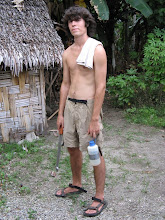
Life in the Ring of Fire Part 41: Cheers to American Independence
Monday was one of those glorious moments in a Peace Corps volunteer's service when he receives TWO packages from the US on the same day. It was amazing. One was from my family and contained a lot of snack food, which was awesome, except that I realized the problem with getting snack food as opposed to candy is that I can sit down and eat the entire package in one sitting, whereas with candy I'm limited by the fact that if I eat too much at once I get sick. Oh well, the mustard pretzels were glorious for the eight seconds that they lasted. The second package was a little more mysterious. It was from a couple of good friends of mine from college. It was large and had been packed into a beaten-up looking Weber grill box. At first, I assumed that they'd simply recycled an old box they had lying around the house to send me something, but then I noticed that the customs declaration (those things really take the surprise out of getting a package, by the way) listed the contents as a charcoal grill. I was still skeptical, thinking that, really, there was no way that they'd sent me a BBQ all the way to Vanuatu. It was only when I opened it and saw assorted pieces of metal and screws that it finally dawned on me that, yes, I had received a Weber grill. I was pretty stoked about this, mainly because the forth of July was coming up on Friday and I was looking forward to rolling in to our Malekula forth of July party sporting a legitimate BBQ. Duncan was also excited about the grill. He's very much aware of the fact that, when I leave Vanuatu in about a year and a half, I'll be leaving most of my belongings behind and that, more than likely, he'll be the one that they're given to. Thus, he tends to look at anything that I get as something that will be his in the near future. It makes me fell kind of like a really rich dying relative that everyone is nice to in the hopes of being included in the will. It is kind of nice, however, as having a large and intimidating man with a vested interest in your belongings makes them a lot less likely to be stolen. I'd described the concept of BBQing to Duncan previously, and he'd been intrigued by it, especially by my claims that one could preserve meat for long periods of time by smoking it, and that smoke can be a powerful meat tenderizer, capable of transforming a cheap, tough, and chewy cut of beef into a soft, juicy delicacy.
On Tuesday I swung by the Digicel office in Lakatoro to pick up a new SIM card so I could try out the new mobile phone service. Can I just say that our cell phone system in the US is completely and totally insane. Two year contracts, night and weekend minutes, an allotted number of replacement phones, rollover, roaming, insurance, family plans, unlocking codes, all kinds of random garbage. Ni-Vanuatu may not always be the best at finding the area of triangles, but they've really got this cell phone thing down. If you already have a phone, you pay about five bucks for a SIM card to stick in your phone. You buy refill cards with codes on them to type in to add money to your account, which is used up when you make calls. If you don't have a phone, you can pick one out to buy. They have models available from $20 to $200. No contract, no monthly bills, you don't even have to give them your name. Anyway, I was interested in trying out the new service because you can use it to send text messages to the US, which you were not able to do with the old company. I got my SIM card and immediately realized that, except for my parents, I had absolutely no one's cell number from the States written down anywhere. After about forty five minutes of trying to load people's Facebook pages, I also realized that almost no one had their cell numbers listed on Facebook. Still not a total loss, however, as I could text my parents, although I soon realized that they couldn't text me back. Thus, the whole thing was of somewhat limited usefulness. However, if any of you Stateside are interested in receiving random texts from me which, given the time difference, will probably arrive at really inconvenient times AND that you won't be able to respond to, feel free to email me your cell number.
Friday was forth of July. Or, as the Ni-Vanuatu refer to it, American independence. I have yet to be around to witness it, but everything that I've heard seems to indicate that Vanuatu goes absolutely crazy for their independence celebration (on July 30th). Perhaps it's just since it happened so recently that it seems like a bigger deal, but “namba tirti julae” (number thirty July) is, by far, the biggest holiday of the year, easily overtaking Christmas, New Years, and all other contenders. They go more for independence week, as opposed to independence day. And they naturally assume that, since Vanuatu independence is such a big deal, US independence must be HUGE. I didn't really have the heart to explain to them that, in the US, 4th of July is pretty low key. Most people just have small, family BBQs during the afternoon and then sit on blankets to watch fireworks which, because of city regulations, can only be set off by certified officials in the presence of the entire fire brigade and aren't allowed to run past 7:30 at night for fear of keeping people awake. I also, actually, couldn't really think of a good explanation for why the 4th of July is so lame in the States. I mean, come on, we make a bigger deal about the Super Bowl. This is our independence, man, we should be ROCKING it. At any rate, we volunteers realized we couldn't allow Ni-Vans to be more excited about the 4th than we were and that we'd somehow gained a reputation for throwing sweet independence day parties which we would now be forced to live up to. Also, the fact that it was American independence seemed to be taken as an acceptable excuse for us to do basically anything. My headmaster was surprised and a little concerned that I showed up to teach my class on Friday. I ordered a couple of cases of beer from Duncan and he expressed his worry that we wouldn't have enough. People saw me walking around Tautu in the morning and reminded me that I needed to get to Lakatoro to celebrate with the other volunteers. It ended up being a lot of fun, and I highly recommend that everyone reading this blog make it a point to totally cut loose for the next 4th of July. We're going to start a trend here. It's going to be epic.
Our 4th of July party was also my first attempt at using the grill I'd received on Monday. It was an interesting experience, as I lacked such things as charcoal, lighter fluid, BBQ chimneys, and other such tools that make grilling so straightforward in the States. Fortunately, Vanuatu also lacks such hindrances to grilling as fire regulations, so you can basically start a fire anywhere and burn anything you want and no one will say anything. I ended up getting a fire going on the ground first, letting it burn down a bit, and then transferring some of the embers to the grill. It worked... OK, although future attempts would definitely require some refinement of technique. It was also a funny reminder of how inept I am at working with fire. Ni-Vanuatu are masters of the element of fire. They don't have a choice. I'd say about 99% of the country has to start a fire every day just to cook their food, so they get a lot of practice. It's pretty amazing actually, it could be raining for three months straight and Duncan or Linda (or, like, a six year old) will sit down to get a fire going, stack some soaking wood and leaves and stuff together, light a match and, before I can even blink, there's a giant roaring fire which, somehow, manages not to burn down the bamboo and thatch house it's made in. I, on the other hand, take a stack of bone-dry wood and paper, spend half an hour putting a lighter to it, and end up with a pitiful little blaze that goes out in about twenty seconds and only serves to give me a face full of smoke. In the end, though, I did get a fire going for the 4th. I'd forgotten how nice it is to bite into a nice, smoky, BBQed burger. I'll definitely be busting out the grill again in the future, but maybe after Duncan has given me some fire-starting lessons.
Tuesday, July 15, 2008


Sunday, July 13, 2008
Life in the Ring of Fire Part 40: It's a Slightly Smaller World After All
Monday Duncan requested that I go up to the bush to hunt with him after may class was finished, so midway through the morning I boarded my bicycle and pedaled up the road leading to our garden. I found Duncan, Kalo, and Kingsley waiting for me near the turnoff that led into the bush. Kingsley had brought a pot of rice and the plan was to shoot four narwimba before lunch time, roast and eat them along with the rice, and then hike up to a nest of flying fox located on top of a hill deep in the bush. We fanned out along the river which I knew from our trip hunting prawns, keeping our eyes peeled. Narwimba are small birds that very closely resemble the common pigeons you find in larger cities. In fact, they so closely resemble them that I was beginning to suspect that they are, in fact, the same bird, except, since there are no cities on Malekula, that they instead live in the woods here (an animal living in the woods, imagine that). Regardless, since they live in the bush and eat mainly fruit they're OK to eat and actually taste quite good. They've got an unusual amount of fat on them for a game animal and, in a country where nice, fatty meats are hard to find, that makes them pure gold.
I'm just going to go right out and say it: I suck at hunting. It seems like something I'd be good at. I like being in the woods (a common place to find animals), I like meat of all varieties, including game meat, I have no ethical problems with killing animals to eat them, and (perhaps most importantly) I have absolutely no problem carrying around bloody animal carcases, and I can spend half an hour de-feathering (or de-furring, depending) said carcases, skinning them, removing their innards and still be excited to eat them when they're done cooking. Of course, I don't really know how to handle a gun, which is part of the problem, but I'd say really only 10% (or less) of hunting actually involves shooting. The hard work and, at least it seems to me, the skill comes in the lead-up. You, see you have to first FIND the animals before you can shoot them. Thus, the real skill comes in being able to locate the animals, not in the actual shooting of them, and this is what I'm really awful at. Duncan had been up to this particular part of the bush a few days before and had reported that it was “stacked” (actual Bislama word) with narwimba. After our expedition that day, both Kalo and Kingsley agreed. Myself, I didn't see a single one that wasn't already dead. The bush on Malekula isn't like the woods in the States. Most of the forests in the US aren't really *dense*. Oh sure, there are a lot of trees and other plants and what-not, but they're generally at least somewhat spaced out. They almost look downright orderly compared to the bush here. We're talking solid wall of green: trees, vines, creepers, and bushes taking up every bit of available space. The soil's rich, there's plenty of sun and water, so things grow fast and they grow big. This is the kind of forest that, as you look at it from the edge, you think, there's absolutely no way I'm even getting six inches into that without a chainsaw, simply because there physically isn't any space for me to move through. Occasionally you run across a patch of bush that is only marginally impenetrable, something akin to the wilderness in the US, a lot of trees and plants but not so many that you can't pick you way through them. These patches are people's farms and gardens, or places where people used to have farms and gardens. Anyway, in order to hunt narwimba, you have to somehow, out of that tangled mess of bush, pick out a bird the size of a small pigeon. Really the only thing you have going for you is that, every once in a while, the narwimba will call out to each other (a tune which, to me, sounds pretty much like the noise made by every other bird in the bush, but I guess that's why I'm no good at this), thus giving away their position to the observant hunter. To me this seems like an impossible task. I followed the others through bush, eyes and ears peeled as much as humanly possible, but not once did I spot a single narwimba. I guess I'm just not patient or observant enough. Duncan, as it turned out, was the master, somehow adept at picking out little patches of gray amongst the sea of green, and after about twenty minutes we had four downed narwimba. I was impressed.
We got a fire going by the river (which, as it was now dry season, had been reduced to stream status), and we got to work plucking our respective birds. I remembered when I first had to pluck a chicken back in training and it was a huge pain in the ass. Now, who knows how many chickens and narwimba later (although I haven't gotten any better at actually catching either of them), it came naturally. I had mine cleaned in just a few minutes, right along with everyone else. We spread-eagled them and stuck them on sticks to put over the fire. As mine cooked, I watched the melted grease pool in the little wells formed by the bird's broken rib cage. After it was done cooking, I lapped up the grease greedily (trust me, it doesn't seem that weird when everyone else is doing it too). When we'd all finished we regretted our plan to continue up the hill to the flying fox nest, as we were all full of rice and meat and ready for a nap. Duncan however, his eyes still on his goal of shooting 200 flying fox, pushed us onwards and soon we were hiking again. The section we were hiking through was part of someone's garden, so they bush wasn't as dense as it could have been, but none of my bush walks have ever borne any similarity to any of the hiking I've done in the US. There are sometimes trails to walk on, but they're usually only barely discernible from the rest of the bush, and often Ni-Vanuatu don't both to follow them. You really are bush walking. There's no guidance, no path to follow, usually not even any sign of other humans haven been through before. You're just wandering through the bush. Needless to say, if I hadn't been with Duncan and the others, I would've been hopelessly lost. After a little bit of a walk, we found ourselves at the base of a steep hill. The weather had been relatively dry for the past couple of weeks, but the bush never really seems to dry out, no matter how little rain there is. Thus, the hill in front of us was not only steep, but also covered with mud. Not to be deterred, we started up it. I was quickly brought to all fours, and pretty soon all of us were using roots and vines as hand holds to progress up the hill. We made it to the top covered in muck and grime and sweating profusely. After a brief pause at the top to catch our breaths, we set off down the other side and immediately were able to smell flying fox. Flying fox have a very distinctive musky oder that absolutely drives dogs insane (they'll go to great length to get at a flying fox that's been injured or killed), and is actually strong enough that humans can find them by scent fairly effectively, which is kind of cool. A few more minute's walk and we were standing under a tree with a large number of black bulges hanging from it. Duncan let loose with his .22 and downed five before the noise of the gun woke up the swarm and the woods were awash with circling, crying flying fox. After a few minutes, they settled down on a tree a little farther down the hill and Duncan started shooting again. We spent the better part of two hours herding them down the hill like this. By the time we reached the bottom, dusk was beginning to fall and so most of the flying fox abandoned their roosts to go out and find food. We made our way through a coconut and cocoa plantation, eyes searching the coconut trees of feeding flying foxes.
After shooting a few more we paused to rest and snack on some fresh cocoa. To borrow a phrase from a favorite novel of mine, fresh cocoa tastes almost, but not quite, entirely unlike the processed cocoa you're used to eating (ie. chocolate). Cocoa grows in little egg-shaped pods about the size of your fist. Oddly enough, the pods grow mostly on the trunk of the cocoa tree as opposed to the branches, like with most fruits. When the cocoa ripens, the pods turn bright orange. You can crack them open against a tree to reveal a cylindrical clump of seeds held loosely together by a stringy membrane and covered in a white mucus. If you have a dryer and a grinder you can dry the seeds, roast them, grind them, and mix the resulting paste with cocoa butter and sugar to make chocolate. In a pinch, however, the membrane and mucus can be eaten without additional preparation. You simply grab a handful of seeds, suck off the mucus, and spit them out. The mucus has a sweet, tangy, citrus-y taste, kind of like a sweet tart. Ni-Vans claim it's good for cleansing your digestive tract but, since these are the same people who claim that taking Tylenol keeps you from feeling cold, I'm a little skeptical of this claim. It was dark by the time we made it back to Tautu with our catch, totaling somewhere in the neighborhood of thirty flying fox. We stuffed them in plastic bags and put them in the freezer along with the previous night's haul, meaning that Duncan's freezer was now almost halfway full with bloody, black, furry balls. Delicious.
On Wednesday the world got a little bit smaller. I'm sure you've heard the expression “it's a small world.” Well, that's a lie. The world is not, in fact, small. The world is enormous. People who say otherwise probably grew up on Pluto. Of course, most will argue that the small world expression refers not to the Earth's physical size, but to the fact that things like phones, the internet, Google Earth, etc, make it possible for us to find out information about and communicate with all corners of the globe whilst sitting in our houses. This is also untrue. Before coming to Vanuatu, I'd firmly held to the belief the any and all information that one might seek to find is available online. And so, when I got my Peace Corps assignment package telling me I'd be spending my next two years in Vanuatu, I Googled the place. Guess what I found? Well, basically, nothing. Yeah, there's a Wikipedia page that has some general history and basic statistics. There are a few photographs, most of them aerial, showing some islands in the middle of the ocean. There are even a few blogs belonging to various other Peace Corps volunteers. But, honestly, not much at all. Even Google Earth could only resolve Vanuatu to the level of a green, pixel-y, blob. Take a minute and appreciate how cool that is. Choose any place, ANY place, in the US (or any western country) like, say, Bloomington, Illinois, and, after a few minutes of poking around on the internet, you could tell me its exact population, the current weather conditions, the phone number of every local heat and air conditioning repair company, and the best place to get a burger. You could print off pictures of the high school football team and give me directions to the local Kinko's precise to within a few hundred feet. Now try this: Google Tautu. Tell me its population. Tell me what the weather's like here. Find me pictures of it (besides the ones on this blog). Tell me what “kupan ape” means in the local language. Tell me how many nakamals there are and which ones have the best kava. Well, here's the thing, you can't. To the rest of the world, Tautu is a blurry, pixelated green blob. The only way to find out about it is to get your butt over here and see for yourself (no, I'm not answering any of the questions I posed for you. I happen to think a little mystery is a good thing).
Of course, what is true is that the world is getting smaller. I realize I'm part of the process. Every word I write here about Vanuatu is slowly bringing the place more into focus. Sometimes I feel like perhaps I should be leaving more to the imagination, so as not to spoil it for you guys, but what good is having adventures if you can't tell people about them? At any rate, ever since I've been here, there's been a cell phone company working to build cell towers all over the country (Luis and our other Bolivian friends were contracted to work on this project) and open a new mobile phone service offering coverage to something like 70% of Vanuatu (as opposed to the, maybe, 15% currently covered), and on Wednesday they finally had their launching. Digicel, as the company is called, now covers the entire eastern coast of Malekula and is offering cell phones for about $20 a piece, which come complete with solar chargers for those living in areas without electricity. People from all over the island were coming into Lakatoro to buy phones. People who use drums to announce village meetings and don't have a written language now had caller ID. It's nice for us, as volunteers, I suppose. Elin and Laura have cell phones now so, whereas in the past I've spent hours working to get messages to them to warn them of approaching cyclones, I can now text them to let them know that I happen to be eating an especially delicious papaya. Still, I felt a little sad. I wasn't entirely convinced that a little blurriness is all that bad a thing.
As part of the opening, on Thursday the Digicel truck came to my school. Digicel had rented a lorry and done it up in red and white banners and signs. They'd set up a generator in the back hooked up to a speaker system and had hired a guy from Vila to stand up with a mic and DJ and give promotional speeches. They parked in the middle of my school's courtyard during morning break and gave a little rally, handing out free candy and pamphlets to the kids. It was kind of like running into the Snapple truck in New York City, except a lot more of the nearby building were made out of bamboo (and, unfortunately, they weren't giving out free cold drinks). I secretly sort of hoped that some of my students would purchase Digicel cell phones and try to fiddle with them during my class so that I could confiscate them, as I'd always thought that confiscating stuff would be one of the more fun parts of being a teacher and, as of yet, I haven't had a chance to do it. I was also looking forward to trying out the new service myself, as I hear that you can use it to text to the States, but, as of yet, the lines at the Digicel store have been prohibitively long, so stay tuned.
Thursday, July 3, 2008
Life in the Ring of Fire Part 39: Bullets Galore
Duncan had gone to Vila on Saturday and was supposed to come back on Monday but, not surprisingly, this didn't happen. I was actually pretty surprised to learn how much I missed him. He is generally the one that includes me in all the weird and crazy adventures that I end up getting into, so without him things moved a little slowly. I chewed through a lot of books. The brief foray we'd had into cooler weather came to an abrupt halt, with the sun brazenly blazing it's way through the clouds once more, as if trying to show off the fact that, even during the dead of winter, it can still cause sweat stains.
On Tuesday, the lemon tree outside of my house died for some unknown reason. All of its leaves abruptly fell off and the trunk turned and unhealthy shade of black. I was somewhat saddened by the loss, because I really enjoyed being able to wake up in the morning and walk outside to the lemony-fresh scent of my very own citrus tree. Much more annoying, however, was the fact that all the kids at the school decided that they needed to grab as many lemons as possible from my dying tree, as it would no longer be producing more. This meant that my front yard was filled with screaming, shouting, kids throwing rocks and sticks at my lemon tree, trying to knock lemons loose. Of course, most of the thrown objects missed and clattered loudly onto my tin roof. So basically the noise level in my house never dropped below that of a jet engine operating at full power for the entire week. I felt a sudden kinship with crazy old men who wave shotguns around in the air and shout at kids to get off their lawns.
Friday McKenzie and I headed to the airport early in order to meet a new addition to our Malekula family. A new group of volunteers had arrived in Vanuatu in April and was finishing up training and getting ready to head to their sites. Peace Corps, however, had snuffed us Malekulans and not assigned us any new volunteers, meaning that such inferior islands as Tanna and Ambae were now rivaling us for having the most volunteers. Fortunately, a volunteer that had left Vanuatu a few years ago had decided to re-enlist as part of a master's degree program (I guess it bodes well that someone would like Vanuatu enough to come back after returning to the States), and was being sent to work with the tourism office in Lakatoro. She'd be taking over McKenzie's house in Lakatoro (as McKenzie was slated to move one village over, to Litz-Litz, in order to be closer to her office), which was good, because McKenzie's house had become our official party house and is home to our only refrigerator, a crucial component in the production of frosty brews.
Mindi, our newest addition, arrived at the airport on the 7:30am flight with a familiar vacant, exhausted expression on her face, a sign of having spent the previous night taking full advantage of the Vila party scene before heading out to the islands. The three of us headed back to Lakatoro to take naps because, well, that's just what you do on a Friday afternoon.
On Saturday Duncan returned from Vila. According to him, he'd gone to open an account with a new international bank that had just launched a few weeks earlier. Upon his return, however, he informed me that he had not, in fact, gone to the bank, but what he had done was purchase 450 bullets for his .22 rifle. Vanuatu gun control laws focus more on controlling bullets rather than controlling the guns that fire them. I'm not entirely sure, but I think the reason for this is that the primary concern is, in the absence of park rangers, cutting down on the amount of hunting that people are able to do. Thus, everyone with a gun license is entitled to purchase a certain amount of bullets every month which, I believe, ranges somewhere between 50 to 200, depending on the type of license. Duncan explained to me that, in order to be able to buy 450 bullets, he'd had to purchase gun licenses held by two deceased individuals from the police in Vila. He was on a mission. The owner of a French restaurant in Vila was offering $1000 dollars and 1200 bullets to anyone who could catch 200 flying fox. Flying fox, as I've mentioned in previous blogs, aren't actually flying foxes, but rather a kind of fruit bat that are common in Vanuatu. The French prize them as a delicacy (but, honestly, name a single bizarre, unappetizing animal that the French DON'T prize as a delicacy), and I happened to know that the particular French restaurant that had commissioned Duncan to hunt for them charges a little over $30 for their flying fox dish. Quite a tidy markup, if I do say so myself. I'm something of a fan of flying fox as well, although I have yet to taste it cooked in red wine – like the French serve it – which is supposed to be particularly good. If you can get over the fact that you're eating a leathery bat, flying fox has a very strong, unique, game flavor that goes well with a spicy curry (being extraordinary tough, it has to be stewed for a long time before it becomes edible). Of course, I have the advantage of being friends with the Ni-Vanuatu who hunt the things, so I get to eat them for free, which is a much friendlier price than $30 per. Because they can be sold at such a good price to French tourists, flying fox have basically been hunted to extinction on Efate. They are, however, still quite plentiful on all the other islands of Vanuatu, and so all the restaurants in Vila have to import them. Flying fox can be seen in abundance flying between the fruit trees in Tautu once it gets on towards dusk and actually make a pretty continuous racket late into the night outside my house. Hunting them requires a flashlight powerful enough to spot them hanging in the taller coconut trees, a favorite haunt of theirs. Fortunately, my family had sent me such a flashlight from the States a few months before, which I had loaned to Duncan on the grounds that he allow me to take a flying fox for myself every now and then. Thus, on Saturday night Duncan and I took a shell of kava together to commemorate his return and then he abruptly announced that we were going to go shoot. It briefly crossed my mind that handling firearms while intoxicated is probably dangerous and a bad idea, but then I realized that basically everything I do in my day-to-day life in Vanuatu is dangerous and a bad idea, so I let it go. The two of us walked up and down the road connecting Tautu and Norsup, Duncan's flashlight constantly roving between the coconut trees looking for small, black, ball-shaped figures hanging from the leaves. When he spotted one he'd shout “Dan!” and I'd run over and take a position about a foot in front of him and stand as still as humanly possible. He'd then balance his rifle on my head, take aim through his scope, and shoot the flying fox. Despite the fact that this sounds unbelievably dumb, we actually were able to shoot a lot of them quite quickly. As it turns out, the actual shooting of the flying fox isn't really the hard part about hunting them. They're kind of sitting ducks up in the trees, and will stand perfectly still for minutes on end, just waiting to take a bullet. The problem, though, is that they're bats and are thus really good at hanging onto things, even when they're dead, so what happened is that only about 10% of the foxes that Duncan shot would fall out of the tree upon being hit. For the rest we either had to sit underneath the tree for a while waiting for the wind to knock them loose, try to knock them loose ourselves by throwing sticks or rocks, try and shoot out their legs so that they'll fall down, or give up and try to shoot another one. Thus, for the most part, the 10-15 minutes after shooting a flying fox was taken up by us trying to recover it, slowing us down significantly. I was still surprised as how many we were able to bring in, though. At the end of the night we had about 20 bagged and in the freezer, putting Duncan well on his way to the 200 mark.
Sunday, June 22, 2008
Life in the Ring of Fire Part 38: A Guest
Monday I began to wonder if I'm the only human being on the planet who thinks that, when you get right down to it, finding the perimeter of a square isn't all that hard. This was brought on when I introduced perimeter as the new subject of study in my class and asked if anyone could tell me what perimeter means (a topic which, in the US at least, I believe is first introduced during a child's fourth month in the womb). As usually happens when I ask a question of my class, everyone switched into robot mode and monotonously droned “length times width.” I patiently explained that “length times width” is not the generally agreed upon, Webster's dictionary, definition of perimeter, but rather a formula for calculating the area of a rectangle. Nonetheless, I congratulated them on producing an answer that at least came from the same general area of mathematics (namely, shapes), as opposed to, say, something learned in French class (I like to use positive reinforcement whenever possible). I then wrote the definition of perimeter on the blackboard in big letters, translating it from English to Bislama to ensure that there was no language confusion, underlined it about a billion times and told my students that please, if they remembered nothing else from that day's lecture, to please try and remember what a perimeter was, as it's a concept generally assumed to be understood by most mammals who've progressed beyond the fetal stage of their development. Tuesday I once again got up in front of my class and asked if anyone could tell me what a perimeter was. In the same robot voice that I'd received the previous day, everyone droned “length times width.” I wondered if Duncan had managed to purchase more shotgun shells for his ten gauge yet and, if so, he could be convinced to shoot me in the face.
Tuesday afternoon my headmaster called a teacher's meeting, which worked to further erode my faith international development efforts. The previous week the headmaster and the assistant headmaster had attended a workshop on teaching methods in Lakatoro and now wished to share what they'd learned with the rest of the school staff. Given the content of the meeting, the only thing that had been taken away from the workshop was that it was now necessary to fill out a new kind of lesson plan form before each class. Now, granted, I didn't actually go to this workshop, but I'm pretty sure that this was not the main bullet point that its organizers where hoping the attendees would take home with them. Or maybe it was, I don't even know what to think anymore. After about two hours or so, it was finally decided who would be responsible for photocopying the new lesson plan sheets and in what folder in the school office these photocopies would reside. At the end of the meeting, I was placed in charge of overseeing the implementation of the new teaching techniques we'd all just learned (which, I guess, amounts to making sure that said folder is always well stocked with crisp, warm photocopies) on the grounds that I was the only white person in the room. I tried to picture a time, not so long ago in Vanuatu's past, when these islands were home to fearsome cannibals, bane to missionary and explorer alike, ready to defend with their lives their god-given right to eat each other from the meddling Europeans; people who had no problem meeting unwelcome visitors to their beaches with spears, bows, cooking pots, and seasoning salt. I wondered what had happened in the intervening centuries that had made things go so epically downhill; what had caused the transition from a fierce, warrior-based society, to a passive, useless-paperwork-based one.
In another humorous development, the Vanuatu government decided, based on some sort of recommendation from the UN or something, to ban smoking in all public places. This is strange for several reasons. First of all, the idea of the government attempting to ban anything is inherently funny, as Vanuatu is a country that boasts a grand total of eight law-enforcement officials who, of course, are related, in some way or another, to everyone else in the country and would never dream of doing something as rude as forcing their relatives to obey some law. Second, basically all of Vanuatu is a public place, as illustrated by the fact that kids have absolutely no problem having their faces plastered up against the windows of my house as they watch me go about such mundane tasks as, for example, writing this blog entry. I mean it's not like there are a lot of restaurants or bars or museums, or even buildings, really, which can fill up with secondhand smoke because of inconsiderate smokers. There's usually not a hostess stationed at the entrance to the bush asking you if you'd prefer to shell out copra in the smoking or non-smoking section of the coconut plantation. Finally, the only people in Vanuatu who don't smoke are those who have already died of smoking-related illnesses, so banning smoking is kind of like banning breathing. Despite all this, everyone is very supportive of the new law and, as the police commissioner explained to McKenzie at the nakamal one night whilst chain smoking a pack of Peter Jackson cigarettes, the first round of enforcement is going to focus on making all nakamals smoke-free environments. I wish them the best of luck.
Friday was one of the most exciting days for a while as McKenzie, Laura, and I awaited the arrival of Elin and her real honest-to-god biological father (as opposed to the plethora of random Ni-Vans that all of us volunteers have amassed over the months who, for some reason none of us can comprehend, insist that we call them “tati” -- Bislama for daddy, I think – or “papa”), Randy, who was visiting from the States and would be our first US guest in Malekula. We were all excited to meet Randy because, as someone fresh from the US and as-of-yet uncorrupted by the Vanuatu lifestyle, he could offer an unbiased opinion on whether or not we'd all gone totally, bat-shit, insane. As an added bonus, he came bearing gifts in the form of alcoholic beverages. Friday night we all enjoyed White Russians for the first time in many months. Saturday McKenzie and I were anxious to take Randy to a nakamal for his first kava because we were curious to see if he would gag and vomit. He turned out to be a good sport, however, and kept pace with us, shell-for-shell, although I doubt he would recommend the stuff to future visitors. Sunday he and Elin headed up to her village, Lavasal. The two of them were scheduled for an early flight the following morning and so wanted to be back in Lakatoro that night. Given that it was Sunday, a day when trucks usually don't run, McKenzie, Laura, and I considered this unlikely to happen. Despite all odds, however, they made it, which we considered to be sufficient cause to break into the Tequila that Randy had brought. Me being me, of course, I wanted to make margaritas, however, I had no triple sec. Trying to improvise, I purchased a bottle of orange juice syrup, and hoped that it would make a reasonable substitute (these juice syrups are really gross. Think concentrated kool aid: lots of sugar and artificial flavors). Using this, I mixed up drinks and brought them out. Elin, Laura, and McKenzie accepted them and started drinking without a word but Randy said "What the hell are those?" You see, the syrup was dyed bright orange and so, as a result, our margaritas were neon orange in color. They tasted good though. At least that's what we thought, although we've been away from actual margaritas for so long it's hard to judge. Still, there's nothing like an orange glow-in-the-dark margarita on a fine Sunday afternoon in Vanuatu, if I do say so myself.
Life in the Ring of Fire Part 37: Mostly About Chicken
Teachers in Vanuatu are crazy about workshops (not sure why, they require more effort and take up more time than teaching class, so it's not like you get off of work for a week. And I guess it is important to have better trained teachers, but can we please have these trainings sometime when class isn't in session?), and apparently the second term of school is considered to be prime workshop territory because, after just returning from a workshop running Wednesday through Friday of the previous week, it was announced that the year 7 and 8 teachers would again be out attending a week-long workshop in Lakatoro. Fortunately, showing at least a small amount of guilt over the fact that their classes were about to go unattended for two weeks straight, it was decided to not cancel class and instead leave work for their students on the blackboard while the teachers were at the workshop. Of course, if I were giving a workshop on teaching, the first topic I'd cover would be why it's important to actually be present in your class as much as possible and not just assign work and leave, but at least this gave me the option of electing to not attend the workshop and instead go ahead teaching my class as usual (I'll grant that I decided to do this not just because I thought it was important for my students to move ahead in their lessons, but also because I knew that, as is true of any event where a lot of Ni-Vanuatu gather together to talk, the workshop would be painfully slow-paced and long-winded). The downside, however, was that, since the only class my kids had each day was mine, they were slightly less than attentive, and even my captivating lectures on dividing decimals weren't enough to hold their attention while all their friends in year seven played soccer directly outside the classroom door. Halfway through the week I realized that I'd turned into what I'd always hated in school: that one really stubborn teacher who would ALWAYS insist of having a serious class even if the rest of the school was taking it easy on us because it was the last week before summer or something.
Elin had come down to Lakatoro on Friday on her way to Vila in order to pick up her dad, who was scheduled to visit from the US. Instead of coughing up the $100+ dollars for the plane ticket, she decided to try her luck with a ship. A new ship had just opened up shop in Vanuatu, the Fresh Cargo, which was scheduled to run from Luganville to Lakatoro to Vila and then back. The Fresh Cargo's claim to fame is that it is able to make the run from Lakatoro to Vila in about five hours, instead of the more typical day and a half (it's able to accomplish this amazing feat because it can travel at speeds above 1 mile per hour due to the fact that it is equipped with engines, as opposed to all the other ships, which are powered by crew members who take turns getting out to push), thus allowing it to make two, get this, REGULARLY scheduled runs between Lakatoro and Vila a week, one on Tuesday and one on Saturday. The announcement of this new service created quite a stir here in Malekula, mostly because of its implications for inter-island frozen poultry transport. I found myself having a lot of conversations that went something like this:
Ni-Van: “You hear about the new ship?”
Me: “Yes”
Ni-Van: “How long does it take to get here from Vila?”
Me: “About five hours.”
Ni-Van: “So, if I have my friend in Vila put frozen chicken wings on the boat at nine o'clock they'd get here at...”
Me: “About two o'clock, yes”
Ni-Van: “Would they still be cold?”
Me: “Uh, I don't know, probably.”
Ni-Van: “Wow.”
Me: “Um, also, you can now get to Vila for $20 instead of $100 dollars and be back in the same week!”
--contemplative pause---
Ni-Van: “What about a whole frozen chicken?”
Of course, this is Vanuatu, so the first ship ever to boast of having a regular, reliable, schedule was a day late in coming and so Elin didn't get off until Wednesday but, still, being only a day late is pretty darn good. Ironically, this was the same day that we heard that the cargo ship belonging to the nearby plantation had capsized on the way to Vila and all the crew were missing and feared dead. Elin made it to Vila just fine, but she texted us telling us that they'd skirted the wreck on the way but hadn't been able to rescue anyone. It turned out that, in an unbelievable display of badassness, all the crew successfully swam the five or so miles to shore, including the captain, despite the fact that he had one of his legs bitten off by a tiger shark. The captain bled to death before they were able to get him medical attention, but the rest of the crew survived unharmed and would, no doubt, have quite the story to tell the grandkids.
On Thursday, we had a last kava and dinner for Bill, a volunteer that was just finishing his two years of service in a village a little bit to the south of us. He'd brought a chicken, which he'd spent his service raising, that we roasted for the occasion. We put the bird in the oven and then headed out to kava. When we returned we discovered why it is that Ni-Vans never make roast chicken out of their local birds, preferring instead to cook them for eight plus hours in an underground lap-lap oven: roast local chicken comes out having the approximate consistency of a tanned leather belt. On the plus side, Bill had been saving a bottle of wine for the occasion so all of us got to briefly enjoy imbibing a wine that was actually intended for drinking, as opposed to removing soap scum from the linoleum.
Friday McKenzie and I went to see Bill off at the airport. The plane, of course, was late, so we got to enjoy the company of a British guy who was also waiting for the flight, who decided that it was his responsibility, as a seasoned veteran of life in Vanuatu, to offer us advice on getting by in this crazy country. All three of us, each sunburned, covered in dust, and (at least Bill and I) sporting grizzly beards and hairdos, listened patiently to this well-dressed and impeccably clean Englishman list Vanuatu's eccentricities, all of which we'd long ago gotten used to and ceased noticing. “How long have you been here?” One of us finally asked. “Quite a while actually,” he responded “about five weeks.” We all nodded and resumed staring at him, blank-faced. “How about you guys?” He finally asked. “The two of us, about eight months,” said McKenzie, indicating her and myself. “And I've been here about two and a half years,” said Bill. At this, the British guy decided to stop offering advice and we waited in silence for the plane to come.
As usual, there were way more people wanting to board the plane than there were seats, leading to a scene that was somewhat reminiscent of desperate civilians fighting to board the last airlift out of a war zone before Germans panzers occupy the city. In particular, a Frenchman (I know it's cliché, but the French really are total jerks, you know?) was making a huge fuss about not being able to board the plane. He was animately arguing with the airport staff, shouting and gesturing wildly, and just generally going nuts. Finally, the ground crew acquiesced and allowed him to board the plane, thus bumping from the flight an elderly Ni-Van woman whose foot was wrapped in blood-soaked bandages. She smiled and apologized for all the trouble she'd caused as she climbed out of the plane and was escorted into a hospital van and driven off towards Norsup, presumably to spend another night at the hospital before trying to once again fly to Vila the following day in search of medical care. Bill, who'd managed to board the flight earlier, in spite of the fact that he was taking (no joke) a bow and arrow carry-on, tried to climb out of the plane and offer up his seat, but was shouted down by the now very-hassled and annoyed-looking flight crew.
“You know,” I said to McKenzie, “I'm really ashamed to be white right now.”
“Yeah,” she agreed.
(To be fair, I later explained the scene at the airport to my host mom, Linda, who told me that the Frenchman in question was actually a doctor at Norsup hospital and was wanting to get on the plane to accompany another patient of his to the hospital in Vila. Nonetheless, the whole thing still left something of a bad taste in my mouth.)
We waved the plane off and then headed to get kava. I pulled out my cell phone to text Duncan and noted, sadly, that approximately half of the numbers I had stored in my address book now belonged to people that had left the country. For the first time, the rocking party island of Malekula felt a little empty.
Wednesday, June 11, 2008
Life in the Ring of Fire Part 36: Mail and Vegetable Peelers
Monday my class size was once again restored to normal, except that one of students had vanished and been mysteriously replaced by another student who'd never attended my class up until that point. It's probably a testament to how much I've accepted the randomness of Vanuatu that I never once questioned this switch-up and simply continued teaching as if nothing had changed (and in what is perhaps a poor reflection on my teaching abilities, this girl who hasn't been coming to my class for the past three months is now one of my best students). Monday is also mail day. I rent a PO box at the Lakatoro post office for the hefty fee of about $6 a year. Conveniently, all the boxes have doors attached to them that open to the outside, thus allowing a renter to, using a key, instantly access their mailbox even if the post office is closed or if the line is too long at the counter. What's less convenient is that basically all the keys have been lost over the years, and there's no one around that knows how to make new ones, so to get your mail you have to go up to the counter and ask the post guy to check your box for you. The Lakatoro postman is perhaps the slowest human being on the planet which, especially in Vanuatu, is saying something, because the competition here is quite fierce (fiercely slow). A request for something as simple as, say, a stamp may take upwards of half an hour to be processed. And god help you if there's someone in front of you wanting to make a Western Union money transfer; those can take weeks. I've also heard stories that the postmen on the outer islands are prone to becoming drunk on power, instituting harsh reigns of terror where all mail is denied to those who displease them. One of the other volunteers on the island told me that this happened to him once, and he was unable to get mail for weeks, despite the fact that he could clearly see packages addressed to him sitting behind the counter. Another volunteer also told me a story of a conversation he'd had with the mail guy which went something like this:
“Do I have any mail?”
“Mail didn't come today.”
“Oh, well, what about that big stack of mail over there in the corner?”
“It's not sorted yet.”
“Are you going to sort it?”
“It got wet on the way over from the airport. I'm letting it dry first.”
“Then you're going to sort it?”
“No, then I'm going to burn it.”
Anyway, I, fortunately, have managed to remain on the postman's good side, and so he usually goes to pull my mail out of the box as soon as he sees me walk in the door, which is nice (also, by some miracle, I have yet, to my knowledge, not to receive a package sent to me from the US). If I don't have any mail, however, he gives me a long, forlorn look and sadly shakes his head no, as if conveying his very deepest sympathy that no postal communications have arrived for me. Needless to say, this is a little depressing, so I try to go for my mail only once a week, thus ensuring that I usually have mail when I check it, as Peace Corps thoughtfully sends me weekly shipments of notices and forms and other such things, which I use in my class as scrap paper. This week was a package week (a week where I get a package from the States, perhaps the single greatest joy a volunteer can experience), however, so I was spared the forlorn stare and, upon opening the package, I experienced the odd and yet gratifying sensation of now having almost too much chocolate. The rate at which candy bars were arriving from the US had finally begun to outstrip the rate at which I was devouring them, leaving me with a projected surplus. I resisted the temptation to blow the surplus on tax rebates, and instead began a stockpile in the hopes of being able to outlast any time of famine I might encounter in the future (sort of Joseph in Egypt style). As an added plus, this was a birthday package and came equipped with a musical greeting card from my little brother. My villagers thought this was the greatest thing next to LED flashlights (a good LED flashlight is regarded as the highest possible technological achievement of this age, even beating out such things as the moon landing and the internet), and the card's batteries were quickly exhausted.
Going into Lakatoro is always kind of intimidating, as basically everyone on the island knows me, but I've been a little slow on getting to know everyone else (in my defense, Malekula has several thousand residents, but there's only one of me), so if anyone comes up to talk to me, I'm often not sure what kind of responses are appropriate. How do I know this person, for example? Am I on good terms with them? Have I helped them out with something before? Have they helped me out with something? Do they live next door to me? etc. Thus, to avoid embarrassing situations (such as asking my host uncle what village he's from), I generally have to bluff and speak as vaguely as possible until I can gather more information. This isn't so much a problem in Tautu, both because I've gotten to know a lot more people in Tautu, but also because I can at least safely assume that anyone that talks to me in Tautu is from Tautu, thus giving me a starting point. In Lakatoro, however, I'm totally lost. It also doesn't help that Bislama, given its lack of vocabulary, relies heavily on context to get its meaning across, so when the context of the conversation is uncertain, understanding can be difficult. For example, on Monday McKenzie and I were standing inside one of the stores when I lady I didn't recognize came up to me and said:
“I have some for you but I haven't brought it down yet, sorry”
“Uh, that's alright. No hurry.”
“OK, I think I'll today or tomorrow if you'll ”
“OK, sounds good.”
“Alright see you.”
After this rather confusing exchange, I turned to McKenzie and asked: “What'd you get out of that?”
“I think she wants you to come to her store to buy meat for your family.”
“Huh,” I said “I thought she wanted to sell me empty beer bottles.”
McKenzie wondered off to take care of some business in town and I settled onto one of the nearby benches to wait for her to finish so we could get lunch. I man sat down next to me, who looked vaguely familiar, but I couldn't quite place how it was that I knew him. We talked for a good twenty minutes while McKenzie was gone and I was able to gather that 1)he seemed to think of me as a friend 2)he seemed to think that either he owed me a favor or I owed him a favor 3)he was under the impression we'd, at some point, agreed that said owed favor would be re-payed somehow in the form of kava, and that 4)he wanted me to meet him at the market Friday morning to do something involving kava. We parted with a friendly handshake just as McKenzie was returning and he shouted over his shoulder “see you Friday!”
“Who's that?” McKenzie asked.
“I don't know,” I replied. She nodded understandingly, as she has similar issues with not know who people are.
“What's happening Friday?” She asked.
“Not sure,” I told her “I'm meeting him here and he's either buying me kava or I'm buying him kava or he's selling me his kava or we're meeting with someone to buy their kava, but kava is definitely involved somehow, and whatever is happening is happening Friday.”
Tuesday I learned that classes 7 and 8 would be canceled for the rest of the week because all the teachers were going to a workshop, thus further diminishing my chances of making it to calculus by the end of the term. On the plus side, a representative from the village mama's group showed up at my door and presented me with two yams and a bunch of other assorted vegetables. Apparently they'd decided to go around and give all of the teachers a selection of foods. I appreciated the yams, which I could easily let sit in my house for months for use at my leisure. The problem with vegetables in Vanuatu, however, is that they come in quantities designed with families of 80 in mind. It's kind of like shopping at Sam's club except every single item is extremely perishable (although they don't have that annoying membership fee like at Sam's club. What is the deal with that?), so I knew that I'd end up having to either give 90% of it to my host family, or watch it rot in my house. I thanked them for it nonetheless, having to speak up slightly to talk over the sound of vegetables rotting in my kitchen. Now, I'd found out a few weeks ago that a new kind of yam was in season, a discovery that excited me more than you can probably imagine, and so I was eager to break into the new yam varietal in order to make french fries out of it (I have an ongoing project of trying to make french fries out of every root crop that enters my house in the hopes of one day stumbling upon one that actually tastes good). It was also an exciting moment because I'd picked up a vegetable peeler in Vila and had, as of yet, not been able to put it to use on a peeling job. Up until that point, I'd been doing all my peeling with my machete and I was looking forward to being able to peel a yam without fear of chopping my fingers off. Thus, I positioned my peeler and went at it. The blade dug into the tough skin of the yam and snapped in half. Yams, you see, have a thick, woody, inedible skin, not at all like the puny thin thing you find on a potato which, I guess, is why everyone peels them with a machete. Fortunately, the vegetable peeler had come as part of a two pack (why would you sell vegetable peelers in a two pack? I'd asked myself when I purchased it. I guess I found out), so I had a spare, but it seemed such a perfect Vanuatu moment to me: an exciting new piece of technology from the West, promising to make life that much simpler and easier, completely and totally failing.
Hmm, well, I'm kind of drawing a blank on any other interesting things that happened to me this week. Sorry for the short blog entry (and the fact that, really, the only stories I related were about checking my mail and peeling a yam, not exactly gripping literature). I'll work on getting into more adventures ASAP. Oh, and just so you all aren't kept in suspense, I showed up to meet the mysterious kava guy at the market Friday morning and couldn't find him, so I still have no idea what that was about.
Monday my class size was once again restored to normal, except that one of students had vanished and been mysteriously replaced by another student who'd never attended my class up until that point. It's probably a testament to how much I've accepted the randomness of Vanuatu that I never once questioned this switch-up and simply continued teaching as if nothing had changed (and in what is perhaps a poor reflection on my teaching abilities, this girl who hasn't been coming to my class for the past three months is now one of my best students). Monday is also mail day. I rent a PO box at the Lakatoro post office for the hefty fee of about $6 a year. Conveniently, all the boxes have doors attached to them that open to the outside, thus allowing a renter to, using a key, instantly access their mailbox even if the post office is closed or if the line is too long at the counter. What's less convenient is that basically all the keys have been lost over the years, and there's no one around that knows how to make new ones, so to get your mail you have to go up to the counter and ask the post guy to check your box for you. The Lakatoro postman is perhaps the slowest human being on the planet which, especially in Vanuatu, is saying something, because the competition here is quite fierce (fiercely slow). A request for something as simple as, say, a stamp may take upwards of half an hour to be processed. And god help you if there's someone in front of you wanting to make a Western Union money transfer; those can take weeks. I've also heard stories that the postmen on the outer islands are prone to becoming drunk on power, instituting harsh reigns of terror where all mail is denied to those who displease them. One of the other volunteers on the island told me that this happened to him once, and he was unable to get mail for weeks, despite the fact that he could clearly see packages addressed to him sitting behind the counter. Another volunteer also told me a story of a conversation he'd had with the mail guy which went something like this:
“Do I have any mail?”
“Mail didn't come today.”
“Oh, well, what about that big stack of mail over there in the corner?”
“It's not sorted yet.”
“Are you going to sort it?”
“It got wet on the way over from the airport. I'm letting it dry first.”
“Then you're going to sort it?”
“No, then I'm going to burn it.”
Anyway, I, fortunately, have managed to remain on the postman's good side, and so he usually goes to pull my mail out of the box as soon as he sees me walk in the door, which is nice (also, by some miracle, I have yet, to my knowledge, not to receive a package sent to me from the US). If I don't have any mail, however, he gives me a long, forlorn look and sadly shakes his head no, as if conveying his very deepest sympathy that no postal communications have arrived for me. Needless to say, this is a little depressing, so I try to go for my mail only once a week, thus ensuring that I usually have mail when I check it, as Peace Corps thoughtfully sends me weekly shipments of notices and forms and other such things, which I use in my class as scrap paper. This week was a package week (a week where I get a package from the States, perhaps the single greatest joy a volunteer can experience), however, so I was spared the forlorn stare and, upon opening the package, I experienced the odd and yet gratifying sensation of now having almost too much chocolate. The rate at which candy bars were arriving from the US had finally begun to outstrip the rate at which I was devouring them, leaving me with a projected surplus. I resisted the temptation to blow the surplus on tax rebates, and instead began a stockpile in the hopes of being able to outlast any time of famine I might encounter in the future (sort of Joseph in Egypt style). As an added plus, this was a birthday package and came equipped with a musical greeting card from my little brother. My villagers thought this was the greatest thing next to LED flashlights (a good LED flashlight is regarded as the highest possible technological achievement of this age, even beating out such things as the moon landing and the internet), and the card's batteries were quickly exhausted.
Going into Lakatoro is always kind of intimidating, as basically everyone on the island knows me, but I've been a little slow on getting to know everyone else (in my defense, Malekula has several thousand residents, but there's only one of me), so if anyone comes up to talk to me, I'm often not sure what kind of responses are appropriate. How do I know this person, for example? Am I on good terms with them? Have I helped them out with something before? Have they helped me out with something? Do they live next door to me? etc. Thus, to avoid embarrassing situations (such as asking my host uncle what village he's from), I generally have to bluff and speak as vaguely as possible until I can gather more information. This isn't so much a problem in Tautu, both because I've gotten to know a lot more people in Tautu, but also because I can at least safely assume that anyone that talks to me in Tautu is from Tautu, thus giving me a starting point. In Lakatoro, however, I'm totally lost. It also doesn't help that Bislama, given its lack of vocabulary, relies heavily on context to get its meaning across, so when the context of the conversation is uncertain, understanding can be difficult. For example, on Monday McKenzie and I were standing inside one of the stores when I lady I didn't recognize came up to me and said:
“I have some
“Uh, that's alright. No hurry.”
“OK, I think I'll
“OK, sounds good.”
“Alright see you.”
After this rather confusing exchange, I turned to McKenzie and asked: “What'd you get out of that?”
“I think she wants you to come to her store to buy meat for your family.”
“Huh,” I said “I thought she wanted to sell me empty beer bottles.”
McKenzie wondered off to take care of some business in town and I settled onto one of the nearby benches to wait for her to finish so we could get lunch. I man sat down next to me, who looked vaguely familiar, but I couldn't quite place how it was that I knew him. We talked for a good twenty minutes while McKenzie was gone and I was able to gather that 1)he seemed to think of me as a friend 2)he seemed to think that either he owed me a favor or I owed him a favor 3)he was under the impression we'd, at some point, agreed that said owed favor would be re-payed somehow in the form of kava, and that 4)he wanted me to meet him at the market Friday morning to do something involving kava. We parted with a friendly handshake just as McKenzie was returning and he shouted over his shoulder “see you Friday!”
“Who's that?” McKenzie asked.
“I don't know,” I replied. She nodded understandingly, as she has similar issues with not know who people are.
“What's happening Friday?” She asked.
“Not sure,” I told her “I'm meeting him here and he's either buying me kava or I'm buying him kava or he's selling me his kava or we're meeting with someone to buy their kava, but kava is definitely involved somehow, and whatever is happening is happening Friday.”
Tuesday I learned that classes 7 and 8 would be canceled for the rest of the week because all the teachers were going to a workshop, thus further diminishing my chances of making it to calculus by the end of the term. On the plus side, a representative from the village mama's group showed up at my door and presented me with two yams and a bunch of other assorted vegetables. Apparently they'd decided to go around and give all of the teachers a selection of foods. I appreciated the yams, which I could easily let sit in my house for months for use at my leisure. The problem with vegetables in Vanuatu, however, is that they come in quantities designed with families of 80 in mind. It's kind of like shopping at Sam's club except every single item is extremely perishable (although they don't have that annoying membership fee like at Sam's club. What is the deal with that?), so I knew that I'd end up having to either give 90% of it to my host family, or watch it rot in my house. I thanked them for it nonetheless, having to speak up slightly to talk over the sound of vegetables rotting in my kitchen. Now, I'd found out a few weeks ago that a new kind of yam was in season, a discovery that excited me more than you can probably imagine, and so I was eager to break into the new yam varietal in order to make french fries out of it (I have an ongoing project of trying to make french fries out of every root crop that enters my house in the hopes of one day stumbling upon one that actually tastes good). It was also an exciting moment because I'd picked up a vegetable peeler in Vila and had, as of yet, not been able to put it to use on a peeling job. Up until that point, I'd been doing all my peeling with my machete and I was looking forward to being able to peel a yam without fear of chopping my fingers off. Thus, I positioned my peeler and went at it. The blade dug into the tough skin of the yam and snapped in half. Yams, you see, have a thick, woody, inedible skin, not at all like the puny thin thing you find on a potato which, I guess, is why everyone peels them with a machete. Fortunately, the vegetable peeler had come as part of a two pack (why would you sell vegetable peelers in a two pack? I'd asked myself when I purchased it. I guess I found out), so I had a spare, but it seemed such a perfect Vanuatu moment to me: an exciting new piece of technology from the West, promising to make life that much simpler and easier, completely and totally failing.
Hmm, well, I'm kind of drawing a blank on any other interesting things that happened to me this week. Sorry for the short blog entry (and the fact that, really, the only stories I related were about checking my mail and peeling a yam, not exactly gripping literature). I'll work on getting into more adventures ASAP. Oh, and just so you all aren't kept in suspense, I showed up to meet the mysterious kava guy at the market Friday morning and couldn't find him, so I still have no idea what that was about.
Sunday, June 1, 2008
Life in the Ring of Fire Part 35: Death by Cattle
Monday was the first day of the second school term (Vanuatu is on the trimester system) or, rather, it should have been the first day of the second term. As things actually panned out, maybe twenty of the hundred and eighty kids that should have come showed up, and myself and the headmaster were the only teachers to attend. I knew that this was frequently a problem at the larger boarding schools throughout Vanuatu, as kids tend to go back to their home islands for the break and the ships to bring them back to school are often late or don't come at all. However, my school isn't really a boarding school (we only have eight borders) and most of our students come from Tautu, Norsup, or Lakatoro. Additionally, all of our teachers live within a half hour's travel of the school. This point was driven home when the headmaster and I decided to cancel class that day and I walked down to the village. Along the way, I ran into a bunch of kids that should have been in the lower years at school. “Why didn't you come to school?” I asked them. “None of the teachers are back,” they answered. A few minutes later, I ran into one of the absent teachers. “Why didn't you come to school?” I asked. “None of the kids came,” she answered. Right.
That afternoon I went into Lakatoro, which was an especially exciting trip as I'd purchased a bicycle while I was in Vila and this was to be my trial run on it. It's a cheap, Chinese made, piece of junk (the kind of thing you'd pick up at a Wal-Mart for forty bucks) except, this being Vanuatu, it cost WAY too much money, so really it's an expensive, Chinese made, piece of junk. However, given Peace Corps' ban on us operating any kind of motorized vehicle, a bike was really my only option for upgrading my transportational situation past the era of cave drawings and woolly mammoths. It felt good to be setting out with a set of wheels underneath me once again, but this brief pleasure was quickly offset by the realization that the roads in Vanuatu really, really, really suck. Of course, I'd known this all along, as I'd spent the past few months walking and being driven around on them (Peace Corps' policy on us not driving cars is inspired out of concern for our own safety. I fail to see, however, how it can possibly be safer for us to precariously balance ourselves on the edges of truck beds than to drive a truck), but being at the helm of a wheeled transportation device really drove the point home. A fact that's often forgotten is that there were actually two important components to that most basic of inventions: wheel. The first is the circular shape of the wheel itself, which is cool because the circle's constant radius always gives a smooth ride on, and this is the second key component, a flat surface (interestingly enough – well, interesting if you're a dork like me – you can actually design a road on which vehicles with, let's say, square wheels can run on smoothly). Thus, the bike's circular tires rode anything but smoothly on the boulder-field of a road that leads to Lakatoro and after a couple of minutes my butt was sore beyond imagining. Making matters worse, it had just rained that morning and so the road was pocketed with mud pits which sucked in my wheels and made it difficult to pedal. This also meant that there was a steady stream of mud, rocks, dirt, sand, and other debris being sprayed in my face throughout the ride. I arrived in Lakatoro looking like I'd spent the morning frolicking with the pigs in the muck. “Daniel, what happened to you?” Asked the post man as I walked into the Post Office. “Did truck throw mud up at you?” No, no, I was just riding my bike, thanks.
My class population slowly increased over the course of the week, reaching the halfway mark around Thursday. I felt sorry for the four or so that had been coming the entire week, as I couldn't in good conscience start any new material while so much of the class was absent, so I had to occupy them with what was, essentially, busywork. And, of course, the kids that actually came to class were the ones in least need of extra practice with last term's material.
Saturday I headed off for my triumphant return to the gardens after a two weekend long absence. We were actually doing something a little different this time, instead of going up to the copra dryer, we were headed for the river than ran through our coconut plantation to try and catch freshwater prawns (or naora, as they're call here, pronounced “now-ra”). During the rainy season, the rivers and streams fill up and the prawns breed like crazy because of the abundant water and food washed in from the banks. However, as the rivers dry up, the prawns get stuck in smaller and smaller pools with fewer and fewer places to hide when you go to catch them. We were equipped with prawn spears: metal prongs fixed to the end of a bamboo pole with an elastic band connected to the opposite end. You tie the elastic to your thumb and hold the spear between your pointer and middle fingers. When you see a naora, you use your other hand to pull back the spear, thus stretching the elastic and sort of making a slingshot, and then release, hopefully spearing the target prawn on the metal prongs. We started where the river came out to the road and followed it up stream, going from pool to pool taking turns donning snorkels and masks and paddling around shooting prawns until the water was too murky and then moving on. The whole thing seemed like a nasty injury waiting to happen, actually, as we were all carrying these sharp metal spears and haphazardly hopping from slippery stone to slippery stone and I was just waiting for someone to mess up and trip a take a spear in the side. Fortunately, the day was accident free, and the fresh-caught prawns were delicious. We were planning on stopping at lunch time to roast the prawns we'd caught but, in the mean time, we ate them raw. You break off their heads and peel their shells off to reveal a small lump of translucent flesh. This you put on a piece of coconut and cover it in lemon juice to make a surprisingly satisfying appetizer. After a couple of hours of slowly working our way upstream through the bush, we came out at a gorgeous cascade waterfall. Probably about thirty feet wide, it sported level after level of deep pools and trickles and streams of water falling down through the rocks. It continued upstream out of eyesight. We settled in next to the largest pool, which was deep enough in some places that I couldn't stand up. I hadn't had a go trying to spear prawns yet, and so I decided to give it a shot. It was actually surprisingly easy. The key is patience. Prawns tend to just kind of sit around doing nothing, making excellent targets for the elastic spear, unless they're startled, in which case the shoot off backward at incredible into the twisted roots of the bank and are never seen again. Thus, you have to move slowly and deliberately enough to not startle them. The hard part about this was that the water was ice cold and sitting still for long periods of time in it was quite painful. I'd been offered Tylenol which, my companions claimed, made it so you didn't feel the cold. I had politely refused, however, not wanting to encourage the rampant overuse of over-the-counter pain killers that goes on in Vanuatu by taking part in it (no joke, they take Tylenol for everything: coughs, colds, stomach aches, gas, toenail fungus, whatever is bothering you). I was only able to stand the water for about fifteen minutes before calling it quits (although I did manage to bag four or five prawns, which I was proud of, but looked a little poultry next to the thirty or so each everyone else had brought in). As I emerged from the water, I saw Duncan, who'd run off earlier hunting a wild pig, standing by the edge of the water holding a large, bloody, side of meat and smiling broadly. Fresh pig and fresh prawns; I knew it was going to be a good afternoon.
We cut up the pig and put the pieces inside bamboo tubes and threw them on the fire. While we waited for it to cook, we ate prawns raw or roasted them on sticks over the fire. When it was done, the bamboo roasted pig was amazing. It was tender and juicy and spectacularly greasy and salty. We even ate the straight fat right beneath the skin (you see, when most of your diet consists of rice, you have something of a different perspective on the nutritional content of fat). When we were finished, we headed back to the village. We followed a different route than when we'd came that put us on an overgrown dirt road running alongside a field of cattle. The rest of the group was pushing on to another part of the river to try and catch more naora before nightfall, but Duncan, Frank, and I were going in early to help Linda cook. After about fifteen minutes of walking along the road, Duncan looked across the cow pasture and said “I think we should cut across, this road puts us out too fat away.” Not really giving it too much thought, I agreed and we struck out across the field. We were about a quarter of the way across when Frank started crying “Daddy! Daddy!” Duncan kept staring straight ahead and urging him to hurry up. At first I didn't realize what was going on, but then I looked back and saw that there were two bulls, each almost as tall as me, following us on either side and eying us. Now I was terrified and I picked up the pace along with everyone else. The bulls began to trot along beside us. Duncan started shouting at them, which checked them briefly, but they were still fixed on us. The field stretched on for a ways ahead and I knew that if they started running at us there'd be no way we'd make it to the edge in time. I started walking even faster when a cry of “Dan!” brought me up short. I looked to my left and saw that a third bull had joined the first two and was making pace with and angling toward me. Duncan and I both started shouting and waving our bush knives in the air. The bull checked, but now there were three following us. My heart was in my throat when the tension was broken by the sound of one of our dogs running to catch up to us. The appearance of the speeding, barking dog drew the bulls' attention, who all immediately started following it. The dog led them off perpendicular to our course and we were able to clear the pasture.
The adventure, however, was not yet over, as the cow pasture was immediately followed by a swamp. Initially, we tried to search for firm patches of ground that would carry us, but eventually we gave up on this and just trudged through the ankle deep mud. Following the swamp was a boggy river which, fortunately, we were able to avoid walking through by balancing along and hopping between fallen trees. Finally, all that stood between us and the road was a few yards of dense brush. My legs were bleeding and itching from the broken twigs and stinging needles as we pushed our way through and at last emerged to safety. A short walk later this road fed us back onto the main road leading to Tautu. I glanced behind me as we turned and saw the entrance to the dirt road we'd abandoned in favor of the short cut. The whole ordeal had saved us about 100 yards.
Subscribe to:
Posts (Atom)