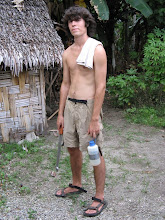
“Ples i hot.” Bislama for “it's hot” (from the English “place is hot”), but it passes for “hello” or “goodbye” or “hey, how's it going?” And it's a great way to meet new people. Just sit down on a bench next to a bunch of guys you don't know, make a show of settling in a taking a load off and let out a “ples i hot” in a lazy voice that's half sigh and half groan. It's a start to many a fast friendship on the islands. When I was back in the States for Christmas, I invested in a $10 combination yard thermometer and hygrometer, thus allowing me to keep track of exactly how amazingly hot the place at any given moment. A hygrometer, by the way, measures humidity and is not to be confused with a hydrometer which, for some reason, is a tool that's used to measure the density of beer. It seems like it would make sense that, since humidity has to do with water and all, a tool that measures it would be called a hydrometer, but I guess beer predates meteorology by a good couple millenniums (apparently millenniums is the accepted plural of millennium now. I always thought it was millenia, but the spell checker doesn't lie), so they got to take all the good names. Anyway, every afternoon as I'm sweating and cooking lunch, I get to glance over at my thermo/hygrometer and see those large, cheerful digital numerals spell out 91.5 F and 68% (I'm all for the metric system, I really am. It makes more sense, it's easier to work with, and everyone else uses it. Thing is, at the end of the day, I still have absolutely no idea how hot 20 degrees Celsius is). Except the .5 on the 91.5 is only half the size over the other numbers (because it's a decimal, and decimals are only half as important) and is sort of tucked away under the F like an afterthought. It's a bonus, the plus tacked onto the A, that says that not only is it really hot, but it's really hot and then a bit extra.
I've always been an ice over fire kind of person. I've always felt it's easier to warm up on a cold day than cool off on a warm day. It's the second law of thermodynamics: it sucks to be hot. Unfortunately, that wonderful food that we eat to stay alive also produces waste heat when it's burned, which has to be dumped somewhere. It doesn't really seem like it should be a problem. Our bodies are running at 98.6, give or take, so that gross sticky air permeating my household around lunchtime is a whopping seven degrees cooler than me. It should be cooling me off, it really should. And I guess it does, it's just that the heat never really gets far enough away. You can feel it when you stand still, the stale air around you slowly getting hotter and hotter until it can't anymore and then it's on your skin, that horrible warm throb as your blood pumps in more and more heat that just goes nowhere, and then it starts oozing inwards, first through your arms and legs and then your chest and head as the whole system just backs up and you want to scream in frustration. Ples i hot. When I first got to Vanuatu I was obsessed with trying to prove myself to the locals who, I feared, would see me a as weak, pampered northerner with no stomach for the island heat. “Ples i hot,” people would call out to me as they passed me on the road. “No,” I'd say, feeling obligated to appear strong “no, it's not that bad. It gets hotter back in the US, actually.” And the Ni-Vans would nod and smile politely and wonder why in the hell I was trying to argue that it wasn't hot. I later realized that the ples i hot greeting was not meant to be patronizing, but was rather an invitation to mutual surrender and acceptance of forces outside of our control. More of a “hey, it's really hot out, why don't we both pass out under a tree for several hours and do absolutely nothing.”
I think the heat is responsible for the lack of success most international development projects experience in Vanuatu. You come up with a development idea, you talk it over with other development workers, you submit your idea to some development agency, get some funding, come up with a good acronym and maybe a catchy slogan, run some workshops and trainings, hand out materials, and pass the whole thing off to someone in-country, who gets sweat stains all over everything and shelves most of the work until the weather cools down a bit, which is never. We're kind of like Superman, the heat is like our kryptonite. When we can get away from it we're unstoppable. We invent things, build cities and civilizations, cross oceans, go to the moon. But when we're confronted with a hot, muggy day we become lazy, lethargic and useless. I think one of my favorite images of Vanuatu are those Sunday afternoons where I eat way too much lap-lap at Duncan's and pass out on his cement floor along with the rest of the family; looking out the door I can see all of the numerous household dogs arrayed similarly on the lawn, man and beast made alike by the afternoon sun.
I think my schoolyard is one of the hottest places on the face of the planet. The yard is open and shadeless, the perfect venue for the sun to do its relentless work, and there are stands of banana trees on all sides that choke out pretty much every breeze that even considers passing through. I can't blame the students at all for not wanting to come to class in the afternoon. There's really only one respectable thing to be doing when face with such oppressive heat, and that's absolutely anything that might help you cool off, even a little bit. Combating the heat is a subtle game and it requires creativity and cunning. Unfortunately, heat is fantastic at dulling both one's creativity and cunning, so the best ideas for combating the heat are often formed whilst away from it (I'll bet you that air conditioning was invented during the winter). Staying cool in Vanuatu is an art. In my opinion, the best option is to get yourself a job somewhere that has air conditioning. On Malekula, this leaves two options, the Air Vanuatu Office and the LTC Office (not the main store, mind you, just the office in the back). But, since the owner of the LTC is kind of a jerk, I think the most set up person on the entire island is the lady who works at the Air Vanuatu ticket counter. She gets to hang around for eight hours a day in the air conditioning, and gets paid. Oh, and occasionally she has to help a customer, but that's a small price to pay. For those of us less fortunate however, the thatch and bamboo houses are a good second choice. Despite their humble appearance and the fact that they often leak when it rains, the bamboo huts actually boast much better thermal properties than the fancier cement block and metal roof homes. Natural materials, you see, provide much better insulation than sheets of metal, which helps keep the heat of the day out. Thus, it's often a good five to ten degrees cooler inside of a bamboo house during the day than inside of my much fancier house. Location can also play an important role. Oceanfront properties are desirable not only for nice views, but also for those delightful ocean breezes which can make the difference between comfort and misery come 1pm. Although not always reliable, there's often a fairly strong wind coming off of the ocean that provides those whose houses are on the beach with a nice, natural, cross breeze. Once again, however, this is of little help to me, whose house is in a stagnant schoolyard, although many of my hours are spent down by the ocean to take advantage of the breezes anyway. Swimming and showering are also tempting possibilities, but they must be employed with care. While that water may feel good against you skin while you're in it, it can sometimes leave you with a vague, humid, sticky feeling that never quite goes away no matter how many times you dry off. The key is to only venture into the water (or the shower) in the later afternoon, as the heat is breaking, so that that last little bit of moisture can be absorbed by the cooler night air as opposed to combining with the sweat of the day.
The sad truth, however, is that on the worst days there's not a lot you can do. When the wind over the ocean cuts out and the sea is glassy calm and the sun's heat manages to work its way through even the thickest of thatch roofs, often the only thing that can give you the smallest hint of respite is the fan. A small piece of something held in the hand and slowly waved back and forth to produce the smallest of breezes across the body. Choosing a good object for fanning is key. You want something stiff enough to move air effectively (sheet of paper, for example, is far to floppy), yet light and easy to move so that you're not expending undo energy. Cardboard boxes in my house are quickly cut up and employed as fans that serve fairly well until the sweat from the hand holding them permeates the cardboard and they become too limp and must be discarded. The Ni-Vanuatu favor fans fashioned from pandanus (similar to their mats), which last long, but are just a little bit too difficult to move for my tastes. Getting the proper fanning speed is also important. If you fan too slowly, you won't feel adequately cooled, but if you fan too quickly the extra heat produced from the exertion will counter whatever cooling effect the breeze you're producing has. Fanning is best employed when the rest of the body is totally immobile, and in slow, steady strokes that can be continued for hours without tiring you out.
Getting through the days are one thing, but by far the worst is when the heat persists into the night. A hot night can make sleeping almost totally impossible, and there's little to be done about it. If you have a cement floor, you can abandon your bed in favor of the slightly cooler cement, although you're sacrificing physical comfort for thermal comfort, so it's only a matter of time before you become too sore and have to return to the bed. It's also possible to fan yourself to sleep, although this is a tricky business. You have to make your fanning motions as mechanical and monotonous as possible in order to become drowsy enough to fall asleep. Close your eyes and relax while fanning yourself slowly and allow yourself to drift off. Now, you're eventually going to have to stop fanning in order to allow sleep to fully take hold, so the key is timing, you've got quit fanning right as you feel yourself on the verge of sleep. Once the fanning stops, you've got only a minute or two to seal the deal before you start becoming too hot again and have to start over. But don't worry, it's OK if you don't nail it on the first go, practice makes perfect. Of course, sometimes the best option is just to have a few shells of kava, which will put you straight to sleep, heat or no.
Although manual fanning is about the limit of what we're able to achieve with local materials, modern technology has opened up some more possibilities for me. The electric fan, under appreciated in our over-air conditioned society, has found a new place in my heart out here on the islands. Unfortunately, technological difficulties have been something of a hindrance, so I'm now actually on my third fan. My first was a cheap, Chinese-made piece that did well for the first couple of months but began to slow down to the point where I had to push-start the blades with a pencil just to get it to move at all. When I was back in the States, I decided to upgrade and invested in an “industrial air circulator,” which worked wonderfully for about 30 minutes before the motor got fried by the electricity here (and yes, I was using a transformer to step down the voltage, but I guess 60Hz motors don't like 50Hz power). This led to a very depressing month or so where I had two fans in my house, neither of which were working. I recently went to Vila, however, and went looking for the most durable-looking, fanciest fan I could find. I finally settled on an 18 inch, 180 watt floor fan imported from England that I got for about $90. So far it's been serving me faithfully, but I'm still only cautiously optimistic that it will last me until December, when I leave, given my history with fans.
Along with the dud of a fan I also, when I was in the States, purchased a vinyl water bed mattress, which is a fancy word for a giant, watertight bag. This was at the suggestion of my engineer-filled family and the idea behind it was twofold. First, since water takes a long time to heat up (has a large heat capacity, in science-speak), a fully filled water bed would always be a few degrees cooler than whatever the temperature happened to be in the house around it. Second, since water is better at absorbing heat than air, even if the bed were to get up to 91.5 F along with the house, it would still feel cooler (sort of like how water at 70 F feels a lot colder than air at 70 F). And so, when I got back to Vanuatu, I set my vinyl bag on the floor up against my wall and set to filling it up. This was actually a lot harder than it sounds. You see, the manufacturers of the water bed were obviously expecting the person filling it up to have running water, which I don't. There was a nice little fill valve on the bed and it came with a nice little adapter to hook up to a hose and then a faucet, none of which would work with my water tank. I ended up placing the end of the hose inside of a bucket instead of attaching it to a faucet and placing the bucket on my kitchen table. I then filled the bucket with water, and used the hose as a siphon to draw water out of the bucket and into the bed. Every thirty seconds or so I ran outside with a second bucket, filled it up with water from my tank, and refilled the first bucket. The whole process ended up taking about an hour and a half, I probably made a least a hundred trips to my water tank, and used up about 2/3 of my drinking water in the process. But it was definitely worth it. Predictions were correct, and the water bed was pleasantly cool to lie on, even in the middle of the afternoon. Plus, I now have the only water bed in the country, which is kind of cool. Really, the main downside is that, given how comfortably cool it is and how difficult it can be to get out to water beds anyway, it's pretty tempting for me to spend entire weeks lying on it.
Together, the water bed and my new Gazz brand 180 watt fan make up my personal cooling solution. Lying on the bed with the fan whirring just inches away from my head goes a long way towards taking the edge off the heat. But, and this is the sad part, it's still just not *quite* enough. There are still those times when the air moving through the fan is still just a little too uncomfortably warm and the water from the water bed isn't quite sucking enough heat out of my back when I still feel the oppressiveness around me and I know that I can never really win, that my victories are small and my fight is in vain. There's just no way around it. Ples i hot.
Sunday, April 19, 2009


Yu No Kick Part 5: Digicel
Cell phones, those in international development like to say, are a leapfrog technology. That is, it's a technology that can be implemented more easily than earlier forms of itself and it doesn't require older forms of itself to be in place in order to function. So, cell towers are easier to build than a network of landlines and they don't require a network of landlines to be in place in order to function, thus the land line phase of telecommunications development can be totally skipped. When I first arrived in Vanuatu, communicating with anyone not within shouting distance was something of a challenge. A French company called TVL had set up a very precarious phone network. Phones connected to large radio transmitters that passed their signals over the ocean between the islands and finally fed into a large satellite dish in Port Vila which allowed a slow trickle of communication with the outside world for those few of us desiring it. Often, the transmitters were located in remote areas without access to electricity and thus relied on solar power to function, an energy source that can become decidedly scarce should it be raining a lot. Phone cord also tends not to last long in the bush, where it is baked by the sun, corroded by the rain, and chewed on by rats, and thus phone cables were often held together via arrangements that made duct-taping seem like a shockingly sturdy and long-term solution. Technicians were also usually less than thrilled to travel to areas reachable only by machete-wielding adventurers to make repairs. But there they'd be, incongruous as palm trees in Alaska, these off-white desk phones, looking like they'd come straight from Office Depot (they even had speed dial), nailed to the side of community centers or housed in little bamboo and thatch huts which you could, if you really squinted, call phone booths. Those phones were a promise, a tenuous glimmer of hope that maybe, just maybe, you might be able to talk to someone outside of your village. That, if it hadn't been raining too much and if the piece of cloth holding the phone wire together continued to function properly, you might just be able to talk to your parents in the US or, if you were really lucky and happened to own a laptop, log on to Facebook and update your status.
TVL made money by charging for plastic, pre-paid phone cards with long numerical codes on the back covered by lottery-ticket style scratch off goop that you removed when you purchased them to reveal your number, which you could then punch into a phone to access airtime. It cost about $5 for the cheapest card, which earned you about ten minutes of talk time. After being prompted for the number you wished to call, a friendly voice would come on and inform of how much time you would be able to connect to said number on your current phone card. The thing was, TVL employed a complicated billing system where the phone charges were based on the time of day, the day of the week, the island that you're calling from, the island that you're calling to, and whether or not it's a good day for yams at the market; the bottom line being that sometimes you'd connect to a number and be granted fifteen minutes to talk and sometimes you'd connect to the same number and have four. You just never knew. Sometimes calling cards were used as a substitute for currency. For example, I once heard a story of a woman buying a baby using phone cards, which I thought was strange because not only did it imply that someone had negotiated the purchase of a child, but that they didn't have the common decency to at least use an actual currency when doing so.
TVL eventually branched out into cell phones as well, but there coverage was rather spotting as you could only use your cell phone in about 10% of the country. You couldn't really blame them for this though, given what a pain it is to build and maintain cell towers. The tower on Malekula, for example, required a forty-five minute hike through the bush, up a rather steep hill to reach, which really isn't that bad if you're just carry a bottle of water and maybe a few snacks, but if you're carrying, say, the cement to build a cell tower with, it starts to look like a real pain in the ass.
When I first got to Malekula, a new phone company, Digicel, was in the process of building a network of cell towers across Vanuatu with the ambitious goal of providing coverage to over 70% of the country. Unlike TVL's towers, however, which were small, simple affairs which relied on terrain (ie. hills) to provide the height needed to broadcast their signal, Digicel's structures were huge, towering monstrosities (at least for Vanuatu), and they were going up all over the country. It was an uphill battle and one that I, when I saw it began, thought was doomed to failure. For one thing, building a large tower that will remain standing for a long period of time, even in the presence of natural disasters such as earthquakes and hurricanes, requires a quality of workmanship that is mostly absent from Vanuatu. For example, the concrete cinder blocks made on my island are so incredibly shoddy and low-quailty that it's entirely possible to break one by stepping on it (which, as you can image, makes me feel really good, given that I live in a cinder block house). To get around this problem, Digicel not only imported the cement (the chemical ingredients used in making concrete) for their towers, but also the sand and water that went into the making of their concrete blocks.
The launching of the Digicel phone network was the biggest thing to hit Vanuatu since independence. Actually, no, the Digicel launching was the biggest thing to hit Vanuatu, period. And it was accompanied by an ad campaign that would have been right at home advertising the release of a new kind of Doritos chip back in the States. They imported who knows how many gallons of red and white (Digicel's logo's colors) paint and sent people up and down all the islands painting everything that they possibly could red and white. People's huts out in the middle of nowhere became Digicel advertisements. So you'll be traipsing through the bush and all of the sudden come upon a little thatch roofed store with DIGICEL written in large, white letters on the side. They wrote theme music, got celebrity endorsements (no mean feat considering that there aren't any celebrities here). The national newspaper sold them their front page for several weeks running. As in, the front page of the newspaper contained not a single bit of news but was one, giant, Digicel ad. They even put a highway-style billboard up in Lakatoro, conveniently large enough to read while you're speeding by in your car. Now all we need are some cars to speed by in. On launching day in Malekula, they rented a truck and decked it out with speakers and banners and drove up and down the island blasting Digicel music and giving out hats. I wondered if someone should try and explain to them that, in order to sell phones in Vanuatu, all they really had to do was, you know, have some phones to sell.
Needless to say, cell phones were an overnight success in Vanuatu. Even the crazy guy who sings outside of our general store got one (although his is a broken one that someone else threw away). The basic Digicel phone model is a black-and-white screen job, which I like because it's simple, functional, and easy to use, but especially because it has a little flashlight on the end of it. In my mind, this is really the only cell phone extra that's actually useful in Vanuatu (or anywhere, really. I actually saw the flashlight phone on sale in the US when I was home for Christmas. I was trying to sell my brother on it when he was shopping for his first cell phone, but with little luck. “Hey Nick, check this one out, it has a flashlight on it!” “But it doesn't even have a color screen or an enhanced keypad and it doesn't flip open or slide or do anything.” “Yeah, but check it out, it has a flashlight!”), although it can lead to complications when you're using it to walk around at night and someone calls and you have to choose between walking and talking on the phone. Of course, people in my village quickly discovered the many and varied features of the fancier phones, including the MP3 player, the camera, and the video recorder, all of which are pretty much totally useless without a computer, but no one seems to mind. I soon became pitied in Tautu as the one, poor guy still using the cheap-o, uncool phone. Even the crazy dude's broken phone is a fancier model than mine. I usually end up getting the last laugh, however, seeing people walking along at night, hunched over low so as to allow the light from the large color screens of their internet-capable camera phones to illuminate the many potholes in the road.
I think leapfrogging is an appropriate image for the arrival of Digicel to Vanuatu because, while Digicel may cover over 70% of the country, things like electricity certainly do not. Originally, Digicel sold their phones with little, red solar chargers which, as anyone who's ever used any kind of solar charger knows, are totally useless. Eventually this plan was abandoned and thriving cell phone charging businesses have sprung up all over the place. People with it enough to own generators or to have large solar setups charge $1 per charge to charge a cell phone. The stores in Lakatoro, who all run on the power grid, charge similar rates to those who want to use their outlets to charge their phones while they're in from the out villages. Given that charing a cell phone uses probably a maximum of ten joules of energy, I think this is a pretty brilliant businesses model.
Along with the lack of electricity, many Ni-Vanuatu also suffer from a lack of anyone to call. Not to be deterred, however, some adventurous Ni-Vans have taken to simply dialing random combinations of numbers and trying to strike up a conversation with however answers. I'm sure it's only a matter of time before someone gets married to a person they met while randomly punching in numbers on their phone one afternoon. For all I know this has already happened. This practice got even worse when Digicel started offering this service where you can send a free text to a friend requesting that they call you back. Whereas before randomly calling people cost money, now you can randomly text people for free and see who calls back. I get at least four such texts per day. Adding to my daily influx of phone spam are special offers that Digicel texts out to all their customers, things like “Make a 20 minute phone call today and make calls for the rest of the day for free.” Helpfully, they will sometimes send out three versions of each message, one in English, one in Bislama, and one in French. For a while, the whole concept of a special offer was a little shaky in the village and so I was having to do a lot of explaining.
Ni-Van: “What does this Digicel text mean?”
Me: “Well, if you make a phone call that lasts longer than 20 minutes, all your calls for the rest of the day are free.”
Ni-Van: “So if I talk for twenty minutes today, I don't have to buy phone cards anymore?”
Me: “No, only calls you make today will be free. Tomorrow you have to start paying again.”
Ni-Van: “So I talk for twenty minutes and then it's free until tomorrow?”
Me: “Yes.”
Ni-Van: “What if I use my brother's phone?”
Me: “No, just the calls you make on your phone.”
Ni-Van: “But what if mine runs out of battery?”
Me: “You know what, just forget about it.”
Ni-Vans are also absurdly bad at accepting the fact that they've dialed a wrong number, or maybe it's just that they don't really care if they actually end up talking to the person they're trying to call, I don't know, but the bottom line is that I get a lot of conversations like this:
Me: Hello
Caller: George?
Me: No, sorry, I'm not George.
Caller: But I'm trying to call George.
Me: Well, I'm not George, sorry.
Caller: Is George there?
Me: No, this isn't George's phone, it's my phone.
Caller: Who are you?
Me: I'm Daniel, sorry, not George.
Caller: Do you know George?
Me: No, I don't, I'm sorry, I think you have the wrong...
Caller: Where are you on?
Me: Malekula, look, I...
Caller: No, George lives on Pentecost, this should be Pentecost.
Me: Yeah, I'm not George. I”m Daniel, I'm on Malekula, look, try...
Caller: Could you get George for me?
But what's worse is when you hang up on them and they call back.
Cell phones in Vanuatu seem like some kind of alien artifact that some UFO accidentally left a bunch of behind when they were visiting earth. They're so out of sync with everything else that's going on in the country. Stores in Vila have even started selling iPhones so that you can get directions to the nearest nakamal with on your cell phone with MapQuest (Continue STRAIGHT for 200 meters on THE ONLY ROAD ON THE ISLAND, then turn LEFT). Digicel has even activated the GPRS network, allowing phones with internet capability to get online. Just last Sunday I was sitting on the beach watching Duncan and some friends grind a batch of kava. We were struggling to find a bucket in which to work the kava and a rag with which to strain out the grinds when I was asked if I knew of any good websites to check out. I turned around and was faced with a bright, color, cell phone screen displaying the Google homepage. I was flabbergasted and for a while could not think of a single web address. Finally, one popped into mind. “Try http://www.nytimes.com,” I said, and watched as the guy painstakingly typed “http://www.nytimes.com” into the Google search bar. “No,” I said “that's a URL, you don't put that in the search bar.” “What's a URL?” he asked. I sighed. Technology is a strange thing.
TVL made money by charging for plastic, pre-paid phone cards with long numerical codes on the back covered by lottery-ticket style scratch off goop that you removed when you purchased them to reveal your number, which you could then punch into a phone to access airtime. It cost about $5 for the cheapest card, which earned you about ten minutes of talk time. After being prompted for the number you wished to call, a friendly voice would come on and inform of how much time you would be able to connect to said number on your current phone card. The thing was, TVL employed a complicated billing system where the phone charges were based on the time of day, the day of the week, the island that you're calling from, the island that you're calling to, and whether or not it's a good day for yams at the market; the bottom line being that sometimes you'd connect to a number and be granted fifteen minutes to talk and sometimes you'd connect to the same number and have four. You just never knew. Sometimes calling cards were used as a substitute for currency. For example, I once heard a story of a woman buying a baby using phone cards, which I thought was strange because not only did it imply that someone had negotiated the purchase of a child, but that they didn't have the common decency to at least use an actual currency when doing so.
TVL eventually branched out into cell phones as well, but there coverage was rather spotting as you could only use your cell phone in about 10% of the country. You couldn't really blame them for this though, given what a pain it is to build and maintain cell towers. The tower on Malekula, for example, required a forty-five minute hike through the bush, up a rather steep hill to reach, which really isn't that bad if you're just carry a bottle of water and maybe a few snacks, but if you're carrying, say, the cement to build a cell tower with, it starts to look like a real pain in the ass.
When I first got to Malekula, a new phone company, Digicel, was in the process of building a network of cell towers across Vanuatu with the ambitious goal of providing coverage to over 70% of the country. Unlike TVL's towers, however, which were small, simple affairs which relied on terrain (ie. hills) to provide the height needed to broadcast their signal, Digicel's structures were huge, towering monstrosities (at least for Vanuatu), and they were going up all over the country. It was an uphill battle and one that I, when I saw it began, thought was doomed to failure. For one thing, building a large tower that will remain standing for a long period of time, even in the presence of natural disasters such as earthquakes and hurricanes, requires a quality of workmanship that is mostly absent from Vanuatu. For example, the concrete cinder blocks made on my island are so incredibly shoddy and low-quailty that it's entirely possible to break one by stepping on it (which, as you can image, makes me feel really good, given that I live in a cinder block house). To get around this problem, Digicel not only imported the cement (the chemical ingredients used in making concrete) for their towers, but also the sand and water that went into the making of their concrete blocks.
The launching of the Digicel phone network was the biggest thing to hit Vanuatu since independence. Actually, no, the Digicel launching was the biggest thing to hit Vanuatu, period. And it was accompanied by an ad campaign that would have been right at home advertising the release of a new kind of Doritos chip back in the States. They imported who knows how many gallons of red and white (Digicel's logo's colors) paint and sent people up and down all the islands painting everything that they possibly could red and white. People's huts out in the middle of nowhere became Digicel advertisements. So you'll be traipsing through the bush and all of the sudden come upon a little thatch roofed store with DIGICEL written in large, white letters on the side. They wrote theme music, got celebrity endorsements (no mean feat considering that there aren't any celebrities here). The national newspaper sold them their front page for several weeks running. As in, the front page of the newspaper contained not a single bit of news but was one, giant, Digicel ad. They even put a highway-style billboard up in Lakatoro, conveniently large enough to read while you're speeding by in your car. Now all we need are some cars to speed by in. On launching day in Malekula, they rented a truck and decked it out with speakers and banners and drove up and down the island blasting Digicel music and giving out hats. I wondered if someone should try and explain to them that, in order to sell phones in Vanuatu, all they really had to do was, you know, have some phones to sell.
Needless to say, cell phones were an overnight success in Vanuatu. Even the crazy guy who sings outside of our general store got one (although his is a broken one that someone else threw away). The basic Digicel phone model is a black-and-white screen job, which I like because it's simple, functional, and easy to use, but especially because it has a little flashlight on the end of it. In my mind, this is really the only cell phone extra that's actually useful in Vanuatu (or anywhere, really. I actually saw the flashlight phone on sale in the US when I was home for Christmas. I was trying to sell my brother on it when he was shopping for his first cell phone, but with little luck. “Hey Nick, check this one out, it has a flashlight on it!” “But it doesn't even have a color screen or an enhanced keypad and it doesn't flip open or slide or do anything.” “Yeah, but check it out, it has a flashlight!”), although it can lead to complications when you're using it to walk around at night and someone calls and you have to choose between walking and talking on the phone. Of course, people in my village quickly discovered the many and varied features of the fancier phones, including the MP3 player, the camera, and the video recorder, all of which are pretty much totally useless without a computer, but no one seems to mind. I soon became pitied in Tautu as the one, poor guy still using the cheap-o, uncool phone. Even the crazy dude's broken phone is a fancier model than mine. I usually end up getting the last laugh, however, seeing people walking along at night, hunched over low so as to allow the light from the large color screens of their internet-capable camera phones to illuminate the many potholes in the road.
I think leapfrogging is an appropriate image for the arrival of Digicel to Vanuatu because, while Digicel may cover over 70% of the country, things like electricity certainly do not. Originally, Digicel sold their phones with little, red solar chargers which, as anyone who's ever used any kind of solar charger knows, are totally useless. Eventually this plan was abandoned and thriving cell phone charging businesses have sprung up all over the place. People with it enough to own generators or to have large solar setups charge $1 per charge to charge a cell phone. The stores in Lakatoro, who all run on the power grid, charge similar rates to those who want to use their outlets to charge their phones while they're in from the out villages. Given that charing a cell phone uses probably a maximum of ten joules of energy, I think this is a pretty brilliant businesses model.
Along with the lack of electricity, many Ni-Vanuatu also suffer from a lack of anyone to call. Not to be deterred, however, some adventurous Ni-Vans have taken to simply dialing random combinations of numbers and trying to strike up a conversation with however answers. I'm sure it's only a matter of time before someone gets married to a person they met while randomly punching in numbers on their phone one afternoon. For all I know this has already happened. This practice got even worse when Digicel started offering this service where you can send a free text to a friend requesting that they call you back. Whereas before randomly calling people cost money, now you can randomly text people for free and see who calls back. I get at least four such texts per day. Adding to my daily influx of phone spam are special offers that Digicel texts out to all their customers, things like “Make a 20 minute phone call today and make calls for the rest of the day for free.” Helpfully, they will sometimes send out three versions of each message, one in English, one in Bislama, and one in French. For a while, the whole concept of a special offer was a little shaky in the village and so I was having to do a lot of explaining.
Ni-Van: “What does this Digicel text mean?”
Me: “Well, if you make a phone call that lasts longer than 20 minutes, all your calls for the rest of the day are free.”
Ni-Van: “So if I talk for twenty minutes today, I don't have to buy phone cards anymore?”
Me: “No, only calls you make today will be free. Tomorrow you have to start paying again.”
Ni-Van: “So I talk for twenty minutes and then it's free until tomorrow?”
Me: “Yes.”
Ni-Van: “What if I use my brother's phone?”
Me: “No, just the calls you make on your phone.”
Ni-Van: “But what if mine runs out of battery?”
Me: “You know what, just forget about it.”
Ni-Vans are also absurdly bad at accepting the fact that they've dialed a wrong number, or maybe it's just that they don't really care if they actually end up talking to the person they're trying to call, I don't know, but the bottom line is that I get a lot of conversations like this:
Me: Hello
Caller: George?
Me: No, sorry, I'm not George.
Caller: But I'm trying to call George.
Me: Well, I'm not George, sorry.
Caller: Is George there?
Me: No, this isn't George's phone, it's my phone.
Caller: Who are you?
Me: I'm Daniel, sorry, not George.
Caller: Do you know George?
Me: No, I don't, I'm sorry, I think you have the wrong...
Caller: Where are you on?
Me: Malekula, look, I...
Caller: No, George lives on Pentecost, this should be Pentecost.
Me: Yeah, I'm not George. I”m Daniel, I'm on Malekula, look, try...
Caller: Could you get George for me?
But what's worse is when you hang up on them and they call back.
Cell phones in Vanuatu seem like some kind of alien artifact that some UFO accidentally left a bunch of behind when they were visiting earth. They're so out of sync with everything else that's going on in the country. Stores in Vila have even started selling iPhones so that you can get directions to the nearest nakamal with on your cell phone with MapQuest (Continue STRAIGHT for 200 meters on THE ONLY ROAD ON THE ISLAND, then turn LEFT). Digicel has even activated the GPRS network, allowing phones with internet capability to get online. Just last Sunday I was sitting on the beach watching Duncan and some friends grind a batch of kava. We were struggling to find a bucket in which to work the kava and a rag with which to strain out the grinds when I was asked if I knew of any good websites to check out. I turned around and was faced with a bright, color, cell phone screen displaying the Google homepage. I was flabbergasted and for a while could not think of a single web address. Finally, one popped into mind. “Try http://www.nytimes.com,” I said, and watched as the guy painstakingly typed “http://www.nytimes.com” into the Google search bar. “No,” I said “that's a URL, you don't put that in the search bar.” “What's a URL?” he asked. I sighed. Technology is a strange thing.
Sunday, April 5, 2009
Yu No Kick Part 4: Centipedes
Vanuatu is pretty lucky when it comes to its fauna, as most of it is friendly, or at least harmless. No large, threatening mammals. No lions, tigers or bears. The closest we've got are wild pigs and cows which, while they're nothing to be trifled with, just aren't really what one pictures when asked to think of a fearsome predator. There are no poisonous snakes (actually we do have white and black striped sea snakes whose venom is lethal, except their jaws are so small that the only place where they can bite you is on the ear lobe) and the spiders, while gigantic, are also harmless. There are no black widows or brown recluses or even wolf spiders. Basically, any animal you might even consider being afraid of doesn't live in Vanuatu. Except for the centipedes. These impossible creatures abound in the country particularly, it seems, in my house. They aren't unique to Vanuatu, really, you can find them in the desert southwest of the US, hanging out with the scorpions and other creepy-looking insectioids. In fact when I was in Big Bend National Park in west Texas over Christmas I noticed them selling centipedes encased in glass as paperweights. They were labeled as “giant centipedes” despite the fact that they were barely four inches long. Any self-respecting centipede enthusiast would scoff at such measly specimens. The centipedes in Vanuatu grow to mutant proportions far exceeding what would conveniently fit inside your average paperweight. Around these parts, centipedes upwards of eight inches aren't an unusual sight to see clambering across my walls. These are centipedes that you wouldn't be particularly surprised to see carrying off small kittens or one of those obnoxious football-sized yappy dogs.
My training group's fear of centipedes was cultivated early on in our Peace Corps experience. A few of us had read accounts of such creatures in various books about Vanuatu and the stories quickly spread. During our first week in Vila we were constantly on the lookout, expecting giant centipedes to be lurking behind every corner, ready to inflict all kinds of unimaginable horrors upon us. I didn't end up seeing my first centipede until we'd moved to our training village, in the bush a little north of Port Vila. Like any self-respecting monster, centipedes eschew the light and prefer dark, damp haunts. However, come nightfall they emerge in search of food and sometimes would venture into my family's dining area. Your average adult centipede is six to eight inches long, reddish brown, and has far more legs than is really necessary. They're about the thickness of your little finger and are made up of countless little segments, each segment sprouting a spindly pair of legs. A menacing set of what are undoubtedly pincers adorn the head and you can tell, without any questions asked, that they just HAVE to be poisonous. It takes about a second to put together the fact that these things are up to no good. Ni-Vans go after centipedes with a overly religious zeal usually reserved for witch-hunters and exorcists. Whoever spots one sounds the alarm and everyone within a fifty foot radius instantly springs into action. Even nakamals, where peace and quiet held sacrosanct, dissolve into frantic mayhem if a centipede is sighted. Flip-flops are quickly removed and converted into clubs with which to bludgeon the beasts. Dirt and gravel fly everywhere as dozens of men ruthlessly pound the ground with their shoes. And then, just as suddenly, when the foe is vanquished, the all-clear is sounded. Everyone replaces their shoes, returns to their seats, and continues their conversations as if nothing had happened.
Although physics would seem to dictate that, as the number of legs attached to a creature increases, eventually it would have far too many than is useful and any further increase in leg number would simply lead to increased clumsiness, this does not really seem to play out in the case of centipedes. They move with an impossible grace that has to be seen to be believed. They don't so much walk as they flow. None of their myriad of appendages ever really seem to move, and yet somehow they are propelled forward with terrifying speed. They ooze through the smallest nooks and crannies like syrup, making them all but impossible to keep out of your house. Of course, anything able to move with such horrible fluidity is certain to be predatory. Centipedes are the lions of the insect world. They descend upon unsuspecting cockroaches and toiling ants and slaughter them like lambs. Frightening enough as they are for us, veritable behemoths hundreds of times their size, one shudders to think how a centipede must appear to its prey: the sudden flurry of legs, the quiet whoosh of impending doom, and those giant pincers closing you.
On dry days, the centipedes stick to the outdoors, preferring the warm and moist hideouts offered by the soil. When it rains, however, they are driven from their holes and begin to creep inside. With the lights out, they claim full reign of the house, rushing across the floors and oozing up the walls to prey on the roaches, beetles, moths, and others who make up my usual collection of house guests. Once sated, they seek out warm nooks to roost: underneath pillows, in the folds of bedsheets and clothing, snuggled up against a sleeping human. I had my first close encounter during my first few weeks on Malekula. I awoke in the middle of the night with the odd sensation of something crawling on me. Still groggy, I glanced down to investigate and froze. Nestled on my sternum was a massive and distinctly alien creature. I'd seen a number of centipedes before, but never one this big. Its fangs glistened in the moonlight. My adrenaline was flowing freely, I was ready for action, but, if it came to a showdown, I was uncertain which one of us would emerge the victor. The thing was HIUGE. I mustered every ounce of strength I had and swatted the beast to the side. It went flying, hitting the wall and falling to the floor. I bolted upright, waiting for it to retaliate, but it was already in full retreat. My mind, in its panic, had vastly overestimated the size of my foe. It was tiny. Even by American standards. Little more than a baby. I smiled and relaxed and settled back into bed. But when you've shared your bed with a centipede, it puts your senses on edge. Suddenly, everything feels like a many-legged creature crawling across your body. The brush of your sheet, the night's breeze against your skin, the tickle of your mosquito net, has you bolt upright in moments, searching for your assailant. It was a long time before I was able to fall back asleep.
Over the months, I've become a seasoned veteran of centipede attacks. At a glance I can distinguish a baby centipede from its somewhat dopey and entirely harmless cousin, the millipede (millipedes rarely get to be more than an inch long and, rather than being fearsome predators, they instantly curl up into little balls whenever they're startled. Their sole purpose in life seems to be to crawl into my house and die. I have to sweep millipede corpses off my floor on a daily basis). I straighten the folds of my bed sheet and shake out my pillow before heading to sleep. And I'm a survivor of many a centipede bite. After spending almost a year in fear of being bitten, my first bite was a surprisingly painless experience: a sharp sting lasting a minute or so subsiding to a dull throb and then an itchy lump by morning. Many a centipede has regretted its decision to sink its fangs into my skin. Usually, I get stung at night when I accidentally roll on top of or brush an appendage against a centipede that's decided to share my bed with me. The sting brings me awake and is followed by a glance at the affected area of confirm the cause. Centipedes leave two little puncture holes right next to each other that make it look like I've been bitten by a midget vampire. The larger centipedes can even draw blood with their bite. With the sight of those two little welts, the hunt begins.
Centipede hunting can be a tricky business. First, you have to choose a weapon. Centipedes are well armored, so going after them empty handed is generally ineffective and will often earn you a second bits. However, they're also fast, so if you delay too long whilst arming yourself your prey will have escaped. The edge of a shoe is generally the choice I prefer (stepping on centipedes is also usually ineffective, they're too fast and slippery and, more often then not, they'll just crawl on top of your foot and deliver another bite). Next, I turn the lights on. When the room floods with light, the centipede will bolt for the nearest cover it can find. If you catch it out in the middle of the floor with no cover in sight, it can become disoriented and start running around in circles, making it an easy target. The key is to drive it out of any cover its able to find. Lift up clothes and pillows and sheets, pick up books or any other objects and force it out into the open. Then, you strike. You need to deliver a sharp blow to effectively damage a centipede. You need a hard edge. Rolled up newspapers aren't going to do you any good, neither will the flat of a book or a shoe. You need something to focus the force of your blow and crush through the centipede's armor, hence the edge of the shoe or the book will work much better than the flat. Once you've delivered one or two good blows, you're on the home stretch. Centipedes are pretty hardy, so it will probably still be alive, but you'll have effectively immobilized it by crushing some of its segments, now you just have to finish the job. Chickens are fond of eating centipedes, so you can carry it outside and feed it to one. You can also burn them. Or you can keep on hammering. Once you're sure that the centipede is damaged enough that it's not going anywhere anytime soon, you leave it and wait. The ants will finish the job for you. Once prey for these mighty beasts, the ants hover on the outskirts of the conflict waiting for you to turn the tables in their favor, then they descend upon the wounded predator. Before long, the centipede is covered in a swarm of these relentless creatures who tear it apart and carry it back to their nest for food. Of the large variety of insects and other small animals that inhabit my house, centipedes may be the most frightening, but the ants are definitely the most insidious. They may be small and weak, and one swipe of my hand my obliterate hundreds of them but, in the end, they always get the last laugh.
My training group's fear of centipedes was cultivated early on in our Peace Corps experience. A few of us had read accounts of such creatures in various books about Vanuatu and the stories quickly spread. During our first week in Vila we were constantly on the lookout, expecting giant centipedes to be lurking behind every corner, ready to inflict all kinds of unimaginable horrors upon us. I didn't end up seeing my first centipede until we'd moved to our training village, in the bush a little north of Port Vila. Like any self-respecting monster, centipedes eschew the light and prefer dark, damp haunts. However, come nightfall they emerge in search of food and sometimes would venture into my family's dining area. Your average adult centipede is six to eight inches long, reddish brown, and has far more legs than is really necessary. They're about the thickness of your little finger and are made up of countless little segments, each segment sprouting a spindly pair of legs. A menacing set of what are undoubtedly pincers adorn the head and you can tell, without any questions asked, that they just HAVE to be poisonous. It takes about a second to put together the fact that these things are up to no good. Ni-Vans go after centipedes with a overly religious zeal usually reserved for witch-hunters and exorcists. Whoever spots one sounds the alarm and everyone within a fifty foot radius instantly springs into action. Even nakamals, where peace and quiet held sacrosanct, dissolve into frantic mayhem if a centipede is sighted. Flip-flops are quickly removed and converted into clubs with which to bludgeon the beasts. Dirt and gravel fly everywhere as dozens of men ruthlessly pound the ground with their shoes. And then, just as suddenly, when the foe is vanquished, the all-clear is sounded. Everyone replaces their shoes, returns to their seats, and continues their conversations as if nothing had happened.
Although physics would seem to dictate that, as the number of legs attached to a creature increases, eventually it would have far too many than is useful and any further increase in leg number would simply lead to increased clumsiness, this does not really seem to play out in the case of centipedes. They move with an impossible grace that has to be seen to be believed. They don't so much walk as they flow. None of their myriad of appendages ever really seem to move, and yet somehow they are propelled forward with terrifying speed. They ooze through the smallest nooks and crannies like syrup, making them all but impossible to keep out of your house. Of course, anything able to move with such horrible fluidity is certain to be predatory. Centipedes are the lions of the insect world. They descend upon unsuspecting cockroaches and toiling ants and slaughter them like lambs. Frightening enough as they are for us, veritable behemoths hundreds of times their size, one shudders to think how a centipede must appear to its prey: the sudden flurry of legs, the quiet whoosh of impending doom, and those giant pincers closing you.
On dry days, the centipedes stick to the outdoors, preferring the warm and moist hideouts offered by the soil. When it rains, however, they are driven from their holes and begin to creep inside. With the lights out, they claim full reign of the house, rushing across the floors and oozing up the walls to prey on the roaches, beetles, moths, and others who make up my usual collection of house guests. Once sated, they seek out warm nooks to roost: underneath pillows, in the folds of bedsheets and clothing, snuggled up against a sleeping human. I had my first close encounter during my first few weeks on Malekula. I awoke in the middle of the night with the odd sensation of something crawling on me. Still groggy, I glanced down to investigate and froze. Nestled on my sternum was a massive and distinctly alien creature. I'd seen a number of centipedes before, but never one this big. Its fangs glistened in the moonlight. My adrenaline was flowing freely, I was ready for action, but, if it came to a showdown, I was uncertain which one of us would emerge the victor. The thing was HIUGE. I mustered every ounce of strength I had and swatted the beast to the side. It went flying, hitting the wall and falling to the floor. I bolted upright, waiting for it to retaliate, but it was already in full retreat. My mind, in its panic, had vastly overestimated the size of my foe. It was tiny. Even by American standards. Little more than a baby. I smiled and relaxed and settled back into bed. But when you've shared your bed with a centipede, it puts your senses on edge. Suddenly, everything feels like a many-legged creature crawling across your body. The brush of your sheet, the night's breeze against your skin, the tickle of your mosquito net, has you bolt upright in moments, searching for your assailant. It was a long time before I was able to fall back asleep.
Over the months, I've become a seasoned veteran of centipede attacks. At a glance I can distinguish a baby centipede from its somewhat dopey and entirely harmless cousin, the millipede (millipedes rarely get to be more than an inch long and, rather than being fearsome predators, they instantly curl up into little balls whenever they're startled. Their sole purpose in life seems to be to crawl into my house and die. I have to sweep millipede corpses off my floor on a daily basis). I straighten the folds of my bed sheet and shake out my pillow before heading to sleep. And I'm a survivor of many a centipede bite. After spending almost a year in fear of being bitten, my first bite was a surprisingly painless experience: a sharp sting lasting a minute or so subsiding to a dull throb and then an itchy lump by morning. Many a centipede has regretted its decision to sink its fangs into my skin. Usually, I get stung at night when I accidentally roll on top of or brush an appendage against a centipede that's decided to share my bed with me. The sting brings me awake and is followed by a glance at the affected area of confirm the cause. Centipedes leave two little puncture holes right next to each other that make it look like I've been bitten by a midget vampire. The larger centipedes can even draw blood with their bite. With the sight of those two little welts, the hunt begins.
Centipede hunting can be a tricky business. First, you have to choose a weapon. Centipedes are well armored, so going after them empty handed is generally ineffective and will often earn you a second bits. However, they're also fast, so if you delay too long whilst arming yourself your prey will have escaped. The edge of a shoe is generally the choice I prefer (stepping on centipedes is also usually ineffective, they're too fast and slippery and, more often then not, they'll just crawl on top of your foot and deliver another bite). Next, I turn the lights on. When the room floods with light, the centipede will bolt for the nearest cover it can find. If you catch it out in the middle of the floor with no cover in sight, it can become disoriented and start running around in circles, making it an easy target. The key is to drive it out of any cover its able to find. Lift up clothes and pillows and sheets, pick up books or any other objects and force it out into the open. Then, you strike. You need to deliver a sharp blow to effectively damage a centipede. You need a hard edge. Rolled up newspapers aren't going to do you any good, neither will the flat of a book or a shoe. You need something to focus the force of your blow and crush through the centipede's armor, hence the edge of the shoe or the book will work much better than the flat. Once you've delivered one or two good blows, you're on the home stretch. Centipedes are pretty hardy, so it will probably still be alive, but you'll have effectively immobilized it by crushing some of its segments, now you just have to finish the job. Chickens are fond of eating centipedes, so you can carry it outside and feed it to one. You can also burn them. Or you can keep on hammering. Once you're sure that the centipede is damaged enough that it's not going anywhere anytime soon, you leave it and wait. The ants will finish the job for you. Once prey for these mighty beasts, the ants hover on the outskirts of the conflict waiting for you to turn the tables in their favor, then they descend upon the wounded predator. Before long, the centipede is covered in a swarm of these relentless creatures who tear it apart and carry it back to their nest for food. Of the large variety of insects and other small animals that inhabit my house, centipedes may be the most frightening, but the ants are definitely the most insidious. They may be small and weak, and one swipe of my hand my obliterate hundreds of them but, in the end, they always get the last laugh.
Tuesday, March 31, 2009
Yu No Kick Part 3: Black Magic
Hanging a breadfruit leaf from your clothesline prevents it from raining. It wasn't entirely clear, when this was being explained to me, what, exactly, the area of effect for this particular weather control device is. Does it just not rain on your clothesline? Sort of like the reverse of the little cartoon raincloud that down pours on just one person? Or does a single breadfruit leaf take out the rainfall for the entire island because, if so, I feel like that might lead to a lot of accidental droughts. There's a leaf for just about anything around here: curing diseases, catching fish, causing diseases, catching women, making money, fertility, birth control, and bringing up the price of copra. In fact, given that there aren't really all that many kinds of plants around I think there are probably more leaf-related spells than there are actual kinds leaves, which suggests that some leaves must being doing double duty, which makes you wonder how if, for example, you're cooking up some papaya-leaf based potion, you specify you want the money-making effect as opposed to the herpes-causing effect. Although I suppose if you assume that each potion has to contain at least three kinds of leaves you open up a lot more possibilities. The local hospitals and health centers are constantly butting heads with practitioners of “kastom” (Bislama from the English word “custom,” referring to practices and traditions predating the arrival of Europeans), so for every guy you see walking around with a professional-looking hospital bandage covering a wound you see a guy strolling around with a heap of leaves fastened onto his cut with a piece of rope (this is even more amazing when you consider the fact that Vanuatu has socialized medicine, so getting bandages and antibiotic creams from the hospital is free whereas getting a stack of leaves from the witch doctor usually costs money). Belief in the magical properties of plants is so strong, in fact, that it's not unheard of for someone to make an announcement at the end of a church service asking if anyone knows of a leaf to help him nab a wife (yes, this actually has happened), which is ironic given how hard the churches work around here to combat belief in black magic and kastom.
Duncan and I go back and forth a lot about the ghost that lives at Aop river. Aop is a small river located about halfway between Lakatoro and Tautu. The road goes right over it and so one really has no choice but to cross it if you're trying to get from my house to Lakatoro or visa versa. Like any good parent, Duncan is worried sick that I'm going to get myself killed. Unlike my Dad in the States, however, who might worry about me getting involved with drugs or ending up in a nasty traffic accident or getting mugged while walking around New York City, Duncan worries that I'm going to get dismembered by spirits (is dismember the appropriate word to describe what spirits do to unsuspecting mortals? I'm not really sure, but I'm going to go with it anyway). You see, while he has no problem with me transiting between Lakatoro and Tautu during the day, I sometimes end up drinking kava in Lakatoro and then biking home after dark, and this is the source of the disagreement. It usually goes something like this:
Duncan: But you're not afraid to ride at night?
Me: No, I like it, it's not as hot.
Duncan: That road is no good at night. There's something no good there. It's not as strong as it used to be when I was little because we all pray now at church, but it's still there, ask anyone.
Me: Mmmm...
Duncan: Like, have you ever seen lights in the coconut plantation at night that look like truck lights?
Me: Yeah.
Duncan: Well, weren't you frightened?
Me: Maybe for a little bit, but then I realized that there was a truck behind me.
Duncan: You are a white man, you can't understand what I'm talking about.
And he's right, I really can't understand him when he tells me that there's a ghost haunting my road home. What's funny is that if he'd told me not to bike home at night because I might get mugged, I probably would've abandoned my late-night kava expeditions, but the idea of another person waiting to jump him on the road sounds about as ridiculous to Duncan as the idea of a ghost sounds to me. In Vanuatu they may be afraid of the dark but in US we're afraid of each other.
Unfortunately for Duncan, I will never be able to believe in ghosts any more than I'll be able to be convinced that breadfruit leaves prevent rain, but I find it increasingly difficult to argue my side of the story. I find it impossible to explain, for example, why it is that I think that antibiotic cream will help a cut heal whereas a leaf won't. Sometimes I catch myself launching into explanations about bacteria and how openings in the skin are susceptible to bacterial infections, especially in Vanuatu's humid climate, and that topical antibiotics help to prevent and fight off such infections, thus leading to better wound healing and I realize that, if one had absolutely no knowledge of bacteria or the microscopes that allow us to see them or the century or so of research into germ theory, this sounds about as plausible as mango leaves channeling the healing power of moonbeams into your skin. People listen to my explanations, of course, and sometimes remark at how right my explanations sound and a few people sometimes take my advice, but none of them really understand what I'm saying, and I realize that I've become something of a witch doctor in my own right. A practitioner of white magic, if you will. I spout scientific theory instead of mystical ramblings, but in the end it all sounds the same to those in the village. I've even had my share of triumphs and I-told-you-so moments. Most memorably, I was once approached by a few friends of mine about a rumor that had been repeated by almost everyone on the island which held that on a certain day the sun would not go down in the evening and we would proceed to have 48 consecutive hours of daylight. My first thought upon hearing this was horror that we would be having two consecutive days of unbearable heat instead of the more usual twelve to fourteen hours, but then I thought about it for a bit, trying to think of any reason why the earth would suddenly stop spinning for a couple days and, unable to come up with anything, I informed them that I was pretty sure that the sun would be going down on schedule. Everyone was duly impressed when this proved true. I felt like I was in one of those movies where some guy from the future, using his almanac, correctly predicts the coming of an eclipse and avoids some horrible fate by proving to everyone that he can blot out the sun from the sky, except mine was a lot simpler because it's WAY easier to predict that the sun will go down seeing as it happens once every 24 hours or so.
However, although it undoubtedly can sound silly, I sometimes find myself envying the Ni-Vanuatu and their black magic. It's something we've lost touch with back home, I think, that experience of standing face to face with nature and the staggeringly powerful forces that make it up. That experience of feeling so small and powerless in the face of something so massive and awesome that makes it possible to think that absolutely anything can happen. Ni-Vanuatu love their weather magic. Stories about controlling the rain are by far the most common for me to hear, and it's easy to see why. Rain is just so mystical and mysterious. It can appear in moments with such terrifying force and disappear just as quickly, sometimes not to be seen again for months. Living on a little island in the middle of the ocean, it's hard to think of anything that one has less control over. And so the breadfruit leaf on the clothesline to keep the rain from showing up. I mean, why not, right? Or the guy in Southwest Bay who can make it rain or (if it's been raining so much that rain has become the norm) stop it from raining by talking to trees (personally, if I could control the weather, I think I'd opt more for a nice, dry, breezy day, maybe in the lower 60's, as opposed to switching between hot and muggy and hot, rainy, and muggy, but I guess that just goes to show how much I know about tree-related weather control). It's easy to laugh at such things when we're sitting on a sofa inside watching the Weather Channel's 10-day forecast sum up nature in a couple of blue boxes with little cloud clip art graphics, but when you're watching the storm clouds race towards you across a rolling sea, it's hard not to see the magic. That's what I think we like to try and forget about science: it doesn't control the world, it just describes it. Newton, for example, didn't invent gravity, as some people like to say. Gravity was always there. All Newton did was come up with a clever way of describing what, exactly, gravity does. Similarly, we had weather before we had the Weather Channel, the Weather Channel just tells us the details of what the weather happens to be doing. But we don't usually think like this. We like to think of science as dictating how nature works when, in reality, the exact opposite is true. We shape scientific theories to conform to what we learn about the world, the world does not shape itself to conform with science. And so, really, we are still doing the same thing as the man hanging leaves on his clothesline. But we've gotten a lot better at it. We don't use leaves anymore. We've gotten very good at describing how the world works. In some cases, we've gotten so good at these descriptions that we can actually predict what the world will do in the future, but we still delude ourselves into thinking that we are in control of these things. We like to pretend that there is no magic in the world, but magic cannot be avoided. Magic is simple. Magic is not whispering at trees to stop the rain, nor is it water vapor in the atmosphere condensing around small dust particles and falling to earth, and it's definitely not a pixel-y smudge on a Doppler radar. When it rains, that's the magic. The rain does not care how we choose to rationalize or describe it, it has been around far longer than we have and long ago decided on its own way of doing things and it will continue to do those things for a long time yet. At its most destructive it swells our rivers, breaks our dams, floods our cities, and washes away our homes. At its gentlest it gives life to our crops, our livestock, and ourselves; it breaks the heat of the day and sends us to sleep with its whimsical patter on our roofs. Tell me that's not magic.
Duncan and I go back and forth a lot about the ghost that lives at Aop river. Aop is a small river located about halfway between Lakatoro and Tautu. The road goes right over it and so one really has no choice but to cross it if you're trying to get from my house to Lakatoro or visa versa. Like any good parent, Duncan is worried sick that I'm going to get myself killed. Unlike my Dad in the States, however, who might worry about me getting involved with drugs or ending up in a nasty traffic accident or getting mugged while walking around New York City, Duncan worries that I'm going to get dismembered by spirits (is dismember the appropriate word to describe what spirits do to unsuspecting mortals? I'm not really sure, but I'm going to go with it anyway). You see, while he has no problem with me transiting between Lakatoro and Tautu during the day, I sometimes end up drinking kava in Lakatoro and then biking home after dark, and this is the source of the disagreement. It usually goes something like this:
Duncan: But you're not afraid to ride at night?
Me: No, I like it, it's not as hot.
Duncan: That road is no good at night. There's something no good there. It's not as strong as it used to be when I was little because we all pray now at church, but it's still there, ask anyone.
Me: Mmmm...
Duncan: Like, have you ever seen lights in the coconut plantation at night that look like truck lights?
Me: Yeah.
Duncan: Well, weren't you frightened?
Me: Maybe for a little bit, but then I realized that there was a truck behind me.
Duncan: You are a white man, you can't understand what I'm talking about.
And he's right, I really can't understand him when he tells me that there's a ghost haunting my road home. What's funny is that if he'd told me not to bike home at night because I might get mugged, I probably would've abandoned my late-night kava expeditions, but the idea of another person waiting to jump him on the road sounds about as ridiculous to Duncan as the idea of a ghost sounds to me. In Vanuatu they may be afraid of the dark but in US we're afraid of each other.
Unfortunately for Duncan, I will never be able to believe in ghosts any more than I'll be able to be convinced that breadfruit leaves prevent rain, but I find it increasingly difficult to argue my side of the story. I find it impossible to explain, for example, why it is that I think that antibiotic cream will help a cut heal whereas a leaf won't. Sometimes I catch myself launching into explanations about bacteria and how openings in the skin are susceptible to bacterial infections, especially in Vanuatu's humid climate, and that topical antibiotics help to prevent and fight off such infections, thus leading to better wound healing and I realize that, if one had absolutely no knowledge of bacteria or the microscopes that allow us to see them or the century or so of research into germ theory, this sounds about as plausible as mango leaves channeling the healing power of moonbeams into your skin. People listen to my explanations, of course, and sometimes remark at how right my explanations sound and a few people sometimes take my advice, but none of them really understand what I'm saying, and I realize that I've become something of a witch doctor in my own right. A practitioner of white magic, if you will. I spout scientific theory instead of mystical ramblings, but in the end it all sounds the same to those in the village. I've even had my share of triumphs and I-told-you-so moments. Most memorably, I was once approached by a few friends of mine about a rumor that had been repeated by almost everyone on the island which held that on a certain day the sun would not go down in the evening and we would proceed to have 48 consecutive hours of daylight. My first thought upon hearing this was horror that we would be having two consecutive days of unbearable heat instead of the more usual twelve to fourteen hours, but then I thought about it for a bit, trying to think of any reason why the earth would suddenly stop spinning for a couple days and, unable to come up with anything, I informed them that I was pretty sure that the sun would be going down on schedule. Everyone was duly impressed when this proved true. I felt like I was in one of those movies where some guy from the future, using his almanac, correctly predicts the coming of an eclipse and avoids some horrible fate by proving to everyone that he can blot out the sun from the sky, except mine was a lot simpler because it's WAY easier to predict that the sun will go down seeing as it happens once every 24 hours or so.
However, although it undoubtedly can sound silly, I sometimes find myself envying the Ni-Vanuatu and their black magic. It's something we've lost touch with back home, I think, that experience of standing face to face with nature and the staggeringly powerful forces that make it up. That experience of feeling so small and powerless in the face of something so massive and awesome that makes it possible to think that absolutely anything can happen. Ni-Vanuatu love their weather magic. Stories about controlling the rain are by far the most common for me to hear, and it's easy to see why. Rain is just so mystical and mysterious. It can appear in moments with such terrifying force and disappear just as quickly, sometimes not to be seen again for months. Living on a little island in the middle of the ocean, it's hard to think of anything that one has less control over. And so the breadfruit leaf on the clothesline to keep the rain from showing up. I mean, why not, right? Or the guy in Southwest Bay who can make it rain or (if it's been raining so much that rain has become the norm) stop it from raining by talking to trees (personally, if I could control the weather, I think I'd opt more for a nice, dry, breezy day, maybe in the lower 60's, as opposed to switching between hot and muggy and hot, rainy, and muggy, but I guess that just goes to show how much I know about tree-related weather control). It's easy to laugh at such things when we're sitting on a sofa inside watching the Weather Channel's 10-day forecast sum up nature in a couple of blue boxes with little cloud clip art graphics, but when you're watching the storm clouds race towards you across a rolling sea, it's hard not to see the magic. That's what I think we like to try and forget about science: it doesn't control the world, it just describes it. Newton, for example, didn't invent gravity, as some people like to say. Gravity was always there. All Newton did was come up with a clever way of describing what, exactly, gravity does. Similarly, we had weather before we had the Weather Channel, the Weather Channel just tells us the details of what the weather happens to be doing. But we don't usually think like this. We like to think of science as dictating how nature works when, in reality, the exact opposite is true. We shape scientific theories to conform to what we learn about the world, the world does not shape itself to conform with science. And so, really, we are still doing the same thing as the man hanging leaves on his clothesline. But we've gotten a lot better at it. We don't use leaves anymore. We've gotten very good at describing how the world works. In some cases, we've gotten so good at these descriptions that we can actually predict what the world will do in the future, but we still delude ourselves into thinking that we are in control of these things. We like to pretend that there is no magic in the world, but magic cannot be avoided. Magic is simple. Magic is not whispering at trees to stop the rain, nor is it water vapor in the atmosphere condensing around small dust particles and falling to earth, and it's definitely not a pixel-y smudge on a Doppler radar. When it rains, that's the magic. The rain does not care how we choose to rationalize or describe it, it has been around far longer than we have and long ago decided on its own way of doing things and it will continue to do those things for a long time yet. At its most destructive it swells our rivers, breaks our dams, floods our cities, and washes away our homes. At its gentlest it gives life to our crops, our livestock, and ourselves; it breaks the heat of the day and sends us to sleep with its whimsical patter on our roofs. Tell me that's not magic.
Sunday, March 22, 2009
Yu No Kick Part 2: Local Cuisine
There is one belief that I hold above all others and that is that a good meal is the best thing in the world. Perhaps there are some that would disagree with me. Perhaps there are some that would point to things like love, or friendship, or NASCAR and say “wait, isn’t THAT the best thing?” But they’re wrong. Nothing else brings a smile like a good meal. It doesn’t really even matter what it is. With the right approach, anything can be made into a mouth-watering, taste-bud-tickling delight. People like to subdivide food into neat little categories so they can organize restaurants listings in the phone book. Italian food, French food, Japanese food, Indian food, Thai food. In the end, there are only two categories that matter: good food and bad food. There are hot dog stands that turn out sublime wonders of flavor and suit-and-tie-required French restaurants whose fare makes cardboard seem appetizing. It’s all in the execution. My family and I tend to plan our vacations around where we’ll be eating. “Want to go to the art museum? Hmm. Sorry, it’s all the way across town from the seafood place we want to try. Maybe next time.” Our memories are all wrapped up in what we’ve eaten. “No, that couldn’t have been Nick’s tenth birthday because that’s the year we went to the pizza place. You know, the one with the good thick crust?” We're not picky, we'll eat anything, as long as it's good.
A lot of people claim not to know how to cook. They site being clumsy or forgetful or too afraid of screwing up, but I think this is bogus. All that's required to make a good meal is a complete and utter obsession with food. Those content with microwave pasta for dinner will never be able to cook well because they'll never see the point: why work hard to prepare something special if you're content with something mediocre? The extra time and effort will just seem wasted. On the other hand, a true foodie will think nothing of walking two hours to get a fresh fish then gutting, scaling, and de-boning it if it means a really good fish fillet for dinner. Even if said foodie has no idea how to go about scaling or gutting a fish, they're sure as hell going to find out. In cooking, as with many things, where there a will, there is a way. Thus, the will is everything.
In Vanuatu, it's easy to give up on food, even for such a devotee as myself. It's hard to muster up the will to bake a batch of cookies when the first step is sharpening a machete to go to chop down a tree for firewood. A lot of volunteers eventually give up on the whole cooking thing altogether and just subsist on boiled bananas provided by their host families. Some of us turn to kava as a replacement for food, which is sort of odd because kava is pretty much the exact opposite of food, it has absolutely no nutritional value and it tastes awful. It's kind of like drinking Diet Coke, if Diet Coke were mud-flavored. However, it's one thing for a volunteer living in Vanuatu for a couple years to suck it up and give up on good food for the duration of his service, knowing that he'll be able to return to it eventually, but it's another thing for a Ni-Van living in Vanuatu all their life to not strive for something beyond the plain, boiled root vegetable. Like with a lot of things, a lack of technology does mean some complications. We like to romanticize about simpler times before modern gadgets took the fun out of everything, but the fact of the matter is that, although a wood-burning oven may sound quaint and appealing, the lack of fine temperature control provided by gas or electric ovens means that goods prepared in an old-fashioned oven tend to be either burnt or undercooked. But, although technology has made fine food more accessible and made possible some previously unattainable culinary feats, the fact remains that good food predates Food Network. Which begs the question, what the heck happened in Vanuatu to make their cuisine so soul-crushingly boring?
The root crop is the mainstay of the Vanuatu diet. It makes sense. They're easy to grow, they're starchy and satisfying, and they have a long shelf life. You can divide root crops into four categories: manioc, yams, taro, and kumala. Manioc is what we use to make tapioca in the states. It's probably the most potato-like of the group. The meat is straight white and has that kind of flour-y, starchy texture. Yams are the broadest of the categories. There are dozen, perhaps hundreds, or different kinds of yams in Vanuatu. They range from potato-sized to full-grown-cow sized. Some have tough, wooden skins, almost like bark, some have thin, soft skins, and some have skins with long, vein-y roots growing out of them. Sometimes they're white on the inside, sometimes they're purple, and sometimes they're white with purple streaks. They can have mild, potato-y tastes or strong, wild tastes. In short, you never really know what you're getting into with a yam. Taro grow in particularly wet, swampy areas. They put out large, triangular leaves that can be as big as your chest and make decent umbrellas in a pinch. Their skins are brown and bark-y, but dotted with purple nodules. They're vaguely reddish-purple on the inside and are so incredibly starchy that cutting one covers your knife and cutting board with a flour-like paste. When you cook taro, you have to be sure to make sure every last bit of it gets soaked in plenty of water or oil or the result will taste like eating dry flour. Kumala are sweet potatoes, and are my personal favorite root crop. Sweet potatoes are kind of magical: they're easy to grow, they keep for months without preservation, they taste good, and they have more nutrients than any of the other root crops. There are two varieties of kumala in Vanuatu. One is similar to the kind you can buy in the US, brown skin with orange flesh. The second has purple skin and white flesh and is slightly sweeter. Personally, I'm a brown-and-orange fan. Unfortunately, kumala doesn't seem to get as much use as the other root crops, probably because you can't make lap-lap out of it.
The standard root crop concoction is lap-lap, and, in my opinion, manioc makes the best lap-lap. Lap-lap is essentially baked root crop mush. I can see it as perhaps a precursor to a flat bread, except they never got as far as drying their starchy mush to remove the excess water before cooking and achieve that nice, fluffy, bread texture. To make lap-lap, you peel your root crop and grate it against a rough board to make a paste. You then take the paste and wrap it in leaves. Then you put the whole thing in an underground oven made by digging a hole and filling it with hot stones. The lap-lap goes in the hole and then is covered with dirt and allowed to sit for a few hours until it congeals. Dig it up and enjoy. Serves 6-10. Manioc and taro lap-lap have the doughiest texture, kind of like raw pizza dough. Yam lap-lap is a little more mealy. Banana lap-lap is more goop-y (yes, I forgot to mention, you can make lap-lap with bananas too. Either unripe sweet bananas or plantaines. No one really like banana lap-lap though, even Ni-Vans complain that it's unappetizing).It's not that lap-lap is bad, it's just not anything. It's plain white bread, or dry mashed potatoes, or plain oatmeal, it's a vehicle for other flavors, not a complete meal in and of itself. Commonly, chunks of meat are cooked in with the root crop paste, which improves the flavor substantially as the drippings from the meat soak into the lap-lap. The more adventurous Ni-Van chefs will add salt or curry powder to the paste, which also adds a welcome addition of flavor. On Malekula, a hole is made in the middle of the lap-lap and then filled with coconut milk after the lap-lap is cooked. You can then dip your lap-lap pieces in the milk before eating. The coconut milk adds much-needed hints of sweetness and oiliness. Overall, lap-lap isn't a bad dish, it's just not something you'd expect as the crowning achievement of thousands of years of culinary practice.
There are other ways to enjoy root crops of course. Simboro is another common dish and is sort of a lap-lap variant. Instead of taking your root crop paste and wrapping it in large banana leaves to bake, you wrap it in island cabbage leaves. Island cabbage leaves are a lot smaller, but they have the advantage of being edible. Island cabbage is one of those vegetables that likes to remind you that you are, in fact, eating a leaf. Maybe it's just from experience, but things like lettuce or cabbage don't look particularly leafy to me. Like, it's obvious they didn't fall off a tree. But not island cabbage. Island cabbage looks like a leaf straight from a tree. It looks like something you might have to rake up off your yard come fall or that you might use to wipe yourself while camping. It tastes kind of like spinach or kale. Anyway, you take your paste and wrap it up in island cabbage to make little rolls that look kind of like damales (grape leaves stuffed with spiced meat and rice and soaked in lemon juice), except they don't taste nearly as good. You then boil the rolls until the paste congeals and serve. I'm not a big fan of simboro, because it's basically exactly like lap-lap, except it's often served by itself, without meat or coconut milk to enhance the flavor, and thus is spectacularly bland. Also, the island cabbage tends to get kind of slimy when you boil it, which is a little off-putting.
My favorite Vanuatu dish is probably bunya. Chop up a bunch of meat and a bunch of kumala or taro, wrap everything in banana leaves, and cook it underground, lap-lap style for a few hours. The meat gets nice and tender from the slow cooking, the banana leaves trap all the moisture inside, and the kumala soak up all the meat juices. Optionally, squeeze some coconut milk on top after it's done cooking. Simple, to the point, good.
The thing is, that that's basically about it as far as traditional dishes go: three dishes, two of which are almost the same. Just a bit of a letdown. That's not to say, of course, that lap-lap, simboro, and bunya are the only three things to eat in Vanuatu, just that these are pretty much the only prepared meals. Most other things are just eaten as is. Pineapples, mangoes, guavas, passion fruit, papayas, avocados, oranges, grapefruits, lychee, and bananas are all eaten raw and plain. I've never seen anyone incorporate fruit into their cooking. It seems like there are some good sauces and pastries that could be made. Peanuts, nangai (kind of like almonds) and other local nuts are also usually eaten raw and plain. Pumpkin and other squashes are boiled and eaten, sometimes with coconut milk. We've got tons of seafood, crabs, clams, mussels, lobsters, prawns, and fish, which are boiled or roasted and eaten plain or incorporated into lap-lap. We have spices. There are small, thai-style hot peppers no bigger than a fingernail but that pack quite a punch. We've got wild ginger and vanilla and pepper and spring onions and lemon grass, all of which go more or less unused. It just seems like there's a lot of potential going to waste in Ni-Vanuatu cuisine. Most of the raw ingredients are there, and yet there are no peanut sauces, no curries, no chutneys, and no fruit pastries. Sometimes I wonder what went wrong, but then I realize that I, who should know better being a food snob of sorts back in the US, have fallen into the same pattern. Most of my meals consist of little more than fried kumala and the occasional piece of plain fruit or meat. I think maybe its the heat.
A lot of people claim not to know how to cook. They site being clumsy or forgetful or too afraid of screwing up, but I think this is bogus. All that's required to make a good meal is a complete and utter obsession with food. Those content with microwave pasta for dinner will never be able to cook well because they'll never see the point: why work hard to prepare something special if you're content with something mediocre? The extra time and effort will just seem wasted. On the other hand, a true foodie will think nothing of walking two hours to get a fresh fish then gutting, scaling, and de-boning it if it means a really good fish fillet for dinner. Even if said foodie has no idea how to go about scaling or gutting a fish, they're sure as hell going to find out. In cooking, as with many things, where there a will, there is a way. Thus, the will is everything.
In Vanuatu, it's easy to give up on food, even for such a devotee as myself. It's hard to muster up the will to bake a batch of cookies when the first step is sharpening a machete to go to chop down a tree for firewood. A lot of volunteers eventually give up on the whole cooking thing altogether and just subsist on boiled bananas provided by their host families. Some of us turn to kava as a replacement for food, which is sort of odd because kava is pretty much the exact opposite of food, it has absolutely no nutritional value and it tastes awful. It's kind of like drinking Diet Coke, if Diet Coke were mud-flavored. However, it's one thing for a volunteer living in Vanuatu for a couple years to suck it up and give up on good food for the duration of his service, knowing that he'll be able to return to it eventually, but it's another thing for a Ni-Van living in Vanuatu all their life to not strive for something beyond the plain, boiled root vegetable. Like with a lot of things, a lack of technology does mean some complications. We like to romanticize about simpler times before modern gadgets took the fun out of everything, but the fact of the matter is that, although a wood-burning oven may sound quaint and appealing, the lack of fine temperature control provided by gas or electric ovens means that goods prepared in an old-fashioned oven tend to be either burnt or undercooked. But, although technology has made fine food more accessible and made possible some previously unattainable culinary feats, the fact remains that good food predates Food Network. Which begs the question, what the heck happened in Vanuatu to make their cuisine so soul-crushingly boring?
The root crop is the mainstay of the Vanuatu diet. It makes sense. They're easy to grow, they're starchy and satisfying, and they have a long shelf life. You can divide root crops into four categories: manioc, yams, taro, and kumala. Manioc is what we use to make tapioca in the states. It's probably the most potato-like of the group. The meat is straight white and has that kind of flour-y, starchy texture. Yams are the broadest of the categories. There are dozen, perhaps hundreds, or different kinds of yams in Vanuatu. They range from potato-sized to full-grown-cow sized. Some have tough, wooden skins, almost like bark, some have thin, soft skins, and some have skins with long, vein-y roots growing out of them. Sometimes they're white on the inside, sometimes they're purple, and sometimes they're white with purple streaks. They can have mild, potato-y tastes or strong, wild tastes. In short, you never really know what you're getting into with a yam. Taro grow in particularly wet, swampy areas. They put out large, triangular leaves that can be as big as your chest and make decent umbrellas in a pinch. Their skins are brown and bark-y, but dotted with purple nodules. They're vaguely reddish-purple on the inside and are so incredibly starchy that cutting one covers your knife and cutting board with a flour-like paste. When you cook taro, you have to be sure to make sure every last bit of it gets soaked in plenty of water or oil or the result will taste like eating dry flour. Kumala are sweet potatoes, and are my personal favorite root crop. Sweet potatoes are kind of magical: they're easy to grow, they keep for months without preservation, they taste good, and they have more nutrients than any of the other root crops. There are two varieties of kumala in Vanuatu. One is similar to the kind you can buy in the US, brown skin with orange flesh. The second has purple skin and white flesh and is slightly sweeter. Personally, I'm a brown-and-orange fan. Unfortunately, kumala doesn't seem to get as much use as the other root crops, probably because you can't make lap-lap out of it.
The standard root crop concoction is lap-lap, and, in my opinion, manioc makes the best lap-lap. Lap-lap is essentially baked root crop mush. I can see it as perhaps a precursor to a flat bread, except they never got as far as drying their starchy mush to remove the excess water before cooking and achieve that nice, fluffy, bread texture. To make lap-lap, you peel your root crop and grate it against a rough board to make a paste. You then take the paste and wrap it in leaves. Then you put the whole thing in an underground oven made by digging a hole and filling it with hot stones. The lap-lap goes in the hole and then is covered with dirt and allowed to sit for a few hours until it congeals. Dig it up and enjoy. Serves 6-10. Manioc and taro lap-lap have the doughiest texture, kind of like raw pizza dough. Yam lap-lap is a little more mealy. Banana lap-lap is more goop-y (yes, I forgot to mention, you can make lap-lap with bananas too. Either unripe sweet bananas or plantaines. No one really like banana lap-lap though, even Ni-Vans complain that it's unappetizing).It's not that lap-lap is bad, it's just not anything. It's plain white bread, or dry mashed potatoes, or plain oatmeal, it's a vehicle for other flavors, not a complete meal in and of itself. Commonly, chunks of meat are cooked in with the root crop paste, which improves the flavor substantially as the drippings from the meat soak into the lap-lap. The more adventurous Ni-Van chefs will add salt or curry powder to the paste, which also adds a welcome addition of flavor. On Malekula, a hole is made in the middle of the lap-lap and then filled with coconut milk after the lap-lap is cooked. You can then dip your lap-lap pieces in the milk before eating. The coconut milk adds much-needed hints of sweetness and oiliness. Overall, lap-lap isn't a bad dish, it's just not something you'd expect as the crowning achievement of thousands of years of culinary practice.
There are other ways to enjoy root crops of course. Simboro is another common dish and is sort of a lap-lap variant. Instead of taking your root crop paste and wrapping it in large banana leaves to bake, you wrap it in island cabbage leaves. Island cabbage leaves are a lot smaller, but they have the advantage of being edible. Island cabbage is one of those vegetables that likes to remind you that you are, in fact, eating a leaf. Maybe it's just from experience, but things like lettuce or cabbage don't look particularly leafy to me. Like, it's obvious they didn't fall off a tree. But not island cabbage. Island cabbage looks like a leaf straight from a tree. It looks like something you might have to rake up off your yard come fall or that you might use to wipe yourself while camping. It tastes kind of like spinach or kale. Anyway, you take your paste and wrap it up in island cabbage to make little rolls that look kind of like damales (grape leaves stuffed with spiced meat and rice and soaked in lemon juice), except they don't taste nearly as good. You then boil the rolls until the paste congeals and serve. I'm not a big fan of simboro, because it's basically exactly like lap-lap, except it's often served by itself, without meat or coconut milk to enhance the flavor, and thus is spectacularly bland. Also, the island cabbage tends to get kind of slimy when you boil it, which is a little off-putting.
My favorite Vanuatu dish is probably bunya. Chop up a bunch of meat and a bunch of kumala or taro, wrap everything in banana leaves, and cook it underground, lap-lap style for a few hours. The meat gets nice and tender from the slow cooking, the banana leaves trap all the moisture inside, and the kumala soak up all the meat juices. Optionally, squeeze some coconut milk on top after it's done cooking. Simple, to the point, good.
The thing is, that that's basically about it as far as traditional dishes go: three dishes, two of which are almost the same. Just a bit of a letdown. That's not to say, of course, that lap-lap, simboro, and bunya are the only three things to eat in Vanuatu, just that these are pretty much the only prepared meals. Most other things are just eaten as is. Pineapples, mangoes, guavas, passion fruit, papayas, avocados, oranges, grapefruits, lychee, and bananas are all eaten raw and plain. I've never seen anyone incorporate fruit into their cooking. It seems like there are some good sauces and pastries that could be made. Peanuts, nangai (kind of like almonds) and other local nuts are also usually eaten raw and plain. Pumpkin and other squashes are boiled and eaten, sometimes with coconut milk. We've got tons of seafood, crabs, clams, mussels, lobsters, prawns, and fish, which are boiled or roasted and eaten plain or incorporated into lap-lap. We have spices. There are small, thai-style hot peppers no bigger than a fingernail but that pack quite a punch. We've got wild ginger and vanilla and pepper and spring onions and lemon grass, all of which go more or less unused. It just seems like there's a lot of potential going to waste in Ni-Vanuatu cuisine. Most of the raw ingredients are there, and yet there are no peanut sauces, no curries, no chutneys, and no fruit pastries. Sometimes I wonder what went wrong, but then I realize that I, who should know better being a food snob of sorts back in the US, have fallen into the same pattern. Most of my meals consist of little more than fried kumala and the occasional piece of plain fruit or meat. I think maybe its the heat.
Yu No Kick Part 1: By Popular Request
Once again, sorry for the long delay between posts. Getting online has not been as easy as it was last year. However, I do have my new laptop keyboard now and that seems to have fixed my computer problem, so hopefully smoother sailing in the future.
**The following are some stories I repeated to various people while I was in the States who requested that they be added to my blog. Enjoy.**
Digging up a banana tree is hard work. Someone told me that bananas are actually more closely related to grass than to other trees. I don’t know if this is true, but it makes sense. Banana trees aren’t really made out of wood, but rather a fibrous and watery leaf-like substance that’s only barely capable of supporting it own weight. They grow quickly, shooting out huge, canopy-like leaves that make decent umbrellas if you become caught in an unexpected downpour. They don’t fruit in those nice, grocery store sized bundles, but rather in huge hands, each carrying 30-50 bananas and easily weighing over 20 kilos. The fruit hands are so heavy that they pull down the trees they’re attached to when they mature and the whole mess comes tumbling to the ground to start the next generation. Thus, banana trees tend to come in stands, since the fruit doesn’t move very far, the new trees tend to grow right on top of the old ones. Often seven or eight trees can grow in more or less the same place, their root structures becoming intertwined and indistinguishable from one another. Thus, although cutting down banana trees is relatively easy (and fun), because of their flimsy trunks, digging a banana stand out of your garden is (because of all the interlocking roots) the effective equivalent of digging out a 100 year old oak. The key is to tackle it in small pieces: use a shovel to separate a bit of truck from the rest, drive the shovel home repeatedly as hard as possible into the opening you’ve created to cut the roots apart, and work on digging out the little section you’ve just isolated. Repeat until the entire stand is gone. It’s not a pleasant job, especially in the late-summer Vanuatu heat, it takes most of the day, and it leaves one absolutely covered in mud and sweat.
I’d just finished a grueling afternoon banana-clearing to make way for my planned vegetable garden (which, by the way, never really panned out. Weeds crept in far faster than I was willing to remove them) when I saw my headmaster make the trek across the school yard from the office to my house.
“Dan!” he called out, “Can you come put the new toner in copier?”
The school had acquired a photo copier because of some ill-thought-out grant scheme in 2003 or 2004. As far as I could tell, they’d used up the original toner and never bothered to replace it.
“OK,” I said, realizing I was probably one of the few people on the island who’d had experience changing toner, and beginning to make my way towards the office.
“If you want to wash first…?” my headmaster added.
I looked down at myself and considered. I was incredibly filthy. Flecks of mud covered almost every inch of me, I wasn’t wearing a shirt, and my pants were soaked though with sweat enough to make it seem like I’d been caught out during a particularly violent downpour. However, changing a toner cartridge wouldn’t take long, I reasoned, and I’d be back to work afterwards and just get dirty again.
“It’s alright,” I said.
We made our way to the office and I realized that the headmaster’s comment about washing had not been a question, but a request. You see, I’d vastly underestimated the level of solemnity involved in a Vanuatu toner changing. I entered the office to find it full of school staff, all dressed in their Sunday finest. Given the size of the office, I had to maneuver carefully so as not to get mud all over people’s island dresses and shirts. I stood in front of the copier and a bubble of people formed around me. I reached for the copier but was told to wait as the pastor stepped forward and led us in a prayer thanking God for life and the new day and also for providing both a new toner cartridge and a Peace Corps volunteer capable of installing it. Then the headmaster stepped forward and gave a short speech covering the same basic points. Finally, he nodded toward me, indicating I had the go-ahead to replace the toner. I got to admit, I was a little nervous. Although I knew, in general, how to replace toner, I had no experience with the specific copier in front of me and I worried that I might spend too much time fiddling around with various catches and levers and ruin the moment. Perhaps, I thought, a trial run should be suggested for next time. Fortunately, the copier was well labeled (thank you Xerox) and so the procedure went off with the necessary smoothness. When I’d finished, everyone clapped politely and the pastor closed with another prayer. We all filed out of the office and I went back to my yard work wondering what in the world had just happened.
**************************
There are surprisingly few birds in Vanuatu. Well, maybe it’s not surprising. I sure as heck wouldn’t want to have to flap my way across thousands of miles of empty ocean from the mainland in order to colonize a rather small and somewhat dull string of Pacific islands. Perhaps what’s more surprising is how many land animals went through with the feat. Maybe birds just have more sense. At any rate, there are no crows crowding the rooftops, no pigeons covering the ground in search of food, no birdsong to greet you when you wake up in the morning. There are a plethora of chickens, true, but they just don’t really seem to count. They’re too awkward in the air. There’s also a species of wild pigeon that inhabits the bush that the locals call nawimba. Duncan shoots them up in his garden sometimes, and they’re pretty good grilled. But (perhaps because they’re so tasty) they’re somewhat few and far between. No, in Vanuatu, it’s the mammals that rule the skies. Flying fox (actually a kind of fruit bat) take to the air around dusk and the night is full of their sounds as they fly about screeching and eating fruit. It takes a little getting used to, but it’s actually kind of a nice way to fall asleep.
When Duncan has bullets the two of us roam the village looking for flying fox in the coconut trees to shoot and incorporate into lap-lap. I play the role of human tripod. When Duncan sees a target, he shouts “Dan!” and I run up and stand a few paces in front of him so he can balance the gun on my head as he takes aim. It’s not a bad technique, and we can bag a surprising number in a couple hours.
On one such hunting expedition, however, I discovered that the flying fox is not totally unchallenged in its dominion over the night skies. Duncan had wandered ahead of me a little more than usual one night hunting when all of the sudden he shouted “Dan!” in a tone that was a couple times more frantic than his usual, relax manner (you see, flying fox tend to sit around on one coconut tree for a while, so you’ve got plenty of time to set up your shot). I took my position as the tripod, but I could sense an increased level of excitement: something different was afoot. Duncan fired off a shot and the two of us went in search of the resulting body. I was traipsing around in the bush, finding nothing, when Duncan shouted my name again. I looked over to see him triumphantly holding up an enormous owl. Now, I’m a fan of birds of prey and this owl looked so graceful and deadly, even while dead, as Duncan held it from its wing tip, its body weight causing the wings to spread (it was a white owl, and looked kind of like the one they use to play Hedwig in the Harry Potter movies), that I felt a tinge of regret that I had been accomplice to its killing.
“Do you eat owls?” I asked. All things become justified in the pursuit of fine cuisine.
“No,” Duncan replied, “but when you see an owl, you have to shoot it.” (I should add that the Bislama word for owl is “night hawk,” which makes them sound extra awesome).
“What do you do with them?” I asked.
“Burn them,” Duncan replied.
“Why?”
“Because sometimes they’re really people doing black magic. They can turn into owls.”
That brought me up short. Not so much because he believed that it was possible for people to turn into owls, but more because he believed that this justified killing said people. In essence, that’s what had happened: an attempted homicide prevented by the fortuitous fact that people can not, actually, turn into owls. It’s like, “Hey Dad! Why’d you shoot the dog?!” “Sorry, I thought it was one of the neighbors.” “Oh, well, that’s alright then.” Killing animals for sport is one thing, but killing animals because you think they’re people was a little too much for me to wrap my head around. As tends to happen in such situations, I was at a loss for words. I just smiled and nodded.
**The following are some stories I repeated to various people while I was in the States who requested that they be added to my blog. Enjoy.**
Digging up a banana tree is hard work. Someone told me that bananas are actually more closely related to grass than to other trees. I don’t know if this is true, but it makes sense. Banana trees aren’t really made out of wood, but rather a fibrous and watery leaf-like substance that’s only barely capable of supporting it own weight. They grow quickly, shooting out huge, canopy-like leaves that make decent umbrellas if you become caught in an unexpected downpour. They don’t fruit in those nice, grocery store sized bundles, but rather in huge hands, each carrying 30-50 bananas and easily weighing over 20 kilos. The fruit hands are so heavy that they pull down the trees they’re attached to when they mature and the whole mess comes tumbling to the ground to start the next generation. Thus, banana trees tend to come in stands, since the fruit doesn’t move very far, the new trees tend to grow right on top of the old ones. Often seven or eight trees can grow in more or less the same place, their root structures becoming intertwined and indistinguishable from one another. Thus, although cutting down banana trees is relatively easy (and fun), because of their flimsy trunks, digging a banana stand out of your garden is (because of all the interlocking roots) the effective equivalent of digging out a 100 year old oak. The key is to tackle it in small pieces: use a shovel to separate a bit of truck from the rest, drive the shovel home repeatedly as hard as possible into the opening you’ve created to cut the roots apart, and work on digging out the little section you’ve just isolated. Repeat until the entire stand is gone. It’s not a pleasant job, especially in the late-summer Vanuatu heat, it takes most of the day, and it leaves one absolutely covered in mud and sweat.
I’d just finished a grueling afternoon banana-clearing to make way for my planned vegetable garden (which, by the way, never really panned out. Weeds crept in far faster than I was willing to remove them) when I saw my headmaster make the trek across the school yard from the office to my house.
“Dan!” he called out, “Can you come put the new toner in copier?”
The school had acquired a photo copier because of some ill-thought-out grant scheme in 2003 or 2004. As far as I could tell, they’d used up the original toner and never bothered to replace it.
“OK,” I said, realizing I was probably one of the few people on the island who’d had experience changing toner, and beginning to make my way towards the office.
“If you want to wash first…?” my headmaster added.
I looked down at myself and considered. I was incredibly filthy. Flecks of mud covered almost every inch of me, I wasn’t wearing a shirt, and my pants were soaked though with sweat enough to make it seem like I’d been caught out during a particularly violent downpour. However, changing a toner cartridge wouldn’t take long, I reasoned, and I’d be back to work afterwards and just get dirty again.
“It’s alright,” I said.
We made our way to the office and I realized that the headmaster’s comment about washing had not been a question, but a request. You see, I’d vastly underestimated the level of solemnity involved in a Vanuatu toner changing. I entered the office to find it full of school staff, all dressed in their Sunday finest. Given the size of the office, I had to maneuver carefully so as not to get mud all over people’s island dresses and shirts. I stood in front of the copier and a bubble of people formed around me. I reached for the copier but was told to wait as the pastor stepped forward and led us in a prayer thanking God for life and the new day and also for providing both a new toner cartridge and a Peace Corps volunteer capable of installing it. Then the headmaster stepped forward and gave a short speech covering the same basic points. Finally, he nodded toward me, indicating I had the go-ahead to replace the toner. I got to admit, I was a little nervous. Although I knew, in general, how to replace toner, I had no experience with the specific copier in front of me and I worried that I might spend too much time fiddling around with various catches and levers and ruin the moment. Perhaps, I thought, a trial run should be suggested for next time. Fortunately, the copier was well labeled (thank you Xerox) and so the procedure went off with the necessary smoothness. When I’d finished, everyone clapped politely and the pastor closed with another prayer. We all filed out of the office and I went back to my yard work wondering what in the world had just happened.
**************************
There are surprisingly few birds in Vanuatu. Well, maybe it’s not surprising. I sure as heck wouldn’t want to have to flap my way across thousands of miles of empty ocean from the mainland in order to colonize a rather small and somewhat dull string of Pacific islands. Perhaps what’s more surprising is how many land animals went through with the feat. Maybe birds just have more sense. At any rate, there are no crows crowding the rooftops, no pigeons covering the ground in search of food, no birdsong to greet you when you wake up in the morning. There are a plethora of chickens, true, but they just don’t really seem to count. They’re too awkward in the air. There’s also a species of wild pigeon that inhabits the bush that the locals call nawimba. Duncan shoots them up in his garden sometimes, and they’re pretty good grilled. But (perhaps because they’re so tasty) they’re somewhat few and far between. No, in Vanuatu, it’s the mammals that rule the skies. Flying fox (actually a kind of fruit bat) take to the air around dusk and the night is full of their sounds as they fly about screeching and eating fruit. It takes a little getting used to, but it’s actually kind of a nice way to fall asleep.
When Duncan has bullets the two of us roam the village looking for flying fox in the coconut trees to shoot and incorporate into lap-lap. I play the role of human tripod. When Duncan sees a target, he shouts “Dan!” and I run up and stand a few paces in front of him so he can balance the gun on my head as he takes aim. It’s not a bad technique, and we can bag a surprising number in a couple hours.
On one such hunting expedition, however, I discovered that the flying fox is not totally unchallenged in its dominion over the night skies. Duncan had wandered ahead of me a little more than usual one night hunting when all of the sudden he shouted “Dan!” in a tone that was a couple times more frantic than his usual, relax manner (you see, flying fox tend to sit around on one coconut tree for a while, so you’ve got plenty of time to set up your shot). I took my position as the tripod, but I could sense an increased level of excitement: something different was afoot. Duncan fired off a shot and the two of us went in search of the resulting body. I was traipsing around in the bush, finding nothing, when Duncan shouted my name again. I looked over to see him triumphantly holding up an enormous owl. Now, I’m a fan of birds of prey and this owl looked so graceful and deadly, even while dead, as Duncan held it from its wing tip, its body weight causing the wings to spread (it was a white owl, and looked kind of like the one they use to play Hedwig in the Harry Potter movies), that I felt a tinge of regret that I had been accomplice to its killing.
“Do you eat owls?” I asked. All things become justified in the pursuit of fine cuisine.
“No,” Duncan replied, “but when you see an owl, you have to shoot it.” (I should add that the Bislama word for owl is “night hawk,” which makes them sound extra awesome).
“What do you do with them?” I asked.
“Burn them,” Duncan replied.
“Why?”
“Because sometimes they’re really people doing black magic. They can turn into owls.”
That brought me up short. Not so much because he believed that it was possible for people to turn into owls, but more because he believed that this justified killing said people. In essence, that’s what had happened: an attempted homicide prevented by the fortuitous fact that people can not, actually, turn into owls. It’s like, “Hey Dad! Why’d you shoot the dog?!” “Sorry, I thought it was one of the neighbors.” “Oh, well, that’s alright then.” Killing animals for sport is one thing, but killing animals because you think they’re people was a little too much for me to wrap my head around. As tends to happen in such situations, I was at a loss for words. I just smiled and nodded.
Friday, February 27, 2009
Home for the Holidays Part 4: Tacos and Barbecue
Jamitto and Charm followed me back from Utah so that we could all hang out in Austin for a few days. As is customary, as soon as we got off the plane, we immediately went for Mexican food, in this case tacos. In my opinion, the best tacos around are made with barbacoa. Barbacoa is made by taking a cow’s head, baking it slowly for many hours and then scraping off and shredding the meat. Add a bit of salt and you’re in business. Barbacoa tacos are elegant in their simplicity and they epitomize everything a taco should be: a big pile of greasy meat barely contained by a tortilla. In recent years, restaurants like Chipolte have been championing the burrito as the basic unit of Mexican food. I got to say, I cannot condone the burrito. Sure, they’re nice in a pinch, when no other Mexican food is available, but they should be eschewed whenever possible. They get thing wrong right from the start with their big, torso-sized flour tortillas. I mean what the hell? First off, tortillas are mode of corn, end of story (well, actually, they’re made of masa, ground up corn that’s been soaked in lye). Secondly, tortillas should only be about the size of your hand. I don’t want a freaking edible blanket here or some kind of sleeping bag for meat. The tortilla is supposed to be a small platform on which meat rests. The meat should be barely contained by the tortilla (if you two opposite ends of the tortilla together, your taco is definitely questionable) and the whole unit should have very precarious structural integrity. Your best tacos fall about after you’ve eaten about ¾ of them. They’re finger food, but their not dainty. Your hands should be covered in grease and salsa by the end, and there should be a serious danger of ruining your shirt. Mexican food is not for the faint of heart, you have to be willing to get down and dirty. My favorite taco joint, La Mexicana, knows how to do it right and we visited it at least three times while Charm and Jamitto where in town. Its part restaurant, part bakery, part grocery store, part Western Union office, and part jeweler. On top off all that, it’s open 24 hours. You really couldn’t ask for anything else in a commercial establishment.
Charm and Jamitto’s visit, indeed much of my time in Ausin in general, was focused around eating. I continually ran into a problem resulting from my eating habits in Vanuatu. In Vanuatu, I generally eat only one actual meal per day (sometimes less) and I really only get a good meal, like one that I’m actually excited to eat, maybe once a week. This means, that when good food presents itself, I eat as much of it as humanly possible. We’re talking like eating myself to the point of immobility. Afterwards, I pass out on the floor and sleep for several hours. Now, I found it difficult to rid myself of this habit while I was in the US, which led to a problem because basically every meal I was eating was a good meal, so I was gorging myself three times a day and spending most of the rest of the time in a food coma. I also kept forgetting that, in the US, people expect you to do things after eating, so I often found myself trying to do such things as carry on a conversation, run errands, or drive while my eyelids were tending towards shut. I kept reminding myself to not eat as much at the next meal, but it never sunk in.
At the end of the week Ben, another friend from college, joined us in Austin and the four of us made a pilgrimage to Lockhart. Lockhart is a small town about a 45 minute drive from Austin and is home to some of the best barbecue in the world. Lockhart is a city devoted entirely to barbecue and the perfection of barbecuing technique. For many decades, Lockhart had been home to a pair of barbecue restaurants, each excellent and each owned by a rival family totally obsessed with barbecue. A little while back, there was a feud inside of the families related to some obscure nuance of barbecuing technique, which led to a schism and the establishment of a third barbecue restaurant owned by a splinter group of on of the original families. The net result is that there are now three excellent barbecue joints crowded into a town that otherwise has very little to recommend it. My personal favorite of the three is Smitty’s, which is where I directed my guests.
Upon entering Smitty’s, one is immediately struck by a wall of suffocating heat. This is due to the two giant smoking fires burning continually behind the counter. Sometimes, when the line is especially long, it snakes in front of one of these fires and one is forced to wait in the sweltering heat until the line progresses sufficiently for you to move into the clear. The serving counter is a plain wooden deal adorned only with a pair of scales and pair of cash registers. Directly behind this is a huge wooden chopping block for the slicing of meat. Behind this are the two large brick smokers, brick boxes with metal grates in them to hold the meat. The smoke from the smoking fires is drawn up through the boxes and vented through metal chimneys on the roof. The brick smokers are covered with large, hinged metal plates whose handles are connected to counterweight systems on the ceiling, which prevent them from slamming shut when opened to remove meat. The brick walls behind the smokers are covered in a thick layer of black soot. In some places the soot is so thick that it forms soot stalactites clinging to the ceiling or walls. When the smokers are opened, they reveal a cornucopia of briskets, ribs, and sausages. The counters are manned by a team of very sweaty guys whose t-shirts all sport too many grease stains to count. You order your food by the pound and it is presented to you on a sheet of pink butcher paper. Plates are for the weak. Attached to the serving room is a school cafeteria style eating area with tables and chair which, thankfully, is air conditioned. They’ve used their century of barbecue experience well here, and the brisket is melt-in-your-mount tender and greasy, the ribs have just enough seasoning on them to compliment their natural porky flavor, and the sausage is loose packed, spicy, and wonderful.
After we’d eaten enough me to become immobile, we were slated to attend my brother’s 13th birthday party. Apparently, paintball has taken hold as the party activity of choice among middle school boys. Paintball is one of the primal sports which appeals to everyone’s suppressed desire to shoot each other in the face. Although the concept sounds like the kind of thing that a bunch of middle-aged guys came up with one weekend while drinking beer and decided to assemble in their garage, the level of technology involved is a little ridiculous. Paint is encased in plastic capsules of a standard diameter (the manufacture of which is probably not trivial) and propelled through a barrel using compressed carbon dioxide. It’s a decidedly expensive sport to be pursued by middle schoolers with no source of income.
We checked in and were equipped with guns and face mask and led out to the court. My brother and his friends had already been playing for a while, but were excited at the prospect of having some larger people to shoot at. Now, being hit with a plastic ball full of paint isn’t entirely painless. This divides paintballers into two distinct groups: those hesitant to get hit and those not. I’d been paintballing a few times before when I was in high school, during which I generally fell into the former category. Now, however, having gotten a bit bigger and lived in the bush for a year, getting hit with a paintball didn’t seem like that huge a deal. My guests tended to agree with this sentiment as well, so the four of us had a good time charging startled middle schoolers, a strategy that work reasonably well because it’s intimidating, and also because paintball guns aren’t particularly accurate.
After paintballing, we cleaned up and headed to a restaurant called Chuy’s, a Mexican place which, for some reason, decided to go with a 1950’s Elvis theme. They serve excellent Mexican Martinis, which are basically margaritas with olives in them. They are awesome, not so much because of the olives, but because you get about three margaritas worth in one order. After dinner, we headed to 6th Street, where Austin keeps all of its bars and clubs. It was a scene remarkably like college, except everyone was a little older, thus making everyone look more ridiculous when they’ve had too much to drink. It was nice to be with college friends again, but it was somewhat short-lived. Jamitto and Charm had only been able to make it for a week, and Ben only a couple of nights, so everyone took off Sunday afternoon. The price, I suppose, of having a real job as opposed to living on an island in the South Pacific.
My vacation home ended a little over a week later and, as vacations often do, it felt too short. Being in Austin just felt so good. It was hard to put my finger on, what, exactly, I found most appealing about it, but it just felt like home. Despite my year in the jungles, I was still a city boy at heart and I knew I’d be glad to return to the US and to Austin the following year at the end of my service.
Charm and Jamitto’s visit, indeed much of my time in Ausin in general, was focused around eating. I continually ran into a problem resulting from my eating habits in Vanuatu. In Vanuatu, I generally eat only one actual meal per day (sometimes less) and I really only get a good meal, like one that I’m actually excited to eat, maybe once a week. This means, that when good food presents itself, I eat as much of it as humanly possible. We’re talking like eating myself to the point of immobility. Afterwards, I pass out on the floor and sleep for several hours. Now, I found it difficult to rid myself of this habit while I was in the US, which led to a problem because basically every meal I was eating was a good meal, so I was gorging myself three times a day and spending most of the rest of the time in a food coma. I also kept forgetting that, in the US, people expect you to do things after eating, so I often found myself trying to do such things as carry on a conversation, run errands, or drive while my eyelids were tending towards shut. I kept reminding myself to not eat as much at the next meal, but it never sunk in.
At the end of the week Ben, another friend from college, joined us in Austin and the four of us made a pilgrimage to Lockhart. Lockhart is a small town about a 45 minute drive from Austin and is home to some of the best barbecue in the world. Lockhart is a city devoted entirely to barbecue and the perfection of barbecuing technique. For many decades, Lockhart had been home to a pair of barbecue restaurants, each excellent and each owned by a rival family totally obsessed with barbecue. A little while back, there was a feud inside of the families related to some obscure nuance of barbecuing technique, which led to a schism and the establishment of a third barbecue restaurant owned by a splinter group of on of the original families. The net result is that there are now three excellent barbecue joints crowded into a town that otherwise has very little to recommend it. My personal favorite of the three is Smitty’s, which is where I directed my guests.
Upon entering Smitty’s, one is immediately struck by a wall of suffocating heat. This is due to the two giant smoking fires burning continually behind the counter. Sometimes, when the line is especially long, it snakes in front of one of these fires and one is forced to wait in the sweltering heat until the line progresses sufficiently for you to move into the clear. The serving counter is a plain wooden deal adorned only with a pair of scales and pair of cash registers. Directly behind this is a huge wooden chopping block for the slicing of meat. Behind this are the two large brick smokers, brick boxes with metal grates in them to hold the meat. The smoke from the smoking fires is drawn up through the boxes and vented through metal chimneys on the roof. The brick smokers are covered with large, hinged metal plates whose handles are connected to counterweight systems on the ceiling, which prevent them from slamming shut when opened to remove meat. The brick walls behind the smokers are covered in a thick layer of black soot. In some places the soot is so thick that it forms soot stalactites clinging to the ceiling or walls. When the smokers are opened, they reveal a cornucopia of briskets, ribs, and sausages. The counters are manned by a team of very sweaty guys whose t-shirts all sport too many grease stains to count. You order your food by the pound and it is presented to you on a sheet of pink butcher paper. Plates are for the weak. Attached to the serving room is a school cafeteria style eating area with tables and chair which, thankfully, is air conditioned. They’ve used their century of barbecue experience well here, and the brisket is melt-in-your-mount tender and greasy, the ribs have just enough seasoning on them to compliment their natural porky flavor, and the sausage is loose packed, spicy, and wonderful.
After we’d eaten enough me to become immobile, we were slated to attend my brother’s 13th birthday party. Apparently, paintball has taken hold as the party activity of choice among middle school boys. Paintball is one of the primal sports which appeals to everyone’s suppressed desire to shoot each other in the face. Although the concept sounds like the kind of thing that a bunch of middle-aged guys came up with one weekend while drinking beer and decided to assemble in their garage, the level of technology involved is a little ridiculous. Paint is encased in plastic capsules of a standard diameter (the manufacture of which is probably not trivial) and propelled through a barrel using compressed carbon dioxide. It’s a decidedly expensive sport to be pursued by middle schoolers with no source of income.
We checked in and were equipped with guns and face mask and led out to the court. My brother and his friends had already been playing for a while, but were excited at the prospect of having some larger people to shoot at. Now, being hit with a plastic ball full of paint isn’t entirely painless. This divides paintballers into two distinct groups: those hesitant to get hit and those not. I’d been paintballing a few times before when I was in high school, during which I generally fell into the former category. Now, however, having gotten a bit bigger and lived in the bush for a year, getting hit with a paintball didn’t seem like that huge a deal. My guests tended to agree with this sentiment as well, so the four of us had a good time charging startled middle schoolers, a strategy that work reasonably well because it’s intimidating, and also because paintball guns aren’t particularly accurate.
After paintballing, we cleaned up and headed to a restaurant called Chuy’s, a Mexican place which, for some reason, decided to go with a 1950’s Elvis theme. They serve excellent Mexican Martinis, which are basically margaritas with olives in them. They are awesome, not so much because of the olives, but because you get about three margaritas worth in one order. After dinner, we headed to 6th Street, where Austin keeps all of its bars and clubs. It was a scene remarkably like college, except everyone was a little older, thus making everyone look more ridiculous when they’ve had too much to drink. It was nice to be with college friends again, but it was somewhat short-lived. Jamitto and Charm had only been able to make it for a week, and Ben only a couple of nights, so everyone took off Sunday afternoon. The price, I suppose, of having a real job as opposed to living on an island in the South Pacific.
My vacation home ended a little over a week later and, as vacations often do, it felt too short. Being in Austin just felt so good. It was hard to put my finger on, what, exactly, I found most appealing about it, but it just felt like home. Despite my year in the jungles, I was still a city boy at heart and I knew I’d be glad to return to the US and to Austin the following year at the end of my service.
Subscribe to:
Posts (Atom)