Friday, November 30, 2007

A Picture Takes A Lot Longer to Upload Than a Thousand Words: The First Ever Photo Issue

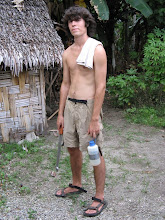
So, now that I've left Mangaliliu, I think it's finally time I post some pictures of the place. Enjoy


My Host Family (Thelma and Wari are the parents. Coco is my older brother, Samuel is the younger, and Susan is my sister)


My House


Dining Room


Shower


Toilet

I'll add some more to this post shortly, but uploading takes forever, so it will have to wait for another day.


Life in the Ring of Fire Part 9: A Brush With Death

Sometimes it's hard to remember when I didn't watch the sunset over the Pacific Ocean every evening. On Monday my life had pretty devolved into that of a beach bum. Class had let out early because the people teaching us were as sick of it was we were. I spent a solid two and a half hours watching the sun's slow plunge into the ocean. It was a somewhat cloudy day, which always leads to better sunsets. Rays of sunlight wormed their way out of holes in the clouds, breaking free in fabulous multi-colored bursts. A rainbow was visible along the horizon, and as the sun neared the end of the journey it lit up low-hanging clouds like a Halloween jack-o-lantern. There's a tourism advertisement in Vila that I walk by every time I go in. It reads: “So many call it paradise, we call it home.” Paradise, I think, is a relative term. It's a place we can read about in travel books and sometimes visit for a few days when finances allow, but if you try to move in it inevitably turns into something of a drag. While watching the sunset, my gaze kept wandering back to the small coral road that separates the beach from the rest of the village. Like a thirsty man seeing mirages in the desert, phantom taco trucks kept passing in front of my eyes, dispensing greasy barbacoa tacos piled high with salsa and enormous glasses of iced tea.

As swearing-in approaches, training has taken on that listless feeling of the last week of class before summer vacation. We complain about being bored while at the same time resent being given anything to do. There's a general feeling that nothing that's going on is really going to count, like when you figure that the material covered in that very last class will probably only be worth one or two points on the final. I've come up with all kinds of elaborate plans of things to do once I get to site, few of which, I know, will ever become reality. On Tuesday, the village began constructing a stage for our swearing-in ceremony down on the beach. This seemed rather unnecessary, as there's already a rather nice shelter a mere ten feet away, where we've been having class ever since coming to the village.

On Wednesday we were slated for another trip into Vila to visit the teacher's college. However, only one bus showed up to take us, and so me and a few others had to ride in the back of the Peace Corps pick-ip truck. Now, by this point I'd ridden in the back of many a pick-up and was pretty well acquainted with the usual discomforts and dangers of traveling in the truck bed. I climbed in next to a big stack of luggage that other volunteers were having carried into Vila in preparation for next week's move-out. The truck was about to move out when we had to pick up a few more passengers that couldn't fit in the bus. “Danny,” said one of my trainers (Ni-Vans have a hard time with names not ending in vowels, so my name tends to devolve into Danny a few minutes after I introduce myself to anyone), “climb up on top of the luggage to make some more space.” I looked dubiously at the precariously tall stack of bags, just barely shorter than the roof of the cab of the truck. Being a good sport, however, I clambered up. “No, no,” said another one of the trainers, casually swinging himself into a seat on the roof of the cab, “sit up here with me.” Already in too deep, I climbed up on the cab with him, carefully noting the nice, smooth surface of the roof and the lack of anything, really, to keep me from being swept off the speeding truck, should, God forbid, the driver decide to make a turn. Or slow down, or speed up, or perform any of the activities that one normally associates with driving. Now fearing for my life, I clamped down on the metal bar which framed the back window of the cab with all the strength and determination of a main character of a bad action movie who is forced to cling desperately to the outside of a flying helicopter to prevent the evil-doers from making off with his sweetheart.
Fortunately, the driver handled the truck with the patience and care approximately equivalent to that of a teenager given permission to drive his father's Porsche on the autobahn, and the road connecting Mangaliliu with Vila only had slightly more craters and potholes than the surface of the moon. “Ow.” I said, as I was clocked by a low-hanging tree branch a few seconds after setting out. It was the only noise I was to make the entire journey, as I needed all the concentration I could muster to will myself not to die. Facing backwards as I was, I was torn as to whether or not I should keep an eye out over my shoulder on the road ahead. Doing this afforded me the benefit of seeing where we were going, allowing me to duck at the appropriate moment to avoid further trees. The downside, of course, was that I could see where we were going, and my brain definitely did not always appreciate being informed of the fact that, for example, we were descending the Hill of Death, a section of road almost steep enough to require ropes and harnesses, and that the truck was currently not showing any signs of possessing brakes. In the end, however, I did arrive at my destination, unharmed except for the fact that it would prove difficult for me to unclench my hands for several days.

At the teacher's college we sat in on a workshop being given by JICA, sort of like a Japanese Peace Corps, on early math education. The audience was mostly made up of current Ni-Van teachers. The main focus of the workshop was math teaching techniques, but it was obvious that a lot of teachers present also needed training in basic math. The most striking example of this was when they were covering perimeter. The presenter drew up a 3-4-5 right triangle and labeled the lengths of two of the sides, but left the third to be deduced. He asked the class what the perimeter of the triangle was (12). The class which, keep in mind, was composed of current math teachers, started shouting out random answers, ranging from 3 to 18. To solve this problem you need to know the Pythagorean theorem, which a lot of the teachers obviously didn't. That, however, wasn't what was surprising about the situation. The Pythagorean theorem is, after all, just a formula, something that you either happen to know or not. What was somewhat disturbing was the fact that most of the teachers didn't realize that they didn't have enough information to do the problem. Someone just piping up and saying “I don't know how to find the missing side” would have been a huge improvement over random guessing. Also, a lot of guesses just didn't make any sense. Guessing 3, for example, is obviously wrong as the sides whose lengths were given already added up to more than 3. All in all, a very interesting experience.

After our observation, we headed back to the Peace Corps office. The following day was Thanksgiving which, like Halloween, obviously isn't celebrated in Vanuatu. Also like Halloween, we decided that we were going to put on our own Thanksgiving party. I'd somehow been talked into volunteering to make the pumpkin pie along with Laura and McKenzie, and so I headed over to the supermarket to get supplies. A couple minutes after entering the store, I realized that it was going to be a difficult undertaking. A lot of key ingredients were missing, including, for one, pumpkin. There are a lot of things which are called “pumpkin” in Vanuatu (it's kind of like the generic name for all squash) and a selected a couple that looked vaguely like what I would call a pumpkin back home, hoping that them having an appearance similar to pumpkin would translate to them having a taste similar to pumpkin. Pie crusts were also lacking, and while I new that one could make them from scratch, I had no idea how to do this. Instead, we purchased a lot of danish butter cookies and a lot of margarine, hoping to make something similar to a graham cracker crust (there weren't any graham crackers, of course). There also weren't any pie dishes to be had which, I decided, would have to be a bridge we would cross when we came to it. Whipped cream deemed unnecessary, mostly because it cost about $10 a can, and these pies were already costing us about $40, mainly due to the fact that evaporated milk was $6 a can.

After class on Thursday, we set to work trying to craft a pumpkin pie. Class had gotten out early, which was good, because it quickly became clear that our cooking project was going to take forever. For starters, we needed to steam about 3 pounds of pumpkin over what amounted to little more than a camp stove. The crust also took a while, although it turned out pretty well, except for the fact that we ran out of margarine and had to borrow some from McKenzie's host family, making me feel somewhat bad about mooching things off of villagers in an underdeveloped country. The search for pie pans was also abandoned in favor of the more plentiful roasting dishes, meaning that our pumpkin pie would be rectangular. After the pumpkin was done steaming, we skinned it and mashed it. The recipe that I'd downloaded from the internet suggested using a Cuisinart for this, but we had to settle for forks. Finally, the batter was done and the pies were in the oven (a generous term for a small box with a butane burner in it), which didn't pack nearly enough of a punch because the pies were still good and liquidly a good ½ hour after the suggested cooking time had elapsed. Progress was also temporarily halted half way through as the oven ran out of fuel and we had to switch the operation of Ryan's family's oven. In the end, however, something similar to pumpkin pie (if a little undercooked) was produced.

That night's feast was awesome. I'd kind of forgotten what it was like to be in the presence of more delicious food than I could possibly eat. In lieu of turkey (only in America, sorry) one of our number had prepared an enormous rid-roast which, because a lot of our group are vegetarians, I got to eat most of. Nachos were also present which, being topped with both olives and guacamole, were probably the best thing I'd tasted in several months. After eating myself into oblivion, we watched “Charlie Brown Christmas,” which is always nice, and then hit the sack.

On Saturday, we took a field trip to Hat Island, which is a small island just off the coast of Mangaliliu, and is the last resting place of the infamous Roi Mata. According to custom, you're not supposed to make any loud noises on the island or else you'll either get permanently lost in the bush (an impressive feat on an island that you can walk across in less than 5 minutes), or the Ocean will become so choppy that you can't get back to the village. Someone must have been shouting up a storm the night before, because we woke to a rainy and windy morning. Now, in the US you might associate the words “rainy” and “windy” with the word “cold,” however, in Vanuatu this is not the case. As we are all learning, it is entirely possible for a day to be rainy and miserable and hot as all hell at the same time. At any rate, after a baking boat ride over to the island (how can it be baking if the sun's not out? I really have no idea, but it happens here), we paid our respects at Roi Mata's grave and then hit the beaches. Me and Dennis elected to go crab hunting along the coast with some of our Ni-Van guides. Crab hunting works as follows: you get a group of 8-year-olds to run along the rocks by the ocean and another group to follow along in the surf. Running along the rocks scares the crabs, causing them to scamper into the surf where they can be picked up and put into a rice sack. Me and Dennis' role in the whole thing was a little unclear. While the kids were quite adept at picking their way through the surf, trapping crabs underfoot and deftly nabbing them off the rocks, most of my energy was focused on trying not to slip on a rock and fall on my face. I think I probably was able to catch a grand total of two crabs during the whole hour-long expedition, but our guides came back carrying two bulging bags full.

While I'd been busy crab hunting, some others in our group had gone spear fishing and had brought in quite a haul. I was instructed to go get my pocket knife in order to learn how to scale and gut a fish. This turned out to be a lot easier than I expected, and soon we had a large pile fish ready for cooking. We made a fire on the beach and our guide demonstrated two fish-cooking methods. The larger fish we speared through the mouth with sticks and placed near the fire, kind of like roasting marshmallows. The smaller fish we wrapped in leaves and tossed in the coals. Limes were thoughtfully provided by the nearby lime tree and, although I definitely could have gone for a garlic or onion patch or something, it was probably some of the best fish I'd had since entering the country. For a place completely surrounded by ocean, I'd been eating a shockingly large amount of canned tuna.

Upon returning from Hat Island, we discovered that we were down another man. Dale, who'd been down with a bad infection for the past few days, had decided to call it and had been moved to a hotel in Vila until he was well enough to catch a plane home. I don't think I'll ever get used to people in our group going home. The speed at which Peace Corps gets people packed and out of here has such disturbing finality to it. It kind if makes me feel like a contestant on Survivor, anxiously waiting to see who's going to be voted off next.

On Sunday we all chartered a bus into Vila to say goodbye to Dale but, as usual, the bus was late in coming to pick us up and so we were left with some free time in the “city.” I can tell I'm starting to go local because every time I go into Vila I feel like I have less and less I want to do there. At the beginning, I'd spend hours on the computer and almost as long in the grocery store considering what snacks to buy. Now, I go head out to a restaurant for a quick burger and fries, quickly download my emails, and grab a couple bags of chips. The whole process probably takes me less than half an hour, and I'm left sitting idly around the Peace Corps office looking for something to do.

Upon our return from Vila, we were informed of the presence of a tropical depression in the area when the sky opened up and an almost biblical amount of rain was dumped on Mangaliliu. The roads quickly turned into muck and I arrived back at my house looking like I'd fallen into a very muddy lake. The tin roof of my house was pleasantly waterproof, but translated the falling rain into a deafening roar over which it was almost impossible to hear anyone talk. I'd just settled in to watch a nice Chinese bootleg DVD with my host siblings when Ryan appeared in my doorway, shirtless and soaking, to inform me that his family was throwing him a going-away party and that a plethora of cheese-garlic bread, pasta with tomato sauce, French fries, and Champagne (which, we later learned, Ryan's host papa had to bribe a shopkeeper into selling him on a Sunday) was available for our consumption. It was quite the night, listening to nature vent its fury while eating wonderful (at least, relatively speaking) American food and drinking Champagne. I had no idea what was on the slate for the following day, but I prayed it wasn't more class.

Tuesday, November 20, 2007

Life in the Ring of Fire Part 8: First Casualty OR There's a lot of Important People Here, Could you Please Put on a Shirt?

Monday training switched up a bit. We were now in “technical training week,” during which we were supposed to be learning practical skills. I'm not entirely sure why we weren't doing practical skills from the beginning, but whatever. We started off the morning with everyone talking briefly about their sites. It was cool to hear what everyone had to say about their walkabout experiences. As it turned out, I had a pretty deluxe site. Twenty-four hour electricity alone was a rare commodity. The week after walkabout, we were told, is generally a time when a lot of people re-assess their ability to do Peace Corps, and some people go home. There were certainly some volunteers in our group that had had a tough time. Boredom was a common complaint. We'd all thought that life on Efate was pretty damn slow, but compared to the pace of things on the outer islands, Efate moves at a break-neck pace. The two volunteers who had gone to Tanna were particularly hard-hit by this. Like I've mentioned before, Tanna is a very traditional island, where people still live off the land more or less like they've been doing for the past few thousand years. Also, since Tanna is a volcanic island (as in, it still has an active volcano on it) the soil is ridiculously rich and thus living off the land doesn't take much effort. “People in my village literally do nothing.” Chris, one of the Tanna volunteers, told us. It's difficult, especially for Americans, who are used to hectic lives and often would jump at the chance of doing nothing for a while, to anticipate just how trying boredom can be on a person. It's something we've all dealt with somewhat since coming here, and I think we've all more or less come to the conclusion that doing nothing is only fun when there's something that you should be doing.

Another volunteer had come back literally covered with mosquito bites, to the point that one of the Peace Corps nurses suspected that she'd caught chicken pocks, and was determined not to return to her site. At first, I though this was something of an extreme response to a mosquito problem, but then I remembered back to some stretches of the AT that I'd been through where I was being swarmed by mosquitoes and wanted nothing more than to book it out of there.

After debriefing, we split into our assignment groups. The Vanuatu education project has three branches: Teacher Trainers, Math and Science Teachers, and Rural Trainers (kind of like vocational school teachers). I am one of three math and science teachers, which put me in a group learning various math-teaching techniques led by a volunteer who's been teaching here for a year and uses the f-word at least once per sentence. These math-specific classes were a little more entertaining and potentially useful than a lot of trainings that we'd had, which was good. That night me, Ryan, and Alyssa stayed up waiting for Elin, the last of our number, to return from site. Flights off her island had been canceled indefinitely because nobody wanted to cut the grass on the runway, and thus it had become unusable. She ended up having to take a boat to another island and a plane from there back to Efate. She didn't get back to Mangaliliu until 9 or so at night, but had managed to bring home 10 beers from Luganville. Of course, lukewarm beers are a crime against humanity, so we still needed a source for ice, but at least we were halfway there.

I'd received a few mosquito bites while in Malakula, and I had made the mistake of scratching one open. While, normally, this might not be that big a deal, you have to remember that bacteria, like people, also need a place to go on vacation, and Vanuatu is one of their favorite spots. The tiniest cut or nick, if not soaked in iodine and smothered in antibiotic ointment, will quickly turn into an enormous, gaping, pussy, fly-infested hole that takes weeks to close up. We're actually issued oral antibiotics in case we contract blood infections from scrapes. This is, we were told, not that uncommon an occurrence. At any rate, my tiny mosquito bite had blossomed into such a monstrosity, and so I lathered up in iodine and squeezed out the contents of several ointment packets before heading to class. I think we'd all started counting down the days until swearing in. I was getting tired of being stuck in the limbo of the training village and took to occupying my time by planning out home improvements, culinary exploits, pastimes, and hobbies to try once I got to site. The first two months after swearing in, December and January, are school holidays and are supposed to the be the most mind-numbingly boring times we were to encounter, so I figured I'd need some entertainment ideas at my disposal.

On Wednesday Ryan's host papa was headed to Vila, and so we arranged for him to purchase some ice and more beer for us, so we'd have a good collection of cold beer for Thursday night (and yes, planning parties for Thursday nights still reminds me of Princeton). On Thursday afternoon, however, we suffered out first casualty. Samantha, who'd been attacked by mosquitoes on walkabout, hadn't been able to convince Peace Corps to change her site, and so decided to head back to the states. In a surprising turn of events for Vanuatu, Peace Corps was shockingly efficient at getting her out of the village and on a plane as soon as possible. We cost them money every day we're in country, so I guess they don't want us hanging out any longer than necessary once we've decided to call it quits. They had her packed up and headed to Vila before lunch, and she was slated to fly out on Saturday. We all said our goodbyes, had a group hug, and went through the other standard niceties. The whole thing was actually surprisingly depressing. We'd all developed a pretty strong sense of family within our group, and seeing someone go got a lot of us down.

Thursday afternoon our village had a taboo ceremony. A variety of sea slugs, giant clams, and other assorted ocean mollusks were being released on the reef just offshore of Mangaliliu and the chief was declaring the whole area closed to fishing (taboo) until they had a chance to repopulate. A bunch of chiefs from a variety of nearby villages came to give speeches, as well as representatives from various sea-related government ministries and organizations. I was sitting on the beach with Ryan, watching the proceedings. One of our trainers wandered up to us. “There's a lot of important people here today,” he said, addressing Ryan, “could you please put on a shirt?”

In addition to giving speeches, an important part of any ceremony in Vanuatu is killing a pig. It's kind of like how no agreement in the US is official unless everyone has signed the contract. Here nothing is official unless a pig has been clubbed over the head with a wooden mallet. Needless to say, if you're a pig, Vanuatu would definitely not be the place to raise your children. Also an integral part of any ceremony, kava and food were served and we all partook. After dinner we headed over to Ryan's house to enjoy some frosty brews. It's amazing how something as simple as frozen water can seem so wondrous and amazing. Like taking a hot bucket shower on a cold morning, drinking a cooler full of frosty beers represented an almost criminal-seeming defiance of the second law of thermodynamics, for which I expected to be reprimanded by the entropy police at any moment.

Saturday we were slated to go into Vila for a cultural festival and to watch a FIFA World Cup qualifier match between Vanuatu and New Zealand. Unfortunately, this meant we had to catch a bus into Vila at 7 in the morning, which was starting to seem earlier and earlier as I got more and more used to sleeping through the roosters and dog fights which take place in the early hours of the morning. The cultural festival involved a display of custom dance and dress, and, surprise, surprise, the killing of a pig (our chief's second pig of the week), and kava. Given Vanuatu's heinously hot and humid climate, “custom dress” is usually more or less equivalent to “naked.” Those of you who've been to Disney World have no doubt noted the peculiar European tendency to wear slacks and long-sleeved shirts no matter the circumstances, as it is always possible to pick out the tourists from Europe in the sweltering south Florida sun by the in appropriateness of their clothing. One can image their reaction when they came to Vanuatu and saw the scantily clad natives. “But of course!” They said, slapping themselves on their foreheads, “When it's HOT we can wear LESS clothing!” However, rather than admit this rather embarrassing centuries-long oversight, they decided instead to use their cannons to force the hapless Ni-Vans to share their mistake. Probably the most infamous member (no pun intended) of the Ni-Van custom dress code is the “namba,” which is a woven grass tube that men use to cover their penises. These are fastened to the body using grass rope around the waist. Another grass rope is used to secure the namba to the stomach, permanently in the up position. Apparently the penis was the only body part deemed necessary to cover, as all other clothing is lacking aside from the namba and two pieces of rope (try that one out for “Three Pieces of Clothing Night”). On Malakula, variation in namba size led to the creation of two quarrelsome tribes: the “Big Nambas,” or “Overcompensaters,” and the “Small Nambas,” or “Those Comfortable with Their Manhood.” Over the centuries both tribes gained reputations as fierce warriors, despite their relative nakedness, and were responsible for the consumption of many a missionary and slaver.

After the festival, we headed over to the stadium for the game. One of our number had taken the opportunity to stock up on wine to take back to the training village and was carrying it around with her in her backpack. At the gate, our bags were searched and she was told she couldn't take her wine inside the stadium. “I won't drink it inside,” she promised. “Well, OK,” said the security guard. I love Vanuatu. To be honest I was surprised they even bothered to hire security. Not going to lie, I was a little disappointed to see the Vanuatu national team wearing regular soccer jerseys. I was secretly hoping that instead of the standard polypropylene jerseys, that they'd be decked out in matching Hawaiian shirts (the style of choice for Vanuatu) with their numbers in acrylic on the back. Vanuatu put up quite a good fight, but ended up loosing 2-1 in the last five minutes of the game. To be honest, however, both team's play was a little disappointing, nowhere near as fluid, organized, or impressive as soccer I was used to watching. I guess that's what you get when you only watch the world cup games.

Two of our group had birthdays on Saturday, so that night we arranged to stay in Vila for dinner and cocktails. A good time was had by all and we wrapped up the night with our usual bonfire on the beach. We only had a few weekends left together as a training group and we had to live them up. Sunday I slept until 10:30, a record for me in Vanuatu and spent most of the rest of the day laying in my hammock. All in all, a weekend well spent.

Friday, November 16, 2007

Life in the Ring of Fire Part 7: Malakula

Monday, my first day of class at site, I awoke to the sound of people beating on empty metal gas canisters, the first bell, signifying that school was to start in half and hour. For breakfast I had freshly baked bread, which I was to discover was made by my uncle in a large stone oven. The oven was about as big as I was with a small opening for baking. The interior is filled up with hot coals, which they let burn out, thus heating up the stone. Then they scrape out the ashes and put the bread in to bake. It comes out quite delicious, and I was definitely looking forward to swinging by ever y morning during service to score some hot bread. After breakfast, I made my way to the school, which was only a 5 minute walk away. It wasn't long before I was put on the spot: the entire school had been gathered in one of the classrooms for an assembly. I was introduced and asked to give a short toktok (speech). This went over fairly smoothly. To be honest, I don't think it would have mattered what I said. After the assembly I went to observe year 8. The Ni-Vanuatu education system is weird. Anyone who can pay school fees is welcome to attend years 1-8. However, after year 8, there is a national exam. Students that do well enough on the exam can go on to years 9-10, where they must take another exam to get into years 11-12, where they have another exam to get into year 13, where they sit a final exam to go on to University. If a student fails one of these exams, they're out of the school system. They are not offered to chance to make up the grade and then re-take the test. To be fair, however, the school system really does lack the resources necessary to accommodate students repeating a grade. In any case, the year 8 exam was only a week away and so the kids were having a review week. This was more or less the worst time for me to come observe, as all that was happening was that the kids were taking practice tests. Unfortunately, the year 7 class was also doing a review because, even though they weren't sitting a national exam, they still had a school-wide test. I would later learn from another volunteer that teachers will often use the excuse of doing review to get out of teaching.

The school itself was very surreal. The buildings were mostly made of bamboo, with cement floors and tin roofs. Most of the cement floors, however, were cracked or contained large holes. The tin roofs also meant that the building heated up like nothing else during the afternoon. I made a mental note that when I was teaching we would be having class outside as frequently as possible. The photocopier at the school (well, I guess at least they have one) was out of toner, and a new cartridge wouldn't be in until January, so the teacher had to write test questions on the board for students to copy onto their papers and then answer. Ni-Van students are obsessed with copying. From my time observing class in Vila, I had gathered that most of the early grades consisted entirely of copying material into notebooks from the board, so I guess by the time they get to year 8 they're really good at it. I saw the whole class spending all kinds of time painstakingly making pen borders for their papers, copying the figures and text perfectly and neatly, and then not answering the question. Talk about taking “neatness counts” to the next level. Unlike in Vila, however, the students in Tautu school all suffered from crippling shyness. The class was usually very quiet, and calling on a student to answer a question usually prompted them to very purposefully look at the floor and mumble.

Since there was nothing being taught, I didn't get a chance to teach a class, but the year 8 teacher did ask me to write up some practice test questions about perimeter, area, and volume. I came up with about 15 questions and wrote them up on the board. The students dutifully copied my crooked figures (I decided neatness doesn't count for teachers) onto their papers, drew their borders, and got to work. After about an hour, everyone handed their tests into me. I looked over them and graded them quickly. Out of fifteen, I think the highest score was 3. Obviously something had gone wrong somewhere. I looked through the papers again and saw what the problem was: most of the figures that I'd given them to find the perimeter, area, and volume of usually weren't fully labeled. That is, I didn't specifically write down the side lengths of each side, but left some sides blank to be deduced from properties of the shape (ie. I drew a square and labeled the length of only one side). What had happened was this: to find perimeter the kids added together whatever numbers I had happened to write down, and for volume and area they'd multiplied them. I was at something of a loss for words.

When the year 8 teacher came back, I handed him the tests and asked him “Do the kids speak English?” (all classes are given in English). “Some do, but not very well.” Right. The teacher looked over the scores of the students and proceeded to scold them for their poor marks and not working hard enough. That was probably the worst I'd felt in a long time. “It's not their fault!” I wanted to shout, because it obviously wasn't. They were being tested on something which they had not properly learned. The point that had been repeated so many times in training about not jumping in and starting to do things too quickly was finally driven home. For the rest of my time in Tautu I refused all requests to make up test questions.

After school I went down to the cool of the beach to read before heading back home to socialize at the nakamal. In stark contrast to Mangaliliu, where a swarm of people would follow me wherever I went, I was more or less left alone as I sat on the beach. It was a very nice experience, and I hadn't realized how much I missed it, but it also left me somewhat concerned that maybe everyone else had run inland to avoid a tsunami or something and had forgotten to tell me and that I was about to be washed away by some enormous wave.

On Tuesday I went to school in the morning, but left after the lunch break because I was getting really bored of watching kids take tests. I walked up to the town of Norsup to get a look at the hospital and the cattle plantation that was supposedly nearby and was rumored to sell beef for $3 a kilo (BBQ, here I come). On the way, I ran into the French Army, who had apparently decided to come on over from New Caledonia in order to build a branch on the University of the South Pacific on Malakula. There did indeed seem to be some sort of structure under construction, but to be honest it looked more like I'd wondered onto the set of a porn movie. There were a large number of well-muscled Frenchmen wandering around wearing shorts that extended maybe 2 inches down their legs, and no shirts. I even saw a couple cowboy hats. Most everyone was carrying around a hammer or some sort of construction implement, but no one really seemed to be doing any actual work. It was all I could do not to point and laugh. I would later hear about the French at the nakamal. Some of the villagers in Tautu had been hired to cook for the soldiers and were criticizing the French for constantly complaining about the food they were served, and always demanding something different. Even those villagers who had not been hired to cook were generally annoyed that the French would never even try to respond to them when they greeted them on the road (keep in mind that because of the joint colonial rule of both the French and English, a good number of them do, indeed, speak French). As I cleared the Army base and continued up the road to Norsup, two kids came up to me and asked “Are you one Army?” “No,” I said, “I'm Peace Corps.” We're more polite and our shorts are longer.

On Wednesday I went with my host mama to a nearby town to see a wedding. This wedding was honestly one of the most depressing things I'd seen in a long time. A lot of marriages in Vanuatu are arranged, and it was obvious that both of these (it was a double marriage) had been. Both couples acted like awkward middle-schoolers at their first dance. When they were sitting next to each other, they looked very painstakingly in opposite directions. Their vows were said in a whisper, all while avoiding eye contact. Needless to say, there was no kissing. After the church ceremony there was the exchanging of the yams. In order to get married in Vanuatu, the groom must “buy” the bride from her family. Traditionally, this is done with a combination of either woven mats, pigs, or yams (although the more modern man might pay currency, or even phone cards). These families had decided to go the yam route. Now, when you picture a yam, you no doubt image the small, potato-like tuber you regularly encounter at the grocery store. Sure, it's a little goofy looking, maybe a little longer and pointer than the average potato, but it's something that's definitely recognizable as having originated on Earth. What they don't tell you, however, is that these are domesticated yams. House yams, if you will. These yams have been to several weeks of obedience school and have properly learned how to heel and not poop on the floor. In Vanuatu they have wild yams, and wild yams are about as similar to domesticated yams as Alaskan timber wolves are similar to those little fur-puff dogs that yap a lot. When I exited the church and went to explore the village I, for the first time, witnessed the awesome power of the yam. This yam was so huge (no joke) that it rested on the shoulders of no less than 8 grown men. It had also long ago decided to leave behind the all-to-constraining basically-cylindrical shape of the basic yam and branch out with a large number of enormous bulbous protrusions that looked like some sort of alien egg-pod from which, at any moment, a small yellow creature would emerge, latch onto my face, and slurp my brains out through my nose like a 7-11 slushy. A complicated bamboo support structure had been constructed around the yam to provide support to these protrusions so they would not fall off during the transport process. It was probably the most intricate and impressive piece of engineering I'd seen since entering the country.

Still recovering from my close encounter with The Yam, I took a seat under a tree with Andy and David and sampled some Ni-Van wedding cake which was, I gotta say, not very good. We watched everyone shower the unhappy newlyweds in talcum powder, because, I guess, they'd used up all the rice making the wedding lunch. After lunch (which consisted of rice, and not much else) we dropped off Andy at the airport, as he was going to visit a girl he'd met in Luganville. The plane, we were informed, was late, so we headed over to the waiting room, which was the beautiful sand beach directly across the road from the airport. Aside from the risk of firebombings, I think I can learn to love Ni-Van airports.

On Thursday, I had my first opportunity to observe a science class. The class was mysteriously titled “Basic Science,” which was helpful in that it gave absolutely no hint as to what would be taught. They, of course, were doing review tests, but I took the opportunity to look through the course books while the students copied from the board. The lesson books were literally packed full of experiments that the students were supposed to perform. Some of them were simple enough, but many required materials that were clearly not available at Tautu school, if even in Vanuatu. One experiment called for dry ice, another for a variety of glass lenses. “Do you have the materials to do these experiments?” I asked the teacher. As expected, he told me that, no, they did not. I asked him how they dealt with this. “Well, we just have the students memorize the experimental setup and the results that you would get if you were to do it.” I had to check to make sure my mouth wasn't hanging open. I was almost tempted to try and explain that this completely missed the point of science as a discipline (that, in fact, this was almost the opposite of science), but I remembered my experience with the practice test I'd written and so I kept quiet.

Friday was my last night in Malakula, and I was not feeling very excited to go back to training. After being kept on a tight leash for almost two months, it was such a relief to be cut loose on my own, if even for a week. In celebration of my departure, however, my host papa broke into a freshly brewed batch of home brew. Home brew, which, I guess, is basically moonshine, is the alcoholic drink of choice in Vanuatu, considering how expensive store bought alcohol is. Some home brew is simply sugar water into which bread yeast has been dumped and then let sit for 2 weeks. My host papa, however, had taken things up a notch. He had used actual brewer's yeast (bread yeast home brew, I'm told, tastes disturbingly like bread) and coconut water to add some flavor. I'd heard from other volunteers that pineapple and mango also make good additions. I had been warned against the awful taste of home brew, and so I was pleasantly surprised when it did not, in fact, taste like ass. It actually probably tasted about a thousand times better than kava. I made a note to myself to look into making my own home brew for my time at site.

Saturday I met up with Laura and McKenzie, the other two volunteers that had flown in with me, and we went through the same haphazard airport procedures as we had on our outbound journey, except made all the more ridiculous by the fact that they were taking place in a building which had been firebombed and never repaired. Instead of collecting the luggage that we were checking, we were instructed to place it ourselves on the luggage cart to be taken to the place. The plopped my bag down and was instantly rewarded with a lot of violent squawking. It was then that I realized that someone on the flight had decided to check a burlap sack full of live chickens. Thus intrigued, I took a closer look at what other passengers were checking and discovered a large number of yams (nothing like The Yam, of course, but yams nonetheless), and a number of kava roots, which look kind of like yams, except they smell a lot worse.

It was raining, so we were all glad of the concrete runway when our plane was actually able to take off somewhat on time. Back in Vila, the “big city,” if you will, we headed back to the Peace Corps office. Some other volunteers were already back from walkabout and while we waited to head back to the village more trickled in. I felt pretty lucky that I had enjoyed my time at my site. Some people looked mighty shell-shocked, and some people even looked to have lost a good deal of weight. That night, Ryan, Alyssa, and Evelyn invited me to stay in Vila with them to recover before heading back to the village on Sunday. I didn't really feel like I had anything to recover from, but I took them up on it, and it was good to have one last night of cold beer before returning to the prohibition zone of our training village. Sunday we got a ride back to Mangaliliu and, after talking briefly with my host family and other volunteers that I hadn't managed to run into yet, I slept most of the day. Over dinner, one of our number was telling us about his experience in middle-bush Tanna. Middle-bush Tanna is one of the few places in Vanuatu where traditional life still prevails. People still follow their old customs, live off the bush, and have little need to currency or other niceties of western civilization. Upon his arrival in Tanna he was instantly given a custom name, because, obviously, his western name of "Noa" would not fly in middle-bush. Thus, the people of his village proudly dubbed him "Tom."

One of the staff informed us that we were a record breaking group: all of us made it to walkabout on time (ie. no flights were canceled) and only one person was still stuck at site, Elin, whom we all felt sorry for and looked forward to seeing on Monday.

Life in the Ring of Fire Part 6: A Change of Pace

My last week in Mangaliliu kicked off, as usual, with class. By this point, all of us had gotten quite sick of going to class and really wanted to either get to site or just hang out in the village. We were, however, given an interesting lecture (there's usually one really good one a week) about land in Vanuatu. When Vanuatu gained independence, all land in the country was supposed to return to its “custom” owner. Meaning the village, tribe, family, etc. that had owned it before the colonial government. The problem with this, as you might be able to guess, is that it's often not easy to figure out who the custom owner of a piece of land is. All history is oral history and is thus prone to the usual inaccuracies or has been forgotten. Because of this, almost all court cases currently under consideration in Vanuatu are with regards to land. There has even been some violence around Vanuatu related to land disputes. To me, however, what's more troubling is the growing problem of development. Land developers are starting to push pretty hard, especially on the island of Efate, to buy up land from the Ni-Vanuatu. Developers will often offer something on the order of $20,000 for a stretch of beach. This is a huge sum of money for most people and sadly, this has tempted many Ni-Vans to sell their land. We're actually in the middle of such a land crisis right now in Mangaliliu. There are developers pushing to try to make a resort down by Mangas beach, our favored weekend getaway and historical site of Chief Roi Mata's village, as well as up by Survivor beach. This involves both cutting large roads near Mangas as well as through many of the villager's gardens. The potential destruction of an important cultural site aside, I personally would be quite upset to see such a nice and peaceful stretch of beach turned into a resort. Fortunately, the chief of Mangaliliu has block land sales. Unfortunately, some of the developers have been trying to go behind his back and get people to sell anyway. In one such incident, an Australian got one of the villagers good and drunk in Vila and talked him into selling the island on which Roi Mata is buried. Oops. On Monday one of the villagers was driving through town showing off his new truck, the obvious conclusion being that he'd sold some land in order to be able to afford it.

It's a difficult road to walk, because many Ni-Vans welcome the opportunity to sell their land in order to buy cars, generators, TVs, etc. and it's not really our place to tell them that they shouldn't. On the other hand, Vanuatu sometimes seems like a house of cards ready to fall over. The selling of land breaks up village communities as people move to the cities. However, it is the strength of village communities that holds back problems such as hunger, poverty, and homelessness. The influx of money into a community from land sales often also disrupts the power of the local chiefs. However, in the absence of any law enforcement, Vanuatu relies on chiefs to maintain order in the outer islands. To me, it seems impossible that unchecked development can continue without causing major problems in the country, possibly leading to instability such as that found in Fiji, The Soloman Islands, or PNG. I sometimes feel stuck in the classic “the grass is always greener” problem: Ni-Vans envy the amenities and luxuries of a more developed country, while I envy the peacefulness and freedom of their life.

On Wednesday we got our final site announcements. Granted, I'd pretty much known where I was going for several weeks, but it was nice to get it in writing. My next two years are indeed slated to be spent on the island of Malakula, the second-largest in the country. Those of you familiar with romance languages can probably recognize the peculiarity of this name: “mala” meaning “bad” and “kula” meaning “ass.” Why would you name an island “Pain in the Ass?” you might ask. The story goes that French missionaries arrived on the island and began preaching to the natives. The natives, however, did not appreciate this very much and rather wished that the French would leave. However, they considered it rude to ask visitors to leave, and so they took the passive-aggressive route. They tricked the missionaries into using poisonous leaves as toilet paper, giving them all nasty rashes on their butts. The French left, cursing the island and giving it its name. Granted, this story is widely believed to be apocryphal, but even if it's not true, it certainly should be.

Aside from having an interesting name, Malakula is also known as the island where the most recent incidence of cannibalism took place, back in the 1960s. The implication of this fact, of course, is that there's a possibility that some of the people present at this nefarious cook-out might still be around and thus I might get the opportunity to ask if people do indeed taste like chicken. Cannibalism, like many of Vanuatu's customs, was something the missionaries decided had to go, if not from personal distaste, then at least over concerns for personal safety, as visiting Europeans were often the ones that went into the cooking pot. I gotta say, it is pretty tempting to side with the missionaries on this one. However, given that the diseases brought over by Europeans would eventually wipe out something like 80% of the native population (a loss which Vanuatu's population has yet to recover from), and that Ni-Vans were routinely taken as slaves to work on plantations in Australia or PNG, maybe the natives had the right idea on this one.

Wednesday was also Halloween, a holiday which is very much non-existent in Vanuatu. However, given that Wednesday was Vila day and we weren't back in the village until late, we decided to postpone the whole affair until Thursday, which was actually kind of fitting because (due to the ever-confusing international dateline) it was still Wednesday, and thus Halloween, in the US. While in Vila, I took the opportunity to stock up on chocolate and purchase a pumpkin from the outdoor market. Unlike in the US, where one must traipse through a hot, dusty, picked-over, pumpkin patch looking for that perfect pumpkin, only to discover that it costs upwards of $20, in the market pumpkins were littering the floors and cost about an average of a dollar a piece. Interestingly enough, at the French supermarket in town they also sell pumpkins, which they purchase from the outdoor market and resell a mere 100 yards away for several dollars more. Having procured my pumpkin, I noticed that something wonderful had happened: pineapple season had begun. The market was absolutely crawling with pineapples. I immediately purchased the biggest one I could find (it was probably actually bigger than the pumpkin I bought), and struck out for the Peace Corps office, an enormous piece of produce clutched precariously under each arm.

Thursday afternoon, we led the village kids in pumpkin carving in which, just like kids in the US, they quickly lost interest. The mamas, in turn, seemed very perplexed as to why you would want to do anything with a pumpkin besides eat it. I was forced to concede that this was indeed something of a valid point. More interest was garnered by the pinyata and the trick-or-treating, thus proving the fact that eating chocolate and hitting things with sticks transcend cultural boundaries. One of the more crafts-y members of our group rigged up a pinyata with cardboard and starch paper. It was a little overly reinforced, however, and proved to be resistant to the best attempts of all the village children as well as the chief, the Peace Corps country director, and other prominent community members. The village children were probably even more desirous of candy than kids in the US, if this is possible, and the ground was cleared of candy mere milliseconds after we had to rip the pinayta open. For trick-or-treating, we all set up mats around the community center, taught the kids how to say “trick-or-treat” and, of course, “thank you,” and had them make the rounds collecting candy. They quickly discovered what every American kid eventually discovers: that if you can hit house two, or even three, times you can vastly increase your candy haul. Unfortunately for them, this doesn't work too well when there are only about 20 kids in the village and they're all trick-or-treating in an area about the size of a soccer field. We decided to humor them, however, and everyone had good time. Tomorrow morning we heard reports that many kids, and even some mamas, had earned themselves horrible stomach aches from eating too much candy the night before.

Friday, tensions in our training group were palpable as people were more or less done with classes and anxious to get out to site. The day seemed to drag on forever, but finally we wrapped up and I threw some items into my hiking bag to take with on my week long expedition. Me and some friends spent our last night hanging out at Ryan's house playing spades (card games get a lot of face time in the training village). We were going to call it a night, it being around 9:30 and well past our bedtime, but, out of the blue, Ryan's host papa showed up from Vila with 10 cold Tuskers (the national beer of Vanuatu, named after the infamous twisted pig's tusks which are a symbol of wealth) and a bag of ice, both precious commodities in Mangaliliu. Thus, I ended up not getting home until midnight, which was nice considering I had to wake up at 4am the next day to catch my 6:45 flight.

Checking in for a flight in Vanuatu was a real treat. I handed them my ticket in exchange of a small slip of paper on which was scribbled a few incomprehensible words. This, it was explained, was my boarding pass. My luggage was weighed, and then I was motioned on to the scale. I saw a clerk carefully writing down the weight of everything going on the plane. I guess every ounce (or, should I say, gram) counts when you're flying a plane about the size of a SUV. I sure hoped the scale was accurate. There was a security check, which consisted of a guy handing out blue tags with the word “SECURITY” printed on them, which we were instructed to attach to our bags to show that they had cleared the security check. The plane took off more or less on time, which was kind of shocking considering how long everything takes around here, and landed a short 45 minutes later. I say short because, of course, I slept through the entirety of it. The airport in Norsup was very modern, by Vanuatu standards, meaning that it had a paved runway. This will definitely be a plus in the future when I'm trying to travel and won't have to worry about flights being canceled because the runway (ie. field) is too muddy, or some guy was too lazy to get out and mow the grass. The airport building also looked fairly modern, being a reasonably-sized concrete structure with a metal roof. It probably would've looked nicer, however, if it didn't have the appearance of being recently firebombed. A lot of the roof was missing, most of the walls were covered with scorch marks, and some walls had big holes in them. Later on, I was to find out that the reason that the airport looked like it had been firebombed was because it had been firebombed. By the chief of my village. Or possibly the guy who owns the electronics store, as part of a land dispute. We (I shared a flight over with 2 other volunteers who will be posted near me) were greeted by some of the current Malakula volunteers at the airport and taken to a pickup truck, where I met my host papa. We piled into the truck and were driven to our respective sites.

My site is situated more or less between Norsup, where the hospital and provincial education office are located, and Lakatoro, where the general store is. My village is called Tautu which, together with Lakatoro and Norsup, sort of forms a tri-village area in north-central Malakula. The whole area is covered in coconut plantations, as the main cash-crop is copra, a coconut derivative. There's a large dirt and coral road which runs up and down the eastern coast, and it is pretty big and well-maintained. Tautu is a fairly large village, and has such deluxe amenities as cell phone service (stay posted for my cell number) and 24 hour electricity. The village is very pretty and, although it is sweltering hot, there's a nice breeze coming off the ocean pretty much 24-7 which cools things down nicely. The general store in Lakatoro sells cold beer and cheese, the two staples of life, and is a short $1 truck ride to get to.

My host family had a fairly nice house, although it wasn't fully finished yet, so all the walls and floors were bare cement. The crowning glory, though, was that I walked in to find three ENORMOUS pineapples sitting on the dinning table. I instantly felt at home. After eating pineapple, I slept for most of the day, and actually slept through the tour of the village my papa had offered to give me. I woke to the sounds to kava being made outside. As it turned out, my papa runs a nakamal and sells kava. Now, this is both good and bad. The plus side is that my house is more or less like a bar, and if I want to meet people and get to know the community it's no more difficult than chilling in my front yard. The downside, of course, is that drinking kava is a gastrointestinal feat of endurance that my green American stomach is not yet really up to. I do, however, get free kava, as my host papa was quick to inform me that the kava business is in the family and that I should never attempt to pay him.

That night, in addition to a lot of random community/family members, I met the chief (who seemed really nice, all allegations of firebombing aside) and Andy and David, two Americans from Oklahoma who were actually brother and father, respectively, to a past Peace Corps volunteer and who came to visit Vanuatu and were never really able to leave. My host papa filled me in that they'd been spending about half their time in Vanuatu for the past few years. It was definitely nice to have some other English speakers to talk to, and I also had an opportunity to show off my Bislama, as Andy and David had been in the country for a good deal longer than me, and yet I had picked up more of the language.

Sunday I headed to church, where I stood outside the door and shook hands with about a billion people after the service. Much like Sundays in the training village, me and my family spent most of the afternoon by the beach, where I read a lot. I also got to take a look at my house-to-be, which was about 20 feet away from the beach. I was very excited to see the house. It had a raised cement floor, which is always a plus as it keeps the bugs out, but the walls and roof were made from local materials, which are a lot cooler during the daytime than the more “deluxe” tin roofs. I also have legit power outlets, not just the more typical power strips hanging precariously down from the ceiling. There's also theoretically running water because some guy from Israel came through a few years back and offered to install and electric pump and plumbing system if the village made him a chief. This seemed like a pretty good deal to the people of Tautu, so they let him kill a pig (the official chief-making pastime) and he, as promised, installed the water system. The only problem is that the electric pump, of course, runs on electricity, a lot of electricity, and the village soon racked up an electric bill in the tens of thousands of dollars. Obviously, they couldn't pay the bill, so the power company cut off service to the pump until the outstanding bill is paid. According to the villagers this should happen sometime in December, maybe before I come back, but based on my experience in Vanuatu I'm gonna go ahead and guess that it will be more around the time our sun collapses, sending billowing clouds of hot gases outwards, burning the surface of earth to a crisp, and making the whole issue moot. Not that I'm becoming cynical. Fortunately, I have a rain cistern to hold me over until them.

Tuesday, October 30, 2007

Life in the Ring of Fire Part 5: Fire Dancing

I'm going to kick off this blog entry with a few words of praise for chocolate. Chocolate is awesome. Occasionally one of the lecturers that come to talk to us bring chocolate to hand out to win our love and affection. We swarm a bag of fun-size snickers bars like ants attacking a cake crumb. In what's undoubtedly a sad state of affairs, Vanuatu has quite a number of cocoa plantations. In fact, it's one of their main exports. Unfortunately, it's not refined in country, so all chocolate candy has to be imported and thus is ungodly expensive. So yeah, chocolate is awesome. Especially ENORMOUS amounts of it. Incidentally, my mailing address is:

Daniel Moser, PCV
Peace Corps Vanuatu
PMB 9097
Port Vila
Vanuatu, South Pacific ;-).

Up to this point, I'd been quite lucky. Aside from a minor cold when I got to country, I'd been in more or less perfect health. That night I finally got what was coming to me. I woke up at around 1 in the morning knowing that I was about to hurl. I booked it out to my outhouse and let loose. I gotta say, as unappealing as the thought of throwing up into an outhouse might sound, it does make it a lot easier to get everything out in one go. The next day, Monday, I had a fever and was nausea and so spent most of the day sleeping. I felt a lot better by evening and by Tuesday I was more or less 100% again. I'm not really sure what set me off, but if I had to guess I'd say it was probably the fried Spam I'd been given for dinner Sunday night (no joke).

Tuesday Kevin George came out to give us a talk, which was a welcome change as he is actually good at giving presentations. He started off by reminding us that we shouldn't be afraid to talk to him if we were having second thoughts about our service (so far no one in our training group has bailed). This prompted one of us to ask “Are you getting worried because none of us have left yet?” “Yeah, kinda.”

Kevin's lecture was about law (or the lack thereof in Vanuatu). Police really only exist in Vila and Luganville and so the power of the central government is somewhat limited. On the outer islands, disputes are generally settled by the local chiefs. This actually works surprisingly well. He told us one story though about how Peace Corps needed the police to make an arrest on one of the outer islands, and so they had to pay for the airline tickets of the officers to fly out there. Not only that, but they also needed to book an extra seat on the return trip for the convict. He also talked about the prison in Vila. He described the building and we realized we'd walked by it several times while we'd been in the city. The fences around the prison only come up to about waist height and so one could easily hop them. Apparently a little while ago there was a mass walk out where 80 or so prisoners just strolled on out. Fortunately, they were all apprehended a short time later at a nearby kava bar. You see, they weren't actually trying to escape, they were just going for a kava run.

On Wednesday I went into Vila to teach another couple lessons at Pango school. We pulled up to find all the kids out in the schoolyard playing various games. I walked into the office and one of the teachers that I'd been working with previously greeted me. “We have a small problem today. That's why all the kids are outside,” she said. Apparently feeling like she'd fully filled me in on the situation, she instructed me to sit down in the office and wait. I did as I was told and she wandered out of the office. A few minutes later the word had gotten around that I was at the school and most of the kids in the class that I'd taught the week before showed up in the office and started talking to me. I asked them why they weren't having class. They explained that the day before one of the teachers had hit one of the students. The kid had gone home and told his family about this. His parents, obviously, weren't happy, but being mature adults they decided that the best course of action would be to have the father go punch the teacher in the face. The teachers, obviously, weren't happy about that and so they decided to go on strike until the family decided to apologize. “Does this happen often?” I asked. “Third time this year.” Ah.

The kids invited me to play soccer with them and I took them up on it. We played for about a half and hour and then the bell was rung calling the students together. They were arranged in lines according to class and made to sit down outside. A very angry looking woman who I'd never seen at the school before came out and started to talk to them. You know the old saying that you shouldn't scowl otherwise your face will freeze like that? Well, that actually happened to this lady. I honestly don't think she would have been capable of smiling if she'd wanted to. She gave a fairly long speech in Bislama, which I was actually quite proud of myself for understanding most of. She went on an on about how hard it is to be a teacher and how much they were trying to help the community and then started scolding the students for taking their problems with their teachers home to their parents – where, according to her, they get blown way out of proportion -- as opposed to coming to talk to the headmaster. It was all very strange. If I'd been giving the speech I think the take home message probably would have been “can we please stop hitting each other?” But this point didn't really even seem to be covered at all. Lizzie, the other volunteer at the school with me, talked some with the teacher she'd been working with and discovered that these strikes can sometimes go on for weeks, with both the teachers and the family being to stubborn to apologize to each other.

Thursday I finally got a chance to break out my machete. We were tasked with clearing a patch of bush in order to start a community garden. The entire area was covered with thick creepers and the occasional small tree. The clearing process goes something like this: someone grabs a stick and uses it to tug up a patch of creepers, exposing the roots. A second person hacks at the roots with a machete until they come loose. You continue doing this until you have a huge pile of loose creepers, which you discard. You repeat the process until all the desired bush has been cleared. If you encounter a tree, you let loose with a machete somewhere close to the base until it falls over. It was actually a lot of fun, even if it did tear up my hands. After the bush was cleared, we needed to put posts to make a fence. I was sent out into the bush to fell trees with my machete. Needless to say, I felt quite the bad-ass. We set about building the fence, ramming the posts into the ground with brute force and lashing cross beams to them using the bark of a local tree as rope. An hour or so in, we realized that we didn't have enough wood to complete the project. It was getting late and we were all for putting it off until tomorrow, but the two Ni-Vans who were supervising wanted to finish that evening. They did a quick appraisal of the situation and concluded we needed 8 more cross-pieces. They struck off into the bush by themselves. We settled in to wait for a while, but a short 20 minutes or so they both returned, each carrying 4 perfectly straight, perfectly shaped, logs. I took a look around at the assortment of crocked, haphazardly-sized logs that we'd been using and had to laugh. I guess experience counts for something.

Friday was to be our last Friday in Mangaliliu before we all headed out to walkabout to visit our sites for a week, so we decided it was time for a party. It being Peace Corps, we had to kick things off with a round of yoga. It was actually pretty cool. It was a nice, clear night on the beach with a brilliant full moon. We were sitting on mats in a circle in the sand, each with our kerosene lantern in front of us. It was quite the scene. The yoga mood was all but ruined, however, when someone let loose with a huge fart during meditation and we all cracked up. We got a huge bonfire going and two people did fire dancing with pois, which are chains with burning brands on the ends that you swing around in cool patterns. I ended up staying up until 3am hanging out, a first since coming to Vanuatu.

Saturday afternoon was spent sleeping at Mangas, our beach of choice, and recovering from the night before. Mangas is definitely the nicest beach that we've found in walking distance, and it's an excellent place to sleep out the heat of the day. The one thing that bothers me about going to Mangas, though is that there are no bathrooms. Now, I have no trouble peeing in the woods, no, the problem arises more from the fact that the beach drops off into an archaeological site, the remains of the village of chief Roi Mata. Unfortunately, all the artifacts, be they taboo stones or remains of the ancient wall that used to encircle the village, look, at least to my ignorant western eyes, more or less like rocks. So I can never really be quite sure that the rock that I'm pissing on isn't in fact some powerful artifact, imbued with black magic capable of traveling up my urine stream and turning me into a coconut crab, like some hapless bum getting electrocuted by peeing on the third rail in the New York subway.

Sunday was another slow day playing cards on the beach. In the evening however, the DVDs of Survivor: Vanuatu were finally found (they had been on loan to somebody or something for the past few weeks) and we were all eager to watch it. It was hugely entertaining. In the opening scene a lot the villagers from our village paddle out in outrigger canoes to meet the contestants. They were all decked out in kustom garb and generally scared the shit out of the contestants. “They're actually really nice!” I wanted to shout out “And most of them speak English!” Another funny aspect is that they kept splicing footage from other islands into the show. They'll show everyone doing there thing out on the beach, and then pan inland and suddenly a volcano some hundreds of miles away will appear. It's also just awesome to see them trying to deal with island life: trying to open coconuts, complaining about the rain, drinking kava, eating island cabbage, because we've all done all of that at this point. And the Survivors only have to put up with it for 39 days. What wimps. Although we do get treated a little nicer. I guess there's something to be said for coming to a country to help out as opposed to trying to win a million dollars. Anyway, if any of you all get the chance, I'd suggest checking it out. All the beaches were the contestants live, the tribal meeting place, and the games are all within walking distance of my village, Mangaliliu. The volcano they keep showing is actually on Tanna, and a lot of the shots of the wildlife are also from different islands because most of the wildlife around here has already been hunted out.

Life in the Ring of Fire Part 4: Fowl Play

We kicked off the week with a lesson in chicken killing. Personally, I think it was just arranged just to give the rest of the village a chance to laugh at us. In Vanuatu, you don't keep your chickens in a pen or anything, you just let them wander around. This means that when you want to catch them, you have to run them down. This is a lot harder than it seems. I always had this mental image of chickens as fat stupid birds which had somehow narrowly avoided the evolutionary chopping block. This lesson quickly dissuaded me of that notion, because, while in the US chickens that you see may be fat and dim, wild chickens are FAST, and they can fly. Yes, chickens can fly. You guys may already be aware of this, but I certainly wasn't. They can't fly very high, or very far, but they can certainly fly over your head as you try to corner them against a house. So, imagine 23 Peace Corps volunteers running around the village chasing some frantically squawking chickens and failing miserably at catching them while all the villagers stood by doubled over in laughter. We had about 3 false starts where our chickens got completely away from us and booked it for the bush and we had to wait for them to wander back. Finally, some of the village kids took pity on us and caught them for us. Next obstacle was killing the chickens. When I first heard about this exercise, I was a little doubtful of my willingness to kill a chicken, but a few days prior I was trying to walk to class and was attacked by a chicken that got it my way. It was screaming and flapping its wings and trying to peck me and I instantly lost all sympathy for chickens. It also doesn't help their cause that the roosters wake me up every morning at 5am. Anyway, I actually did pretty well killing my chicken, unlike some members of my group, and after one good smack against a tree it was over. One particularly unfortunate volunteer tried to break his chicken's neck with a windmilling motion but he didn't do it hard enough or something, so he ended up with a squawking, flailing, bleeding ball of feathers that escaped and had to be re-run down. I de-feathered mine, which was an enormous pain, but I missed the gutting process as I had to go to my placement interview.


During my interview I learned that I am almost certainly going to Malakula, to a little village called Tautu near Norsup, which is where the island's main airport is. While my village may not exactly be NYC, it's a short (and cheap) truck ride into a nearby small town, which has a bank, post office, internet cafe, and supermarket. My village even has cell coverage. I'll also have 24 hour electricity at my school. I'll be living the first 2 months with my host family, the mother of which is the headmistress of the school where I'll be working. They live sort of on the outskirts of town, but after the first 2 months I'll be moving to a house close to the school and more in the main village. There will be at least one other volunteer less than 1/2 hour away from me, and there are about 10 volunteers total on the island, and getting around to everyone's sites is supposed to not be too big a hassle. I've met some of the current Malakula volunteers and they're all very positive about it, so I'm feeling very good about my site. Going in, I was kind of hoping for a more rural experience where I could learn the ways of the bush and how to hollow out tree trunks to make outrigger canoes. During my first few weeks here, however, I gained a new appreciation for a few modern niceties, especially grocery stores. As I mentioned before, Vanuatu does sport a plethora of fruits and vegetables, some of which are quite delicious, but I'm definitely excited to be able to have easy access to things like cheese, meat, and cold drinks. On the other hand, I'm hoping my site won't be too city-like, as I still want to be able to do such things as go bushwhacking, plant my own garden, and learn how to make cool stuff, which are experiences which volunteers posted in the capitol miss out on. I'm optimistic that my site will be a good mix of the modern and the rural.


Tuesday was the 5th day after the volunteer death and, according to the custom of our village, it was the end of the period of mourning. On some islands, mourning can last up to 100 days after a death, but Efate cuts things a little short. According to custom people are not supposed to work, shave, or bathe during the mourning period, so for some of the longer waiting periods you can image things can get a little rank. Anyway, the end of the mourning period is cause for a feast, and thus we were able to experience our first pig roasting. Me and a couple other volunteers took a quick break from training to go to the chief's house and watch them kill the pig. It wasn't pretty, as they clubbed it to death with a log, and then de-haired it with a machete. We cooked the pig in the traditional style with hot rocks in an underground oven, much like a Hawaiian luau. It was REALLY good, and a welcome break from the usual tinned fish and corned beef that all too often passes for meat in the village. Unfortunately, although many people fish and hunt and raise animals, the fresh meat is usually sold in Vila to get money to buy imported canned goods. Also, while meat is a common additive to many dishes, it's only rarely that you get just straight-up meat, or a predominately meat dish, and I was really starting to miss my animal flesh.


On Wednesday I got to teach my first class. It was at Pango school, which is where I've been observing classes every Wednesday for the past few weeks. Like I've talked about before, school here is shockingly haphazard. Teachers will wander in and out of classrooms without a second thought about the kids. I told the headmaster that I wanted to team teach part of a class today and he told me “Great,” handed me the lesson book and told me to get to it. I was reminded of School of Rock, when one of the parents asks the principle "do you just let anyone walk in off the streets and teach here?!" In Vanuatu, the answer is yes. Anyway, instead of getting to do a 15 minute lesson or something I got recruited to teach for 3 hours to cover some other teachers that weren't there. I taught 7th grade English and Math. In English class I taught a lesson on tourism and in Math I gave a lesson on lines of symmetry. It was a very rewarding experience and the kids really seemed to like it. My teaching style I think was something of a shock to them, as most teachers here just put stuff on the board for kids to copy or make them do exercises out of activity books. They're also very passive and don't raise their voices or try and control their classrooms. Just speaking in a loud and assertive voice was enough to keep the class in line and the kids seemed to really like something as simple as having them come up to the board to draw lines of symmetry or answering questions out loud. Granted of course, I'm new (not to mention white) and thus something of an object of interest and that probably gave me an easier time that I would have gotten otherwise, but I did feel very positive about the experience.

Towards the end of last week we saw our first tropical depression. It formed over the Solomon Islands and dumped a lot of rain on Vanuatu all through the weekend. We were all kind of hoping/fearing that it might develop into a cyclone and we'd all get to weather our first cyclone together, but this was not to be. The storm fizzled into a tropical breeze and it just rained a lot. On the plus side, however, this meant that our weekend trip to one of the volcanic islands off of Efate was able to proceed as planned. I was a little skeptical waiting, shivering and soaked, under my umbrella for a truck that was several hours late to pick us up and take us to the wharf, but the trip ended up being a lot of fun. When the pickup finally pulled up, we all piled into the back, which had been outfitted with a metal cage covered in a tarp that made the whole affair look something like a troop transport. We barely all fit in, with a few people having to lean out the back, hanging on precariously. The benefits of us being under a tarp, and thus being protected from the rain, were soon outweighed by the fact that the temperature inside soon exceeded a bajillion degrees. We had the driver stop and remove the covering, which actually made the rest of the ride a lot more pleasant, as we had a nice breeze working through the back and we could lean out the sides and try to pull our heads back in before they were smacked by trees.

The truck ride took about an hour and a half and then we were deposited on a concrete wharf. Two small motor boats were waiting to carry us across to the island. The sea looked threateningly ominous, as if it had already eaten several such small boats earlier that morning and was eagerly awaiting a second helping. The Ni-Van boat drivers seemed unconcerned, however, and urged us all to pile in. We set off at a good clip and apparently the seas weren't nearly as rough as I thought because I spent most of the ride taking a nap. We pulled up on a beach some 45 minutes later and the boats departed. The wind had picked up considerably since we'd struck out and we all had to shout at each other to be heard. The volunteer that was hosting us took the lead and lead us up a path away from the beach. The word was handed down that the village was about a 30 minute walk up the hill. Although the rest of the people in my group will probably want to kill me for writing this, it was actually a pretty nice hike. The wind was nice and cooling and the rain had let up, and so I was able to use my umbrella as a walking stick. It wasn't terribly steep or terribly far and I got up it without even having to breath hard. Apparently I still have something left from my AT trek and haven't been completely ruined by weeks of sitting on the beach.


The village we were to stay at was quite nice. It was a lot cleaner than our training village, where people more or less just chuck their trash to the side whenever they're done with it. And it had a lot of nice grassy areas to hang out. We were welcomed to the village and given leis and then lunch was served. For the first time since I've gotten to Vanuatu, I got to have pineapple, which I was very excited about. It was wonderfully delicious, but unfortunately I was only able to nab one slice since we were splitting a pineapple between all 20 or so of us. It was nice to spend the afternoon hanging out and doing nothing. Granted, this is generally what we do in our training village as well, but it was good to get away from our host families for a bit and let our culturally-sensitive guard down and just hang out with Americans.

That night we had a barbecue, which, to be honest, was the only reason I'd signed up for the whole expedition. Like I mentioned, I was missing my meat. We grilled up chicken wings with ginger and soy sauce and steak with barbecue sauce (think a couple cuts below Masterpiece, but I wasn't about to complain). It was all wonderfully delicious and for only the second time since I'd gotten to training village I ate myself to contentment.

That night it stormed like nothing else, and I was quite glad they we'd all elected to stay inside the community center instead of setting up outside, as was our other option. I'd brought my hammock and managed to string it up between two rafters, but quickly discovered that trying to sleep in a hammock is monstrously uncomfortable. It would be natural to conclude that, since hammocks are good for stretching out in to relax, they should be good for sleeping as well. The fact is however, that if you move at all in our sleep you will get hopelessly tangled and wake up to discover that your dream about being caught in a giant spider web was closer to the truth than you would have thought possible.


The next morning was rainy and dreary. and we had the option of climbing up to the summit of the volcano. Our host advised that it would probably be really windy and cloudy and thus that we wouldn't be able to see much, and so I opted out in favor of trying to catch up on some sleep that I had not gotten the night before in the hammock. Around noon the volcano away team returned and we all headed back down to the beach. The return journey was more or less the mirror of the outbound journey: bumpy boat ride to bumpier truck ride. I got back to the village and crashed out, thus drawing bringing my fourth week in Vanuatu to a close.