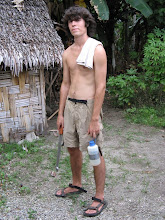
Ni-Vanuatu from other islands have something of a mystique regarding Tanna. Although it's probably the second most visited island after Efate, Tanna maintains a reputation of being primitive and steeped in custom, two of the big reasons why it is such a popular destination for tourists. Ironically, Tanna is being exposed to large amounts of western influence and is becoming increasingly western because of its reputation for being so un-western. Among other Ni-Vans, people from Tanna (“man Tanna” in Bislama) are often looked down upon for being primitive, uncivilized (and yes, it is kind of strange to hear people living in bamboo houses accuse others of being primitive. The deciding factor seems to be whether or not you have a DVD player in your bamboo house), and practitioners of black magic and old customs. There have even been several occasions where I've heard man Tanna discussed in terms that bordered on hatred and fear. Despite the best efforts of the various branches of the Christian Church in Vanuatu, strong belief in black magic still persists (or perhaps, to some extent, the church is encouraging these beliefs. Pastors often stress the importance of attending church and praying because it is necessary to combat black magic, without realizing that this is somewhat counter-productive, as their arguments are implicitly acknowledging the existence and validity of magic), and islands that are perceived as having strong magic (namely Tanna and Ambrym) are viewed with suspicion.
Any evidence of Tanna's primitiveness was not visible from the airport, however. The airport was an impressive structure that was significantly nicer than our airport in Norsup, mostly because it had not been recently firebombed, but also because it had two stories (and as an added bonus the second story showed absolutely no signs of an impending collapse on the first), two sets of bathrooms, and even a customs and immigration counter. The latter, apparently, had just been installed in preparation for the opening of international flights between Tanna airport to New Caledonia which, due to Tanna's extreme southern location, is actually about as far away as Port Vila. In celebration of (or at least in some way related to) the opening of this new flight route, Lenekel, the largest town in the area, was hosting a joint arts festival with New Caledonia showcasing Tafea (Vanuatu's southernmost province, which includes Tanna) and New Caledonian culture, which had been generating a lot of excitement over the past few weeks.
Justine, a volunteer who was accompanying me on this expedition, and I caught a truck from the airport into town and right away I was struck by the large differences between the northern and southern islands of the country. The islands of Vanuatu are spread out laterally over a length about the same as the state of California, which means fairly large difference in climate between the northernmost islands (which are essentially on the equator) and the southernmost. Tanna was noticeably cooler than Malekula, a fact that I welcomed, and the weather seemed to actually be acknowledging the fact that it was supposed to be winter. The flora was also noticeably different, gone (or at least not as dominant ) were the reckless, heat-loving, vines, creepers, and shrubs that preside over the Malekulan bush and in their place were larger, more responsible trees that see the wisdom in growing slowly and protecting their assets with things like bark. Our truck driver dropped us off at the market in Lenekel, which, again, proudly sported its differences with the one in Lakatoro as, instead of the usual collection of bananas, coconuts, and grapefruit, it was stocked with produce more familiar to the American palate. Things like carrots, lettuce, and tomatoes were abundant and I'd heard that even things like apples, grapes, and wild raspberries are sometimes available.
As a town, Lenekel was pretty similar to Lakatoro. It sported a number of stores (more stores than Lakatoro, actually), all of which pretty much sold the same thing: rice, canned food, and packaged crackers and cookies. Unelco even provides power to the town using the same pre-paid power card system as Lakatoro. Unlike Lakatoro, however, which is laid out in a line, Lenekel was more of a square, which made it a lot more convenient to get around. Because of the festival, Lenekel was crawling with people, more people than one usually sees in Vila, much less on an outer island, which made our arrival a little intimidating. Some of the Tanna volunteers met us at the market and escorted us back to the stadium, where the festival was taking place and where one of their families was running a food stall. The arts festival showed really no signs of containing any actual art, however, and looked pretty much exactly like every other event I'd ever attended in Vanuatu, except on a bit of a larger scale. Food stalls arrayed the edges of the stadium (which was actually quite large) selling the standard Vanuatu festival food (chicken wings, fish, plates of rice and meat, fried dough, and strange-tasting cakes and other baked goods), and kava. The field was occupied by soccer players working their way through a tournament and a stage had been set up on which a band was to appear later. The entire festival seemed to be served by only two outhouses with pit toilets which, judging by the stench, had filled up long ago. The only sign of any sort of ongoing cultural-related activity was a small area where representatives from various places in Tafea had erected houses built in the traditional style of their island. For the most part the construction materials were all the same, uncut wood and coconut leaves (unlike in the north where natangora, which makes an excellent thatch, and bamboo, which is naturally grows in nice, straight, beams, are abundant, in the south coconut seems to be the staple building material), and only the shape of the houses varied. Standing next to all the Vanuatu structures was the New Caledonian contribution, a large, circular, concrete building with a thatch roof that looked like it had been erected with aid of cement mixer and a union-certified construction crew. Now, I don't know much about New Caledonian history, so I suppose it's possible but that they developed cement, along with the Romans, a few thousand years ago and have been using it as a building material ever sense (granted, at least in Vanuatu, there is an abundance of limestone from the coral reefs, which is the crucial ingredient in cement), but I kind of doubt it. Really it seem more like the New Caledonia contingent was just showing off that, since they're still under French rule, they have more money than they know what to do with. On a less cultural, but more pleasant, note, we were directed by the Tanna volunteers to a food stall that was making and selling hamburgers, which were excellent as, much to my surprise, they didn't skimp on the meat and included such extras a lettuce, tomato, onion and ketchup.
The festival proceeded pretty much as expected. The main act was a Vanuatu pop band that played a set of reggae-ish music that was heavy on the synth and included mostly covers. After they finished other, more amateur groups took the stage and the music continued into the early morning. Myself, I had my fill come about 11 o'clock and Justine and I pitched a tent in a quiet area behind the stadium and went to sleep. The next day we were planning on heading to the other side of the island to a village called Port Resolution, about 15-20 miles away, which is close to Tanna's volcano. Since it was Sunday, we were outside of the schedule of the usual service trucks, and, being volunteers, we were loath to spend the money that drivers usually charge tourists for charters. It was a nice day, however, and there was a lot of traffic because of the festival so we set out on foot, knowing that we'd probably end up in Port Resolution eventually if we were patient. The road crossing the island was in excellent condition, another testament to Tanna's booming tourist trade, and trucks passed frequently. Unlike on Malekula, where two white people walking outside of town is a rare sight and cause for much consternation, we merited little attention and very few trucks stopped to speak to us (many of the trucks were even carrying other white people and some had done up their truck beds with rain covers and cushioned seating). Tanna is shaped kind of like a hat. We had a steep climb initially, but it leveled off as we got farther from the coast and then sloped down again on the opposite coast. We gauged our progress by how insistent Ni-Vans we spoke to along the way were that what we were doing was impossible. Close to Lenekel we were told that we'd never, in a million years, be able to make it to Port Resolution on foot, towards the middle of the island we were informed that Port Resolution was really, really, really far away, and by the time the opposite coast was visible we were down to people giving us pitying looks and nodding their heads sadly. The highlight of the walk was when we rounded corner and the coastline with the volcano came into view. It was a nice, sunny day and off to the left the ocean sparkled magnificently and looked invitingly calm and peaceful. White beaches were like walls separating the green of the middle bush from the patient turquoise of the ocean. To the right the volcano jutted out rudely from the coastline, smoking ominously and covering the surroundings with a dark haze, seeming to hide something terrible and mysterious. A few minutes later an SUV rounded the same corner, pulled to a stop a few meters ahead of us and a collection of tourists got out and began photographing the vista. The driver, a Ni-Van, came to talk to us an insisted on giving us a ride. Having come this far, Justine and I were somewhat set on finishing our journey on foot, if only to say that we'd done it, and were a little hesitant. “Where is Port Resolution?” I asked. The driver pointed to the smoldering volcano blanketing the landscape in fog and said “On the other side of that.” We looked at the strangely malignant peak for a few more seconds and then got into the car.
As it turns out, it was a good thing we got a ride when we did as the nice packed coral surface of the road soon gave way to the black sand of the volcanic ash plain, and hiking through sand is notoriously difficult. For a while vegetation persisted to poke its way through the sand, before suddenly giving way to a desert of ash. The landscape in front of us was pure black and quickly turned into a minefield of sharp-looking volcanic rocks carelessly tossed onto the smooth sand. To our left, the volcano rose up like a gigantic black sand dune. I had no doubt that we had just crossed into Mordor proper and would soon begin ascending Mount Doom (although it turns out that Mount Yassur, as Tanna's volcano is called, is filled with far fewer orcs and far more Australians than Tolkien's Mount Doom). Our driver skillfully navigated through the potentially tire-puncturing rocks, following some road that I could not, for the life of me, discern. We rounded the base of the volcano and came to a road junction on the other side. One road obviously led up to the summit of the volcano, while the other made its way away from it. The driver explained that he'd be taking his carload of tourists up to the volcano, but that we should follow the other road to get to Port Resolution. As it turned out, we actually weren't even particularly to our destination, as it took another two hours of walking to reach it. We were both pretty exhausted by the time we pitched out tent and went to sleep that night.
The next day we set out to experience the strange volcanic character of the area around us. Across the bay from Port Resolution, where we'd spent the night, was a volcanic vent that had led to some interesting natural features. First, we hiked up to a large, rocky rift where volcanic gases mixed with water to send up wafts of egg-scented steam that seemed oddly refreshing (or maybe it was just that when the wind brought in breezes from across the ocean they seemed refreshing by comparison). Next we were directed to a patch of volcanic mud, a stretch of strangely spongey multi-colored earth. A little digging revealed that the upper layers of clay-like mud were warm and an inch or so away from the surface were downright hot. You could dig around to find pretty much any color of clay you wanted and its consistency made it kind of like a naturally-occurring Play-Doh. Finally, we climbed a ladder down a cliff-face to the ocean below where the tide-pools were dotted with springs of boiling water that occasionally let out sulfurous belches. That evening we caught a truck up to the top of the volcano, the event that was my motivation for coming to Tanna in the first place. The black sand road wound its way up the slope of the volcano, where the air became steadily cooler and more biting. We jumped out of the truck a couple hundred meters from the summit and continued on foot. At this point, the winds were quite strong and, even though I was wearing I jacket, I felt the coldest I'd ever felt in Vanuatu. Mount Yassur is billed as the world's most accessibly volcano. I don't know if this is true or not, but it certainly seemed plausible to me. Unlike the volcanoes I'd visited in Hawaii when I was little, which were carefully controlled with areas where it was safe to stand nicely roped off and park rangers ensuring that no one wandered off somewhere where they might be hit by a bit of flying magma, Yassur (in typical Vanuatu style) was just there. You were free to explore at will. We hiked all the way up to the rim of the volcano, where being shoved in by the strong winds seemed like a very real possibility, especially given the slippery footing offered by the volcanic sands. Unfortunately, you could not, as I'd hoped, stare down from the rim into a boiling pool of lava. The volcano was essentially a very large, circular sand dune. It slowly sloped up on the outside, finally coming to a peak at the rim, and then sloped downwards, somewhat more steeply, into the the volcano. A ways downwards a sort of flat, circular shelf was visible which separated the slope of the inner dune from a giant, dimly glowing pit in the middle. It seemed possible to safely walk down the interior slope of the volcano and stand on the shelf overlooking the pit, and we briefly considered this option when a deep grumbling sent hundreds of chunks of flaming magma flying up out of the pit. For a moment these glowing fragments hung still in the air and then descended, blanketing the shelf where we'd just been considering standing in brilliant, burning embers, and we decided that the view was just fine from the rim. The volcano's activity apparently fluctuates week-to-week (or even day-to-day) and we caught it during something of a quiet spell. I was told that it's not unheard of for the volcano to fling magma up over the rim where we were standing and onto the outside of the volcano and the assortment of volcanic rocks that dotted the outside flank were a testament to the truth of this. As it was, however, while we were there the bursts of magma never came close to the rim. We watched the volcano for about an hour and it fell into a sort of pattern. It would spend a ponderous five to ten minutes plotting its next outburst. Rumblings and tremors would announce that it was about to fire up. A sort of crashing boom accompanied each flare and chunks of burning red rained upward in one mammoth firework. Then the glowing rocks tumbled downwards, their bright forms twisting and turning in the short evening light. They peppered the shelf and sometimes the inside flank with flaming dimples which dimmed slowly as they cooled before finally going out. It was an awesome sight, but the novelty soon wore off as the wind became colder with the setting sun and soon enough we were ready to head back down to our ride.
Tired of walking, we caught a truck back to Lenekel to visit the last item on our agenda: a giant banyan tree. The banyan is a strange tree, not content to grow slowly thicker with each year, its branches attempt to create satellite trunks to support their rapid growth. Thin wooden tendrils worm their way down from the banyan's branches and, when they hit ground, begin to thicken and eventually form sturdy trunks which then sprout more branches. Older banyan trees are a mess of intertwined trunks and branches that form a sort of wooden jungle gym. The giant banyan on Tanna is supposedly the third largest in the world, a fact that I'm sure some Ni-Van just made up at some point and is now endlessly repeated. Third largest or not, however, it was a pretty impressive sight. Its network of trunks covered an area on the ground approaching half of the schoolyard at which I teach and the canopy was much larger. Intertwining woodwork formed thousands upon thousands of rungs which made the tree easily to climb up and maneuver around. Basically, it was the ultimate tree fort, the kind of thing every eight-year-old wishes they had in their backyard. Even at 23, I spent a couple hours climbing around it and could easily have spent several more.
After visiting the banyan, we headed to the airport. I liked Tanna, although my Peace Corps service has made me somewhat desensitized to natural wonders and I appreciated the plate of hot fish-and-chips that I got just off the plane in Vila almost as much as I did the volcano. Really, though, the only true disappointment was that, due to the geometry of Mount Yassur, throwing a coin into the lava pool had not been feasible, and thus my lifelong dream remains unfulfilled.
Sunday, August 9, 2009


Wednesday, July 22, 2009
Yu No Kick Part 16: Ples Blong Mi Issue 2 (Norsup)
Tautu is sandwiched between two commercial centers, Lakatoro and Norsup. They're not really towns so much and not many people live in either of them, they're mainly just locations where various stores and offices happen to be. Back when Vanuatu used to be jointly ruled by the French and British, Lakatoro was home to the British provincial offices and Norsup was home to the French ones. Today, Lakatoro has a little bit more going on in terms of commerce, but Norsup definitely has its upsides as well. There's a roundabout where the road out of Tautu joins up with the main road along the coast of the island. One turn takes you to airport and then to Lakatoro while the other takes you to Norsup. Ironically the airport is called Norsup airport even though it's not really anywhere near Norsup, which I suppose is in keeping with the time-honored tradition of airports never actually being in the cities (or villages) they're named for. The airport is probably about the midpoint between Norsup and Lakatoro, which makes Tautu a bit closer to Norsup than to Lakatoro. I'm actually not sure exactly where Tautu ends and Norsup begins (and I don't really think anyone is sure) but I usually take it to be around a house on the side of the road that would be quite a home in rural Georgia or something. Broken down cars and car parts absolutely litter the lawn. There are rusted out hulks of every kind of vehicle imaginable, buses, trucks, cars, and unidentifiable wheel beds. There's about as many broken cars on this lawn then there are functioning cars on the island, and I have absolutely no idea where all these wrecks came from, but they probably date back to British and French rule.
After passing Georgia, you round a bend to the left and the ocean, which is hidden from view for the majority of the walk from Tautu, emerges. Personally, I think Norsup has some of the best views in the area. Norsup Island, a small island just off the coast, is plainly visible and there's usually at least some canoe traffic going back and forth from the mainland. My favorite nakamals are here too, situated between the road and the ocean, providing and excellent view of the moon and stars over the water at night during kava time. There used to be only two nakamals along this stretch, but in recent months they've been springing up like Starbucks, one right next to the other. Considering that they all sell exactly the same (disgusting) thing for exactly the same price, I'm not really sure what's fueling this boom, but I suspect it has something to do with the Presbyterian Church in Tautu banning kava there on the weekends, thus forcing Tautu residents to search elsewhere. Just past nakamal row on the left is the Provincial Education Office, whose shabby-looking, dull yellow exterior masks a shabby-looking, dull yellow interior. Behind the education office is the Co-op, a large-ish store with the reasonable selection, but no refrigeration (hence no cold drinks or meat or cheese and, really, why else would I be going to the store?), and thus really only visited as a last resort. Behind the Co-op is another bank of nakamals providing emergency backup kava in case the oceanfront nakamals run low. Across from the education office is what is probably the nicest looking and newest building in the area. It was actually built by the French army when I first got to site, and thus it's larger and looks more structurally sound than most buildings on the island. It was also a source of amusement when it was being built as the construction crew was big into really short shorts and cowboy hats and thus tended to look more like an escort service. Originally the building was supposed to house a branch of the University of the South Pacific, but that didn't pan out for some reason and so this year it was re purposed as an office for the TVET program, a nebulous, Australian funded aid organization whose purpose still remains unclear to me. After the TVET office come another cement court that looks like it might once have been intended as a basketball or netball court but is currently being used as a nakamal.
The Norsup French school takes up a considerable amount of space along the road and is actually pretty impressive-looking. Unlike the British, the French have continued to fund their schools in Vanuatu even after independence as part of their (seemingly failing) mission to maintain French as an important language in the world. To their credit, however, the French schools do somehow manage to teach all of their students excellent French, a feat the English schools have yet to duplicate with English. Because of their funding, the Norsup school is able to build and maintain its facilities and has an excellent campus. Despite me having been here for almost two years, the students still seem to not have caught on to the fact that I don't speak French and so always call out to me in French as I walk or ride by on my bike.
Following the school is the hospital which, like the school, seems to be in impressively good condition. The buildings are relatively new and modern and the hospital is quite large. It's also probably the last place I'd want to be if I were sick. Norsup hospital lacks a regular doctor and the Ni-Vanuatu nursing staff are woefully under-trained. Malaria is given out as a default diagnosis for most ailments, including cuts. After McKenzie's and Elin's experiences with the hospital, I've avoided it for purposes of health care. The real reason for going to Norsup is the plantation. The PRV Plantation is (I think) the largest coconut plantation on the island and focuses on producing copra, although they also grow cocoa. The plantation worker housing is located right down the road from the hospital and is a collection of about ten to fifteen duplexes that look strangely reminiscent of cooker-cutter housing developments in the US. The walls and roof of each duplex are constructed entirely from corrugated iron, which undoubtedly makes them preposterously hot during the summer. Although I initially thought such houses to be totally unlivable, they're actually some of the fancier homes on the island. They even have legit power lines running between them. At the end of the housing comes the plantation store, a large, white, wooden building elevated off the ground a good six to eight feet for no reason that's apparent to me.
I have no interest in selling either copra or cocoa, but I frequent the plantation store probably more than any other on the island because they have by far the best butchery. As I explained in a previous entry, coconut fields are very large and relatively empty on the ground, leaving lots and lots of space for things like grass and shrubs to grow. Now, in order to make coconut harvesting easy and effective, its important to keep the grasses cut low so that workers don't have to be tramping through knee-high grass looking for fallen coconuts. Of course, there aren't very many lawn tractors on Malekula (and, even if there were, maneuvering them through the coconut trees would difficult), cutting grass with a machete is a gigantic pain, and even push mowers would take forever to cover that much ground, but there's actually a simple, 100% natural solution: cows. You see, cows eat grass, lots of grass, and they're totally automated, and never have to be paid or re-fueled. They even reproduce. The only thing is that, if you have a lot of coconut plantation to cover, you end up with a lot of cows and you've got to have something to do with the excess ones that are bound to spring up every now and again. Thus, most coconut plantation also wind up selling beef. Now, Vanuatu doesn't have a lot going for it in the food domain. Most of the local dishes are bland and boring and exist simply to sustain life. Plus, the hands-off approach to agriculture generally means that the quality of produce and livestock is inconsistent at best. But I tell you, Vanuatu has the best beef I've ever tasted. I was actually never that into beef in the US. True, I am totally obsessed with meat, but I tended to prefer pork, lamb, fish, and poultry to beef. Now I am a convert. The thing is, beef in the US is a little on the tasteless side. Our modern agricultural practices have indeed succeeded in producing cows that are more muscular and meat that is more tender, but we seem to have lost some flavor along the way. But Vanuatu beef is amazing, it's juicy and flavorful and you can eat it with absolutely no seasoning and it's delicious. And it's not just me. Every visitor we've had from the US and every volunteer that we've eaten with has mentioned that the beef here is some of the best they've ever had. The problem is that Ni-Vanuatu don't know how to respect a good cut of meat. To them, meat is meat. When Ni-Vans slaughter a cow, they chop it up with a machete into a bunch of one or two kilo chunks and sell all the meat for the same price, no matter where it came from on the cow. Thus, most of the beef Ni-Vans eat is tough and inedible unless it's stewed for many hours or cooked in a lap-lap. You never really appreciate the services a good butcher provides until you don't have one. The PRV, however, is French run and the French will be damned if they're going to see a good piece of meat go to waste. Unlike most stores on the island, the PRV store butchers their cows properly and sells their meat by the cut, from filet all the way down to stew meat. Fortunately, their prices are still all incredibly reasonable (filet for example, the most expensive cut, sells for about $4 a pound). Unfortunately, the names of all the cuts are in French, and it's taken me a while to sort out what's what, but I think I've got a pretty good handle on it now.
Upon entering the store, you're usually greeted by a plump, French-speaking, Ni-Van lady passed out behind the store's counter, her head pillowed by her arms against the wood of the counter top. Her eyes are the only thing that move as you approach. A dusty blackboard on the left lists the various cuts of beef available and their respective prices. It's up to you to initiate the transaction, as the lady behind the counter could comfortably let you stand in the store for many hours on end without speaking to you, so once you're sure of your order, you tell her, politely “half a kilo entrecote, please” And, seeming to marshal great amounts of energy in order to accomplish this, she'll lift her head off of her arms, shout your order to the wall behind her, apparently to no one, and begin rummaging around for a pen. A few moments later, strange noises will begin in the back of the store, clanging of metal, stomping of feet, occasional cursing and, sometimes, what I swear sounds like an electric saw. Once the lady finds her pen, she calculates your total on a large calculator sitting next to her on the counter, all the while muttering to herself in French, takes your money, and begins recording your purchase in a beat-up school notebook. A while later, an old, skinny, wily-looking Ni-Van man comes shuffling out of a door on the left side of the store wearing a white apron in various stages of being totally covered in blood and asks something like “two kilo faux filet, yes?” After you correct him, he shuffles back through the door and the strange noises resume. A little while longer and the man re-emerges clutching a plastic bag filled with red meat. If you're really lucky, the meat will still be warm from the slaughter, although this has only happened to me a few times over the couple of years I've been here. The total round trip from Tautu on foot is generally around an hour, but the results are so, so worth it.
After passing Georgia, you round a bend to the left and the ocean, which is hidden from view for the majority of the walk from Tautu, emerges. Personally, I think Norsup has some of the best views in the area. Norsup Island, a small island just off the coast, is plainly visible and there's usually at least some canoe traffic going back and forth from the mainland. My favorite nakamals are here too, situated between the road and the ocean, providing and excellent view of the moon and stars over the water at night during kava time. There used to be only two nakamals along this stretch, but in recent months they've been springing up like Starbucks, one right next to the other. Considering that they all sell exactly the same (disgusting) thing for exactly the same price, I'm not really sure what's fueling this boom, but I suspect it has something to do with the Presbyterian Church in Tautu banning kava there on the weekends, thus forcing Tautu residents to search elsewhere. Just past nakamal row on the left is the Provincial Education Office, whose shabby-looking, dull yellow exterior masks a shabby-looking, dull yellow interior. Behind the education office is the Co-op, a large-ish store with the reasonable selection, but no refrigeration (hence no cold drinks or meat or cheese and, really, why else would I be going to the store?), and thus really only visited as a last resort. Behind the Co-op is another bank of nakamals providing emergency backup kava in case the oceanfront nakamals run low. Across from the education office is what is probably the nicest looking and newest building in the area. It was actually built by the French army when I first got to site, and thus it's larger and looks more structurally sound than most buildings on the island. It was also a source of amusement when it was being built as the construction crew was big into really short shorts and cowboy hats and thus tended to look more like an escort service. Originally the building was supposed to house a branch of the University of the South Pacific, but that didn't pan out for some reason and so this year it was re purposed as an office for the TVET program, a nebulous, Australian funded aid organization whose purpose still remains unclear to me. After the TVET office come another cement court that looks like it might once have been intended as a basketball or netball court but is currently being used as a nakamal.
The Norsup French school takes up a considerable amount of space along the road and is actually pretty impressive-looking. Unlike the British, the French have continued to fund their schools in Vanuatu even after independence as part of their (seemingly failing) mission to maintain French as an important language in the world. To their credit, however, the French schools do somehow manage to teach all of their students excellent French, a feat the English schools have yet to duplicate with English. Because of their funding, the Norsup school is able to build and maintain its facilities and has an excellent campus. Despite me having been here for almost two years, the students still seem to not have caught on to the fact that I don't speak French and so always call out to me in French as I walk or ride by on my bike.
Following the school is the hospital which, like the school, seems to be in impressively good condition. The buildings are relatively new and modern and the hospital is quite large. It's also probably the last place I'd want to be if I were sick. Norsup hospital lacks a regular doctor and the Ni-Vanuatu nursing staff are woefully under-trained. Malaria is given out as a default diagnosis for most ailments, including cuts. After McKenzie's and Elin's experiences with the hospital, I've avoided it for purposes of health care. The real reason for going to Norsup is the plantation. The PRV Plantation is (I think) the largest coconut plantation on the island and focuses on producing copra, although they also grow cocoa. The plantation worker housing is located right down the road from the hospital and is a collection of about ten to fifteen duplexes that look strangely reminiscent of cooker-cutter housing developments in the US. The walls and roof of each duplex are constructed entirely from corrugated iron, which undoubtedly makes them preposterously hot during the summer. Although I initially thought such houses to be totally unlivable, they're actually some of the fancier homes on the island. They even have legit power lines running between them. At the end of the housing comes the plantation store, a large, white, wooden building elevated off the ground a good six to eight feet for no reason that's apparent to me.
I have no interest in selling either copra or cocoa, but I frequent the plantation store probably more than any other on the island because they have by far the best butchery. As I explained in a previous entry, coconut fields are very large and relatively empty on the ground, leaving lots and lots of space for things like grass and shrubs to grow. Now, in order to make coconut harvesting easy and effective, its important to keep the grasses cut low so that workers don't have to be tramping through knee-high grass looking for fallen coconuts. Of course, there aren't very many lawn tractors on Malekula (and, even if there were, maneuvering them through the coconut trees would difficult), cutting grass with a machete is a gigantic pain, and even push mowers would take forever to cover that much ground, but there's actually a simple, 100% natural solution: cows. You see, cows eat grass, lots of grass, and they're totally automated, and never have to be paid or re-fueled. They even reproduce. The only thing is that, if you have a lot of coconut plantation to cover, you end up with a lot of cows and you've got to have something to do with the excess ones that are bound to spring up every now and again. Thus, most coconut plantation also wind up selling beef. Now, Vanuatu doesn't have a lot going for it in the food domain. Most of the local dishes are bland and boring and exist simply to sustain life. Plus, the hands-off approach to agriculture generally means that the quality of produce and livestock is inconsistent at best. But I tell you, Vanuatu has the best beef I've ever tasted. I was actually never that into beef in the US. True, I am totally obsessed with meat, but I tended to prefer pork, lamb, fish, and poultry to beef. Now I am a convert. The thing is, beef in the US is a little on the tasteless side. Our modern agricultural practices have indeed succeeded in producing cows that are more muscular and meat that is more tender, but we seem to have lost some flavor along the way. But Vanuatu beef is amazing, it's juicy and flavorful and you can eat it with absolutely no seasoning and it's delicious. And it's not just me. Every visitor we've had from the US and every volunteer that we've eaten with has mentioned that the beef here is some of the best they've ever had. The problem is that Ni-Vanuatu don't know how to respect a good cut of meat. To them, meat is meat. When Ni-Vans slaughter a cow, they chop it up with a machete into a bunch of one or two kilo chunks and sell all the meat for the same price, no matter where it came from on the cow. Thus, most of the beef Ni-Vans eat is tough and inedible unless it's stewed for many hours or cooked in a lap-lap. You never really appreciate the services a good butcher provides until you don't have one. The PRV, however, is French run and the French will be damned if they're going to see a good piece of meat go to waste. Unlike most stores on the island, the PRV store butchers their cows properly and sells their meat by the cut, from filet all the way down to stew meat. Fortunately, their prices are still all incredibly reasonable (filet for example, the most expensive cut, sells for about $4 a pound). Unfortunately, the names of all the cuts are in French, and it's taken me a while to sort out what's what, but I think I've got a pretty good handle on it now.
Upon entering the store, you're usually greeted by a plump, French-speaking, Ni-Van lady passed out behind the store's counter, her head pillowed by her arms against the wood of the counter top. Her eyes are the only thing that move as you approach. A dusty blackboard on the left lists the various cuts of beef available and their respective prices. It's up to you to initiate the transaction, as the lady behind the counter could comfortably let you stand in the store for many hours on end without speaking to you, so once you're sure of your order, you tell her, politely “half a kilo entrecote, please” And, seeming to marshal great amounts of energy in order to accomplish this, she'll lift her head off of her arms, shout your order to the wall behind her, apparently to no one, and begin rummaging around for a pen. A few moments later, strange noises will begin in the back of the store, clanging of metal, stomping of feet, occasional cursing and, sometimes, what I swear sounds like an electric saw. Once the lady finds her pen, she calculates your total on a large calculator sitting next to her on the counter, all the while muttering to herself in French, takes your money, and begins recording your purchase in a beat-up school notebook. A while later, an old, skinny, wily-looking Ni-Van man comes shuffling out of a door on the left side of the store wearing a white apron in various stages of being totally covered in blood and asks something like “two kilo faux filet, yes?” After you correct him, he shuffles back through the door and the strange noises resume. A little while longer and the man re-emerges clutching a plastic bag filled with red meat. If you're really lucky, the meat will still be warm from the slaughter, although this has only happened to me a few times over the couple of years I've been here. The total round trip from Tautu on foot is generally around an hour, but the results are so, so worth it.
Yu No Kick Part 15: Ples Blong Mi Issue 1 (Tautu)
The village where I live, Tautu, is actually made up of two villages. There's both Big Tautu and Small Tautu and, as these things tend to work, I'm pretty sure Small Tautu is actually bigger than big Tautu. Of course, it's hard to know for sure because the city has been a little slow putting up one of those big, friendly, welcome signs on the side of the road that say “Welcome to Tautu, Population: **,” but I'm pretty sure Small Tautu at least covers more area than Big Tautu. According to what I've heard, these two actually used to be separate villages, with Big Tautu being called Tautu and Small Tautu being called Alau, which grew together over time to form what you could call a twin village area (but probably wouldn't). Since the two villages couldn't have ever really been any more than a kilometer or so apart, the growing together probably didn't take much effort, but there you go. Big Tautu is built directly on the beach, a good move both because of the nice view and the cooling breezes that come off of the ocean during hot season. The houses along the beach are older and thus are almost all custom: woven bamboo walls with thatch roofs. Some houses mix the old with the new, they sport concrete floors in lieu of sand and coral covered with pandanus mats. A few windows made of glass louvers set into their bamboo walls. These glass slat windows are the standard in Vanuatu for some reason unclear to me, as I've never seen one that's not in some way broken. A typical window consists of parallel metal frames mounted against the wood of the window frame (perpendicular to the ground). Each frame sports 5-8 slots for glass pieces. The glass pieces are slender rectangles, maybe two feet long and half a foot wide, that sit in said slots and span the width of the window. Each slot is hinged, allowing you to adjust the angle of the glass pieces using a lever protruding from the frame. When the window is open the glass slats make what looks like a set of transparent shelves and when the window is closed it approximates a standard single pane of glass. Not a bad idea in theory, but the slats are easily unseated from their perches by strong winds or earthquakes and are broken and often never replaced. The humid, salty sea air also makes quick work of the hinges, rusting them into uselessness and freezing the louvers in position. Myself, I prefer the older method, windows covered by hinged wooden boards that can be opened and closed, essentially miniature doors. Glass is more expensive, however, and thus more desirable, and my preference is rarely implemented anymore.
In the main village, the houses are crowded closely together. A housing unit usually consists of at least four separate structures, one house for sleeping and general purpose use, one house for the kitchen and dining area, one smaller shack (often constructed of whatever junk happens to be lying around; rusted, jagged corrugated iron sheets, coconut leaves, pieces of tarps, black plastic garbage backs, or old burlap sacks) for the toilet, and another shack for the shower. White and brown electrical cables worm their way out of the thatch roofs and run between the various buildings, precarious power lines to give life to electric lights, televisions, and DVD players. The lines originate at little gray boxes on poles that allow the power company, Unelco, charge for power consumption. Users must buy little plastic cards at various stores through out the village and insert them into the Unelco boxes in order for them to work (a system similar to prepaid phone cards). One card entitles one to 30kWhrs of power. Sometimes the power lines are allowed to drape lazily between the two structures they connect, requiring anyone passing beneath them to duck to avoid being clotheslined. The more safety conscious prop their lines up with bamboo pole which, for some reason, are always wedged into the ground at an angle as opposed to being vertical. Since I'm taller than most people in the village, I generally still have to duck for these elevated lines, just not as much (actually this is a common problem for me, not just with power lines, but also with doorways and ceilings). Extra power cord is often run between a series of bamboo poles to make clotheslines, which are always placed on the ocean side of the house to take advantage of the nearly constant wind. Such a crowded collection of ramshackle structures, where it to appear in or around a large city in the West, would probably be called a slum, but the picturesqueness of the nearby ocean (literally less than a stone's throw away) and the swaying coconut tree in the distance make it difficult to apply that term here. Also, the crowded character of the village is not due to the space restrictions imposed by a city or town, there's plenty of undeveloped land stretching in both directions from the village, people just prefer to live close to each other.
The village is built a respectful 50 or so meters away from the ocean, leaving a sort of open sandbar between the rows of houses and the craggy black rock that makes up the ocean bottom. As you work your way along this bar you can see the entire village, row after row of brown bamboo walls, occasionally punctuated by what can only be described as the occasional empty lot: a broken cement foundation in various stages of being overrun with weeds and young papaya trees which worm their way through the cracks in the rock, finally terminating in a low tree line that marks the end of the village. The house nearest the tree line belongs to a cement worker and so the patch of sand in front of his house is always covered with homemade cinder blocks and cement toilet seats drying before being sold. Across the sandbar from these stone concoctions is a long wooden bench where the chief and other important men in the village like to hang out. The bench is a makeshift job consisting of a long wooden plank supported in various places along its length by a number of old pieces of machinery. Most look like they were once part of a car, but I'm not really sure. A small path leads into the bush that borders the village, which seems deceptively thick near the village but actually thins out quickly into a pleasant wooded beach area. Occasional short trees with broad branches give excellent shade to what is mostly a bare sandy beach. In lieu of rocks, large washed up pieces of coral dot the ground. Old brain corals have a distinctively rounded shapes, like pieces of a large, spherical shell, that are rough on one side and comparatively smooth on the other. Other corals are bizarre branching structures that look like little stone trees. Remains of giant clam shells are also a common sight, including some that have fused into the rock of a dead coral formation and look like petrified fossils. A little ways down the forested beach gives way to bush once again, but a narrow path offers easy passage through. After a a couple hundred meters, the path spits you out onto the ocean. At high tide you emerge from the bush directly into the water, but at low tide you are greeted with dry, craggy, black rock instead. The sharp and uneven nature of this surface makes it uncomfortable to walk on, even with sandals or shoes protecting you from the worst of it (some Ni-Vans, however, fish along the shallows so often that they have grown used to walking on this sharp surface even when barefooted). The rocks are often slippery as well and the sharp protrusions seem to be taunting you, just daring you to take a fall. At low tide, this area is ripe with tide pools and you can see all matter of bizarre aquatic life living in them. If you walk or wade further you will quickly come to a sharp point from which you can see the shining iron roofs of the French school in Norsup. As the point terminates in the ocean, a couple pillars of black rock jut out of the water, reaching up about eight feet or so. The rough surface of the pillars makes them easy to climb and the tops are covered with vegetation which offers some padding should you wish to sit on top of one and stare off at the sea.
Moving inland from the main village brings you to the community center, an open sand and dirt square shaded by a huge natafoa tree growing in the middle of it. The natafoa is a strange looking tree, as it seems to prefer growing at right angles. The trunk, as you would expect, grows vertically upward, but its all of its main branches extend almost perfectly horizontally outward, with the smaller branches growing out from the main branches then reaching up vertically again. On the right as you walk up from the ocean is one of the village stores, a large window from which you can view the various items on sale and direct the storekeeper (who is usually found sleeping on a bench just in front of the window) as to what you'd like. On the left is a large custom house where I used to live until an unusually leaky roof led me to take up residence at the school. Directly in front is the community dining hall, a large wooden structure with iron roofing, which is currently undergoing renovations and is home to the village's public phone. The phone has been broken since I got here, but nobody really seems to mind (including myself) as Digicel's cell service is both cheaper and more reliable. Behind the dining hall is the soccer field (or anything field I suppose. There are no goals or anything to distinguish it as a soccer field, but that's all I've ever seen played there). The road which connects Tautu to the wider world dead-ends in the soccer field and is often accidentally followed by tourists looking for Lakatoro. Occasionally a particularly obtuse tourist wanders into the village and the villagers have to come fetch me so that I can clearly explain to them in English that they've gone the wrong way.
After the soccer field comes the Presbyterian Church, the largest building in the village. It's painted white with a the iron roof seems to have done an exceptionally good job remaining shiny through the years, which makes the place (compared to the other builds at least, which are usually unpainted) seem very bright and cheery. The community water tank is fed by rain gutters off of the church roof and is a large cement cylinder sitting next to the building. Behind the church lies the school and the ambiguous ending of Big Tautu and beginning of Small Tautu. Houses in Small Tautu are newer, more modern, and spaced farther apart than houses in Big Tautu. Here cement and corrugated iron dominate as the preferred building materials (which to me seems strange given the abundance of high-quality timber available in bush on the island. The problem, I suppose, is the lack of a local saw mill to process the raw trees into timber to be used for building. Cement, on the other hand, can be made by hand relatively easily), some houses could even pass as reasonable houses in the US. The pastor's house, for example, which is located along the path connecting the church with the school, is large and has a big, inviting front porch.
The school's the first thing you see when rounding the bend in the road up from the soccer field. The school consists mainly of a large, open yard dotted by school buildings (including my house) along the edges. About a third of the school yard is taken up by what was at one point almost a basketball court. A while back a Peace Corps volunteer won a grant to build a court but money or interest ran out sometime mid-project and now random, crumbling cement pads adorn the entrance to the school. We also have a mostly rusted iron pole that looks like it might have one time have thought about holding up a backboard. Following the road up from the school away from the ocean takes you into the part of the village I know best, as I walk through it many times daily. The road is white, made from pressed coral, and is fairly wide, at least as far as Vanuatu is concerned, in that it can ALMOST accommodate two cars next to each other. Greenery surrounds the road on either side occasionally punctuated by a clearing denoting a house. The store I frequent is just a hundred or so meters up the road and is set back from it by one of the nicest lawns I've seen in Vanuatu. The store owner liberally enlists the many children in his family to achieve this and one can usually see them laboring away in the heat with a bush knife keeping the grass and weeds at bay. Across from the store is a nakamal known as “Christmas tree,” which I frequent whenever Duncan fails to make kava for whatever reason. The name comes from the fact that the nakamal light is hung from a large Christmas tree in front. Of course, Christmas trees in Vanuatu aren't the same as Christmas trees in the US or elsewhere. Pine trees aren't known for their ability to thrive in the tropics. In Vanuatu “Christmas tree” refers to a large tree that produces long bean pods in the summer, which coincides with Christmas in these parts of the world.
Past the Christmas tree nakamal you finally come to a large, stone roundabout which sits at the intersection of two roads. Going straight through the roundabout will take you to the airport and, eventually, Lakatoro, while the road to the right leads, most immediately, to Duncan's house and then onto the rest of Small Tautu and Norsup. Duncan's, however, is pretty much the end of what I would consider to be my home base or, in Bislama, “ples blong mi” (from the English “place belonging to me”). Home sweet home.
In the main village, the houses are crowded closely together. A housing unit usually consists of at least four separate structures, one house for sleeping and general purpose use, one house for the kitchen and dining area, one smaller shack (often constructed of whatever junk happens to be lying around; rusted, jagged corrugated iron sheets, coconut leaves, pieces of tarps, black plastic garbage backs, or old burlap sacks) for the toilet, and another shack for the shower. White and brown electrical cables worm their way out of the thatch roofs and run between the various buildings, precarious power lines to give life to electric lights, televisions, and DVD players. The lines originate at little gray boxes on poles that allow the power company, Unelco, charge for power consumption. Users must buy little plastic cards at various stores through out the village and insert them into the Unelco boxes in order for them to work (a system similar to prepaid phone cards). One card entitles one to 30kWhrs of power. Sometimes the power lines are allowed to drape lazily between the two structures they connect, requiring anyone passing beneath them to duck to avoid being clotheslined. The more safety conscious prop their lines up with bamboo pole which, for some reason, are always wedged into the ground at an angle as opposed to being vertical. Since I'm taller than most people in the village, I generally still have to duck for these elevated lines, just not as much (actually this is a common problem for me, not just with power lines, but also with doorways and ceilings). Extra power cord is often run between a series of bamboo poles to make clotheslines, which are always placed on the ocean side of the house to take advantage of the nearly constant wind. Such a crowded collection of ramshackle structures, where it to appear in or around a large city in the West, would probably be called a slum, but the picturesqueness of the nearby ocean (literally less than a stone's throw away) and the swaying coconut tree in the distance make it difficult to apply that term here. Also, the crowded character of the village is not due to the space restrictions imposed by a city or town, there's plenty of undeveloped land stretching in both directions from the village, people just prefer to live close to each other.
The village is built a respectful 50 or so meters away from the ocean, leaving a sort of open sandbar between the rows of houses and the craggy black rock that makes up the ocean bottom. As you work your way along this bar you can see the entire village, row after row of brown bamboo walls, occasionally punctuated by what can only be described as the occasional empty lot: a broken cement foundation in various stages of being overrun with weeds and young papaya trees which worm their way through the cracks in the rock, finally terminating in a low tree line that marks the end of the village. The house nearest the tree line belongs to a cement worker and so the patch of sand in front of his house is always covered with homemade cinder blocks and cement toilet seats drying before being sold. Across the sandbar from these stone concoctions is a long wooden bench where the chief and other important men in the village like to hang out. The bench is a makeshift job consisting of a long wooden plank supported in various places along its length by a number of old pieces of machinery. Most look like they were once part of a car, but I'm not really sure. A small path leads into the bush that borders the village, which seems deceptively thick near the village but actually thins out quickly into a pleasant wooded beach area. Occasional short trees with broad branches give excellent shade to what is mostly a bare sandy beach. In lieu of rocks, large washed up pieces of coral dot the ground. Old brain corals have a distinctively rounded shapes, like pieces of a large, spherical shell, that are rough on one side and comparatively smooth on the other. Other corals are bizarre branching structures that look like little stone trees. Remains of giant clam shells are also a common sight, including some that have fused into the rock of a dead coral formation and look like petrified fossils. A little ways down the forested beach gives way to bush once again, but a narrow path offers easy passage through. After a a couple hundred meters, the path spits you out onto the ocean. At high tide you emerge from the bush directly into the water, but at low tide you are greeted with dry, craggy, black rock instead. The sharp and uneven nature of this surface makes it uncomfortable to walk on, even with sandals or shoes protecting you from the worst of it (some Ni-Vans, however, fish along the shallows so often that they have grown used to walking on this sharp surface even when barefooted). The rocks are often slippery as well and the sharp protrusions seem to be taunting you, just daring you to take a fall. At low tide, this area is ripe with tide pools and you can see all matter of bizarre aquatic life living in them. If you walk or wade further you will quickly come to a sharp point from which you can see the shining iron roofs of the French school in Norsup. As the point terminates in the ocean, a couple pillars of black rock jut out of the water, reaching up about eight feet or so. The rough surface of the pillars makes them easy to climb and the tops are covered with vegetation which offers some padding should you wish to sit on top of one and stare off at the sea.
Moving inland from the main village brings you to the community center, an open sand and dirt square shaded by a huge natafoa tree growing in the middle of it. The natafoa is a strange looking tree, as it seems to prefer growing at right angles. The trunk, as you would expect, grows vertically upward, but its all of its main branches extend almost perfectly horizontally outward, with the smaller branches growing out from the main branches then reaching up vertically again. On the right as you walk up from the ocean is one of the village stores, a large window from which you can view the various items on sale and direct the storekeeper (who is usually found sleeping on a bench just in front of the window) as to what you'd like. On the left is a large custom house where I used to live until an unusually leaky roof led me to take up residence at the school. Directly in front is the community dining hall, a large wooden structure with iron roofing, which is currently undergoing renovations and is home to the village's public phone. The phone has been broken since I got here, but nobody really seems to mind (including myself) as Digicel's cell service is both cheaper and more reliable. Behind the dining hall is the soccer field (or anything field I suppose. There are no goals or anything to distinguish it as a soccer field, but that's all I've ever seen played there). The road which connects Tautu to the wider world dead-ends in the soccer field and is often accidentally followed by tourists looking for Lakatoro. Occasionally a particularly obtuse tourist wanders into the village and the villagers have to come fetch me so that I can clearly explain to them in English that they've gone the wrong way.
After the soccer field comes the Presbyterian Church, the largest building in the village. It's painted white with a the iron roof seems to have done an exceptionally good job remaining shiny through the years, which makes the place (compared to the other builds at least, which are usually unpainted) seem very bright and cheery. The community water tank is fed by rain gutters off of the church roof and is a large cement cylinder sitting next to the building. Behind the church lies the school and the ambiguous ending of Big Tautu and beginning of Small Tautu. Houses in Small Tautu are newer, more modern, and spaced farther apart than houses in Big Tautu. Here cement and corrugated iron dominate as the preferred building materials (which to me seems strange given the abundance of high-quality timber available in bush on the island. The problem, I suppose, is the lack of a local saw mill to process the raw trees into timber to be used for building. Cement, on the other hand, can be made by hand relatively easily), some houses could even pass as reasonable houses in the US. The pastor's house, for example, which is located along the path connecting the church with the school, is large and has a big, inviting front porch.
The school's the first thing you see when rounding the bend in the road up from the soccer field. The school consists mainly of a large, open yard dotted by school buildings (including my house) along the edges. About a third of the school yard is taken up by what was at one point almost a basketball court. A while back a Peace Corps volunteer won a grant to build a court but money or interest ran out sometime mid-project and now random, crumbling cement pads adorn the entrance to the school. We also have a mostly rusted iron pole that looks like it might have one time have thought about holding up a backboard. Following the road up from the school away from the ocean takes you into the part of the village I know best, as I walk through it many times daily. The road is white, made from pressed coral, and is fairly wide, at least as far as Vanuatu is concerned, in that it can ALMOST accommodate two cars next to each other. Greenery surrounds the road on either side occasionally punctuated by a clearing denoting a house. The store I frequent is just a hundred or so meters up the road and is set back from it by one of the nicest lawns I've seen in Vanuatu. The store owner liberally enlists the many children in his family to achieve this and one can usually see them laboring away in the heat with a bush knife keeping the grass and weeds at bay. Across from the store is a nakamal known as “Christmas tree,” which I frequent whenever Duncan fails to make kava for whatever reason. The name comes from the fact that the nakamal light is hung from a large Christmas tree in front. Of course, Christmas trees in Vanuatu aren't the same as Christmas trees in the US or elsewhere. Pine trees aren't known for their ability to thrive in the tropics. In Vanuatu “Christmas tree” refers to a large tree that produces long bean pods in the summer, which coincides with Christmas in these parts of the world.
Past the Christmas tree nakamal you finally come to a large, stone roundabout which sits at the intersection of two roads. Going straight through the roundabout will take you to the airport and, eventually, Lakatoro, while the road to the right leads, most immediately, to Duncan's house and then onto the rest of Small Tautu and Norsup. Duncan's, however, is pretty much the end of what I would consider to be my home base or, in Bislama, “ples blong mi” (from the English “place belonging to me”). Home sweet home.
Thursday, July 16, 2009
Still Here...
Hello all, I'd like to apologize for the long delay between posts. I owe you a lot of writing and I'll try to get it posted as soon as I possibly can. July's been a busy month (well, busy for Vanuatu) and I've spent a lot of time organizing various 4th-of-July related parties and attending to visitors. Here are a few tidbits to tie you all over until I can get a real post up:
-Jack, a volunteer down in the south of the island, did us all proud by landing a beautiful tuna and a giant mahi-mahi during a boat trip he took up the coast. Unlike tunas we've caught in the past, this one had the rich, dark, red meat that makes excellent sushi and so I got more practice rolling sushi rolls.
-The 4th gave me an excuse to bust out the sole Weber grill in the country (thanks to Jammy) once again. Still haven't figured out a really good way to make charcoal, but the burgers came out well anyway.
-My waterbed started leaking, leading to a lot of consternation on my part, but I was eventually able to fix it using a whole lot of contact adhesive. Here's hoping it will hold together for four more months until I leave.
-I'm heading to Tanna next week to go see the "world's most accessible volcano" and fulfill my lifelong dream of throwing pennies into a volcano. Will let you know how that turns out.
-Jack, a volunteer down in the south of the island, did us all proud by landing a beautiful tuna and a giant mahi-mahi during a boat trip he took up the coast. Unlike tunas we've caught in the past, this one had the rich, dark, red meat that makes excellent sushi and so I got more practice rolling sushi rolls.
-The 4th gave me an excuse to bust out the sole Weber grill in the country (thanks to Jammy) once again. Still haven't figured out a really good way to make charcoal, but the burgers came out well anyway.
-My waterbed started leaking, leading to a lot of consternation on my part, but I was eventually able to fix it using a whole lot of contact adhesive. Here's hoping it will hold together for four more months until I leave.
-I'm heading to Tanna next week to go see the "world's most accessible volcano" and fulfill my lifelong dream of throwing pennies into a volcano. Will let you know how that turns out.
Sunday, June 28, 2009
Yu No Kick Part 14: Coconuts
When I think about Malekula, the first thing that pops into my head is invariably coconuts. As one descends in a plane into our airport, the only thing really to see are row upon row of slender coconut trees dotting a field of low-cut greenery. Malekula is the copra-producing capital of Vanuatu, which is about as dubious a distinction as being, say, the septic tank producing capital of somewhere. Copra is a vile-smelling agricultural product made by drying coconut meat over a fire. It's supposedly used to make things like soap, but I find it hard to imagine anything pleasant possibly resulting from it. Apparently copra used to be a hot commodity back in the day, as the British and French ran enormous plantations all over the South Pacific in order to make the stuff. These days, making copra completely by hand, as is done in Vanuatu, is kind of like mining coal with a pickax: it's a giant pain, the end product isn't really even all that valuable, and everyone else in the world uses machines that do the work about a thousand times faster. In order to ensure that no one in the country accidentally tries to make or grow something that might actually be exportable, the Vanuatu government jacks up the price of copra with subsidies to something astronomically above the actual price. And so, instead of growing things like kava or sandalwood, which actually fetch a high price on the world market, the vast majority of people on Malekula still grow coconut trees and spend their days tending their copra fires. I don't really know what the government does with all the copra it ends up buying at ridiculously high prices, but I suspect it gets chucked in the ocean.
The largest coconut plantation on Malekula is called the PRV (which is probably an acronym for something, but nobody seems to know what), and it encompasses Tautu, Norsup, and Lakatoro (basically, the entire area surrounding where I live). It is their coconut trees that you see from the plane as you come in to land, the runway cut from amongst the towering palms. It is their trees that line the road from the airport to the town of Lakatoro and it is their trees that dominate the landscape as you gaze out from the beach in Norsup. Coconut groves are striking because of how empty they always seem. Coconuts are a very no-nonsense kind of tree. They don't bother with such frivolities as branches and limbs, their trunks shoot single-mindedly upward, thrusting their palmy canopies right into the face of the sun, like a cheerleader raising a pom-pom. Their forms seem to somehow defy gravity. Most trees grow cautiously, their trunks thick at the base and anchored to the ground with a myriad to thick roots, but coconuts will have none of this. Their trunks are as slender at the base as they are at the top and when you see them lined up and swaying in the wind they seem decidedly alien and impossible. The thin, branch-less trunks leave a lot of space on the ground, however, so you can walk through a dense grove of coconut trees and feel like you're in a mostly empty field. Those serious about growing a lot of coconuts worry about rats climbing up the trees and eating the green coconuts. To prevent this, they wrap a sheet of metal around a small section of the trunk. Although the rat's sharp claws give it traction to climb up the bark of the tree, when it gets to the metal it can no longer get a hold. When these metal bands catch the sun as you drive by a plantation the unreal feeling is complete: row upon row of improbably slender trees rocking back and forth and glinting in the sunlight.
Unlike turning coconuts into copra, the actual growing of coconuts is the easiest thing in the world. Coconuts fall from the trees well-equipped to face the hazards of the world. These well-armored seeds can actually be hazardous to the unsuspecting passerby. Falling coconuts have been known to cause serious injury if they happen to fall on someone from a particularly tall tree, as it's sort of the equivalent of having a rock dropped on you from the top of a three-story building. I've even heard stories of people being killed by falling coconuts, which has got to be one of the more embarrassing epitaphs to have on one's gravestone. The fall of a coconut is proceeded by a loud snap as the fiber anchoring it to the tree breaks. Live in Vanuatu long enough and hearing such a noise has you instantly covering your head with your arms (the beginner's move is to look up upon hearing the noise to see where the coconut is going to fall, but pros know that by the time you're able to locate the coconut, it's most likely already hit you). It's not just people who are at risk from falling coconuts; drivers unfortunate enough (or careless enough) to not check the skies for overhanging coconuts before parking their cars may return to find their windshields broken or hoods caved in.
The coconut tree's rock-like reproductive capsules consist of two layers, the first being a tough, fibrous husk. If you're trying to get into a coconut to eat it, this is the most difficult layer to remove (if you buy a coconut at the grocery store in the US, this work has already been done for you). The husk protects spherical nut whose hard shell seems daunting at first, but is actually surprisingly bitter. Rapping it with a knife is the preferred method for opening, but actually repeatedly striking it against any hard surface will do the trick. What the coconut is hiding behind all this protection is an inner shell of rich, fatty meat and a good deal of water, start-up resources for a new tree. Given the complexity and size of the coconut, and thus the energy required of the tree to make it, one would think that a given tree would only produce a few nuts a year. Coconut trees are always ripe with fruit, however, which, I suppose, just goes to show just how much solar energy is available in the South Pacific. Coconut are kind of egg-shaped and on the small end of the egg there's a sort of eye. When triggered by some kind of magical coconut sense, the eye will sprout a small palm that begins to reach skyward. Roots begin to punch through the husk and dig into the ground. Soon the coconut is anchored firmly in the ground and is growing strong.
On a plantation, the base of the coconut trees must be cleared regularly to guard against the mile-a-minute vine. The mile-a-minute vine was introduced to Vanuatu during World War II by the Americans in order to provide cover so as not to be seen from the air. The vine grows ridiculously quickly (hence the name), and likes to climb up coconut trees and smother them. It winds its way up the tree, it's large, heart-shaped leaves completely obscuring the view of the trunk as it climbs. When it reaches the palm at the top it spreads out, weaving its way around the coconut's leaves and effectively tying them up against the trunk, making them useless for collecting sunlight. Eventually, the vine ensnares all of the coconut's leaves and the tree begins to die and rot. When the trunk weakens and finally collapses, it will take all of the mile-a-minute vine out with it, but the vine does not seem to be a particularly forward-thinking kind of plant.
Despite the aggressiveness of this invader, the coconut is still pulling strong, which is a good thing because coconut trees have a myriad of uses in Vanuatu. Basically every bit of the coconut tree can be put to some use if needed. The meat of the nut, obviously, can be eaten and (if you really, really want to) made into copra. The meat can also be grated and squeezed to extract the milk, and the milk can be boiled until it is reduced to a cream and coconut oil skimmed off the top (the dried meat can actually be cold-pressed to extract the oil directly, but this technology is not native and was brought over by the Europeans). The water contained in the nut is a sure source of hydration if you're in the bush and can't find a stream to drink from. Coconut shells and husks are used for firewood, and the fibrous material that fastens the husk to the shell makes excellent tinder. The trunk itself can be used as a building material if ever anything needs to be hastily put together (coconut woods is soft, easy to work with, and readily available, but rots quickly and thus is not often used for permanent structures). Coconut logs cut into cylinders are often used as columns and coconut wood slats made from cutting the wood longways make surprisingly comfortable benches. The wooden, squid-like fruiting body that connects the coconuts to the tree can be used as a broom to clean your house or burned as kindling. Coconut fronds are used a fencing material; they can be slid between two supporting branches (with the branches running parallel to the ground) and will keep chickens and dogs out. Each individual long leaves of the coconut front has a stiff spine that can be removed and used as a skewer for cooking or a lot of spines can be bundled together to form a more effective broom than can be achieved with the fruiting body. Finally, where a frond connects to the trunk, a sort of fibrous mesh grows which can be used as a strainer to sieve kava or coconut milk. I once tried explaining to Duncan that, in the US, some people are deathly allergic to coconut and ingesting just a little bit of coconut leads to a life-threatening reaction. He just laughed at me and told me that that wasn't possible. In Vanuatu, you see, coconuts are an essential part of life.
The largest coconut plantation on Malekula is called the PRV (which is probably an acronym for something, but nobody seems to know what), and it encompasses Tautu, Norsup, and Lakatoro (basically, the entire area surrounding where I live). It is their coconut trees that you see from the plane as you come in to land, the runway cut from amongst the towering palms. It is their trees that line the road from the airport to the town of Lakatoro and it is their trees that dominate the landscape as you gaze out from the beach in Norsup. Coconut groves are striking because of how empty they always seem. Coconuts are a very no-nonsense kind of tree. They don't bother with such frivolities as branches and limbs, their trunks shoot single-mindedly upward, thrusting their palmy canopies right into the face of the sun, like a cheerleader raising a pom-pom. Their forms seem to somehow defy gravity. Most trees grow cautiously, their trunks thick at the base and anchored to the ground with a myriad to thick roots, but coconuts will have none of this. Their trunks are as slender at the base as they are at the top and when you see them lined up and swaying in the wind they seem decidedly alien and impossible. The thin, branch-less trunks leave a lot of space on the ground, however, so you can walk through a dense grove of coconut trees and feel like you're in a mostly empty field. Those serious about growing a lot of coconuts worry about rats climbing up the trees and eating the green coconuts. To prevent this, they wrap a sheet of metal around a small section of the trunk. Although the rat's sharp claws give it traction to climb up the bark of the tree, when it gets to the metal it can no longer get a hold. When these metal bands catch the sun as you drive by a plantation the unreal feeling is complete: row upon row of improbably slender trees rocking back and forth and glinting in the sunlight.
Unlike turning coconuts into copra, the actual growing of coconuts is the easiest thing in the world. Coconuts fall from the trees well-equipped to face the hazards of the world. These well-armored seeds can actually be hazardous to the unsuspecting passerby. Falling coconuts have been known to cause serious injury if they happen to fall on someone from a particularly tall tree, as it's sort of the equivalent of having a rock dropped on you from the top of a three-story building. I've even heard stories of people being killed by falling coconuts, which has got to be one of the more embarrassing epitaphs to have on one's gravestone. The fall of a coconut is proceeded by a loud snap as the fiber anchoring it to the tree breaks. Live in Vanuatu long enough and hearing such a noise has you instantly covering your head with your arms (the beginner's move is to look up upon hearing the noise to see where the coconut is going to fall, but pros know that by the time you're able to locate the coconut, it's most likely already hit you). It's not just people who are at risk from falling coconuts; drivers unfortunate enough (or careless enough) to not check the skies for overhanging coconuts before parking their cars may return to find their windshields broken or hoods caved in.
The coconut tree's rock-like reproductive capsules consist of two layers, the first being a tough, fibrous husk. If you're trying to get into a coconut to eat it, this is the most difficult layer to remove (if you buy a coconut at the grocery store in the US, this work has already been done for you). The husk protects spherical nut whose hard shell seems daunting at first, but is actually surprisingly bitter. Rapping it with a knife is the preferred method for opening, but actually repeatedly striking it against any hard surface will do the trick. What the coconut is hiding behind all this protection is an inner shell of rich, fatty meat and a good deal of water, start-up resources for a new tree. Given the complexity and size of the coconut, and thus the energy required of the tree to make it, one would think that a given tree would only produce a few nuts a year. Coconut trees are always ripe with fruit, however, which, I suppose, just goes to show just how much solar energy is available in the South Pacific. Coconut are kind of egg-shaped and on the small end of the egg there's a sort of eye. When triggered by some kind of magical coconut sense, the eye will sprout a small palm that begins to reach skyward. Roots begin to punch through the husk and dig into the ground. Soon the coconut is anchored firmly in the ground and is growing strong.
On a plantation, the base of the coconut trees must be cleared regularly to guard against the mile-a-minute vine. The mile-a-minute vine was introduced to Vanuatu during World War II by the Americans in order to provide cover so as not to be seen from the air. The vine grows ridiculously quickly (hence the name), and likes to climb up coconut trees and smother them. It winds its way up the tree, it's large, heart-shaped leaves completely obscuring the view of the trunk as it climbs. When it reaches the palm at the top it spreads out, weaving its way around the coconut's leaves and effectively tying them up against the trunk, making them useless for collecting sunlight. Eventually, the vine ensnares all of the coconut's leaves and the tree begins to die and rot. When the trunk weakens and finally collapses, it will take all of the mile-a-minute vine out with it, but the vine does not seem to be a particularly forward-thinking kind of plant.
Despite the aggressiveness of this invader, the coconut is still pulling strong, which is a good thing because coconut trees have a myriad of uses in Vanuatu. Basically every bit of the coconut tree can be put to some use if needed. The meat of the nut, obviously, can be eaten and (if you really, really want to) made into copra. The meat can also be grated and squeezed to extract the milk, and the milk can be boiled until it is reduced to a cream and coconut oil skimmed off the top (the dried meat can actually be cold-pressed to extract the oil directly, but this technology is not native and was brought over by the Europeans). The water contained in the nut is a sure source of hydration if you're in the bush and can't find a stream to drink from. Coconut shells and husks are used for firewood, and the fibrous material that fastens the husk to the shell makes excellent tinder. The trunk itself can be used as a building material if ever anything needs to be hastily put together (coconut woods is soft, easy to work with, and readily available, but rots quickly and thus is not often used for permanent structures). Coconut logs cut into cylinders are often used as columns and coconut wood slats made from cutting the wood longways make surprisingly comfortable benches. The wooden, squid-like fruiting body that connects the coconuts to the tree can be used as a broom to clean your house or burned as kindling. Coconut fronds are used a fencing material; they can be slid between two supporting branches (with the branches running parallel to the ground) and will keep chickens and dogs out. Each individual long leaves of the coconut front has a stiff spine that can be removed and used as a skewer for cooking or a lot of spines can be bundled together to form a more effective broom than can be achieved with the fruiting body. Finally, where a frond connects to the trunk, a sort of fibrous mesh grows which can be used as a strainer to sieve kava or coconut milk. I once tried explaining to Duncan that, in the US, some people are deathly allergic to coconut and ingesting just a little bit of coconut leads to a life-threatening reaction. He just laughed at me and told me that that wasn't possible. In Vanuatu, you see, coconuts are an essential part of life.
Sunday, June 14, 2009
Yu No Kick Part 13: Class Time
I usually teach in the mornings. Despite my general disdain for mornings, this is actually a good thing. Even in the thick of the hot season, the hours before 9AM are generally tolerable. It becomes difficult to teach a class when you can't even see what you're writing on the board because there's too much sweat dripping into your eyes. Heat also makes pretty much everyone want to be somewhere besides a tin-roofed classroom. Hence, morning classes are the way to go. Mondays and Tuesdays I get the prime 7:30-9:30 slots for my math class and so I get to check out and go sit in front of my fan as heat of the day starts to set in. Wednesdays and Thursdays I get the 10:00-11:30 slot, which is not as ideal, but still better than an afternoon class. Fridays is a half day and so I only teach from 7:30-8:30. I have one afternoon class on Tuesdays 1:30-2:30, which is invariably my most unpleasant and the one I'm most likely to curtail in favor of some small assignment for my kids to work on outside. At first glance, a school in Vanuatu may seem to be only a few steps away from total chaos. Upon closer inspection, however, it's revealed to actually be total chaos. Accurate timekeeping is important in maritime navigation as it allows you to determine your longitude by measuring the difference between the local time where you are and a reference time. Similarly, accurate timekeeping is important for maintaining an orderly school environment as it lays a groundwork upon which one can build things like schedules and lesson plans. Unfortunately, Vanuatu lacks a method of accurate timekeeping. It's not so much that accurate timepieces are unavailable (actually now, thanks to Digicel, almost everyone has a cellphone with a built-in clock), but rather that the numbers read off of a timepiece are not connected to reality in any meaningful way. So, while a person may be able to glance at their cell phone and determine that it is, in fact, 7:30, the connection isn't always made that school starts at 7:30 and thus they should be at school as opposed to still hanging out at home. Actually, the problem isn't so much of with the students as it is with the teachers, which isn't to say that the kids are always timely and punctual, but rather that since none of the teachers are timely and punctual, the student's punctuality is irrelevant. It's very much a top-down problem. Since not every kid can be counted upon to have a watch at home, the beginning of school is announced with three bells (which are the bane of my existence), one at 6:30, one at 7:00 and one at 7:30. This seems reasonable, except that the bell must be rung manually and thus ends up being rung whenever the headmaster thinks of it instead of being on a fixed schedule. Some days the bells are only a couple minutes off, some days they're half an hour off or don't happen at all. Mondays are especially patchy and we often don't get the last bell until 8 or 8:30.
How good the teachers are about showing up on time seems to be proportional to how far away we are from a weekend. Wednesdays almost everyone shows up at a reasonable time, Mondays almost no one does. Students tend to mirror this behavior, and it's hard to blame them. If their teachers don't show up, they just get to goof off outside anyway. On Mondays and Fridays we don't even get to start right away as there's an assembly. Everyone gathers in the sixth grade classroom (the largest classroom) and all of the teachers who've showed up sit down in front of them. We start by greeting each other. One by one the teachers stand up and say “Good morning everyone” and all of the kids chant back “goodmorningmister(or Miss) – (whatever the teacher's name is)” in a monotone that makes the robot on automated voice mail messages seems surprisingly lifelike. Then they all sing a few church songs and the teacher on duty, which changes every week (but is never me because I declined to be put on the duty roster), gets up and recites a bible passage and tries to relate it to a valuable life lesson. Now, it seems to me that there are a lot of very famous bible passages with a lot of very famous life lessons attached to them from which to choose, but most people seem to just pick a passage at random because they're always a really obscure verse from some really obscure book that no one ever talks about and generally seem to be, like, description or background information as opposed to an actual teaching. They then have to come up with some really convoluted explanation to draw a valuable lesson from a passage that goes something like “Then Jesus walked from one town to another.” Full points for creativity, I suppose. Finally, we come to headmaster's announcements, which is always the longest part of the assembly as the headmaster likes to expound at length about the importance of wearing uniforms and being on time to school. When we finally actually start school it's usually something like 8:15 or 8:30 (my class starts at 7:30 on Mondays, remember?) because the assembly for some reason isn't written into the school schedule. So, bottom line, when I walk into my class somewhere between 45 minutes and an hour after it was supposed to have started to give my lesson, I feel like I'm working at a fairly huge disadvantage. Assigning punishments to kids who walk in tardy (and yes, some kids still do manage to be late to class despite the fact that they've had an extra hour to get to school) seems just a little bit ridiculous and besides, if I punished everyone who was late, I'd pretty much be punishing everyone. It's also kind of difficult to call a class to order when half the school is still running around outside screaming because their teachers haven't showed yet.
On non-assembly days starting class is a little easier, but you never really get to walk into a classroom with all of your students calmly waiting inside for the lesson to start (don't confuse calm with quiet. I don't expect kids to wait quietly. Everyone likes to talk. I'd settle for there not being any brawls going on when I walk in the door). Grade Eight, which I teach, does not have one teacher, but several, each teaching different subjects. So at several points during the day, we have to change teachers. Except, since there's no one keeping an accurate schedule, there's no telling when this will happen. Sometimes the stars will align and one teacher will be leaving just as the next one is showing up, but more often one teacher will leave and it will be a good half hour before the next one comes. Or sometimes one teacher will come to find that the previous one hasn't finished yet and so head back home. Understandably, the kids don't wait in their classrooms for the teacher, the spread out to various corners of the school yard and do whatever it is kids do to amuse themselves. When it looks to them like a teacher's about to be entering a classroom, they start meandering back over. This takes a while. The school yard's not that big, but hurrying isn't really a concept here, so there will often be a long delay between receiving the visual information that a teacher is in the classroom and activating the motor skills needed to walk back inside. Simply walking into a classroom and starting a lesson tends to generate confusion, so I try to give the kids as much time as possible. I slowly walk from my house across the schoolyard to the office to get chalk, thus signaling to everyone that class is about to begin. I then go back to my house and putter around for a few minutes inside, pretending to get my things together. Then I walk into the classroom and put my stuff down on the teacher's desk, do a survey of the classroom, sigh and, pretending to have forgotten something, walk back to my house and return with a piece or paper or a pencil or a similarly school-related, yet unnecessary object. Then I pick up the eraser (actually just a piece of cloth) and start slowly erasing the board, which actually does take a while as cloth isn't the ideal board wiping material and our blackboard is especially sticky or something and thus is a real pain to wipe down. Even if the board is already pretty well erased when I enter, I pretend that the previous eraser did an unsatisfactory job and go about touching it up. By this point usually about 90% of the students who came to school that day have made it inside (on a given day I'll have 1-4 kids out of 32 absent, which is actually pretty good for Vanuatu). Finally, I write a warm-up exercise on the board, usually consisting of about five questions, to give the students who've made it to class already something to do and students who haven't a few more minutes to get inside.
Most of the lower grade's classes seem to be largely chant-based. When I finally get my kids quieted down a bit and working I can hear the other classes in progress around the school. “bananasareafruitfoundmostlyintropicalclimatestheyrequirelotsofrainandlotsofsunlighttogrow,” that's probably an agriculture class. “australiaisthesmallestcontinentintheworldandishometoonlyonecountry,” social studies. “threetimesthreeisninethreetimesfouristwelve,” math. “blahblahblahblahblahblahblahblah,” that's French. By the time they hit Grades 7 and 8, however, they've advanced from chanting to copying. When I come into class right after another teacher has left, I generally find the kids hard at work precisely copying a blackboard full of text into their notebooks. They've grown somewhat comfortable with my science class, as it to requires at least some amount of copying from the board, but they're still flummoxed by my math course, during which I write relatively little on the board. Instead, I expect them to solve math problems, an expectation that some students have obviously never had a teacher expect of them. A healthy portion of my kids still try and translate math problems into copying problems. They try and spend most of the time I allot for solving a problem transcribing the problem into their workbooks. They use a ruler and red pen to draw nice, red boarders around each of the pages, then switch to a blue pen to write any words (if I'm giving word problems) and the problem numbers. Numbers and math symbols in the problem are written in red and then the solution is written in pencil, and all problems have to be copied before work can begin on the first one. Generally they'll copy one question and then leave just one ruled line blank to work the problem and write the answer in. This works fine if the question is something like 4x8, but doesn't really pan out as well for things like decimal division. Also, there's about 1 red pen, ruler, and blue pen to every six students so this procedure is significantly lengthened by the fact that they have to spend a lot of time shouting at/hitting their friend to get them to pass the pen/ruler and recovering the pen/ruler from outside when it is accidentally chucked out a window during the passing process. I always spend a lot of time emphasizing the fact that I'm not handing out any points for neatness and that 1) they should choose one writing implement and stick to it, 2) rulers should really only be used when measuring the length of something and 3) they should finish working out one problem before copying the next one into their notebooks. Actually, that last point is one of my very few class rules. Unlike other teachers, I don't care if they speak Bislama or wear their uniforms everyday (a problem because you can't exactly go to the uniform store around here) or curse or sweep the classroom at the end of the day. All I really want is for them to attempt to do some math as opposed to copy stuff from the board. Some kids do take my advice. They write only in pencil, forgo the ruler, go through the problems one at a time, and finish my exercises in record time. Others I think have yet to finish an in-class exercise.
Unfortunately, a lot of students spend all their time copying things incredibly neatly into their books not because they think that their teachers require it of them, which was my original theory, but rather because copying is really the only part of the class they're comfortable doing. This also leads to a lot of cheating. Interestingly though, a lot of teachers put work on the board and then leave the classroom as the kids work on it, even during exams. This means that most kids are horrible at cheating because they've never had to be subtle about it. There's never been anyone watching them. Thus, I tend to be angered by their cheating, not because of any ethical or moral stance on my part, but rather because I feel insulted that they think I'm dumb enough not to notice that they've got their head on their friend's shoulder and are copying his answers, or that they have their notes open next to them on their desk.
As an education volunteer, I'm supposed to be working to improve the quality of education in Vanuatu. Often I feel like this is kind of like trying to repair a car that's spent eight years sitting on the bottom of a lake: it doesn't seem like repair is really the appropriate solution, rather replacement sounds like the way to go. Sure, some problems are small and seem solvable, like shortages of school supplies, old or poorly maintained buildings and facilities, or insufficient curriculum materials. But many problems are far more entrenched and systemic, like the language of instruction being a language that many students and even some teachers do not fully understand, or the fact that teachers are employed by the ministry of education, not by the schools, meaning that headmasters do not have the authority to fire their teachers or even dock their pay for not attending. And some problems even stem into the cultural realm, like a drastically different conception of the meaning of time or the importance of education. As just one recent college graduate (in a field having basically nothing to do with education, no less), here for just a couple years, the idea that I'm going to somehow fix this system seems a little ridiculous. I usually de-scope this goal and instead see if I can offer a slightly better math course to a few kids than they would otherwise receive, although whether or not this would even be all that beneficial to them in the long run is anyone's guess. Bottom line, I guess, is that the best way to procure a top-notch western education in Vanuatu is to go to Australia. Fortunately, top-notch western educations aren't usually a prerequisite for enjoying a nice beach.
How good the teachers are about showing up on time seems to be proportional to how far away we are from a weekend. Wednesdays almost everyone shows up at a reasonable time, Mondays almost no one does. Students tend to mirror this behavior, and it's hard to blame them. If their teachers don't show up, they just get to goof off outside anyway. On Mondays and Fridays we don't even get to start right away as there's an assembly. Everyone gathers in the sixth grade classroom (the largest classroom) and all of the teachers who've showed up sit down in front of them. We start by greeting each other. One by one the teachers stand up and say “Good morning everyone” and all of the kids chant back “goodmorningmister(or Miss) – (whatever the teacher's name is)” in a monotone that makes the robot on automated voice mail messages seems surprisingly lifelike. Then they all sing a few church songs and the teacher on duty, which changes every week (but is never me because I declined to be put on the duty roster), gets up and recites a bible passage and tries to relate it to a valuable life lesson. Now, it seems to me that there are a lot of very famous bible passages with a lot of very famous life lessons attached to them from which to choose, but most people seem to just pick a passage at random because they're always a really obscure verse from some really obscure book that no one ever talks about and generally seem to be, like, description or background information as opposed to an actual teaching. They then have to come up with some really convoluted explanation to draw a valuable lesson from a passage that goes something like “Then Jesus walked from one town to another.” Full points for creativity, I suppose. Finally, we come to headmaster's announcements, which is always the longest part of the assembly as the headmaster likes to expound at length about the importance of wearing uniforms and being on time to school. When we finally actually start school it's usually something like 8:15 or 8:30 (my class starts at 7:30 on Mondays, remember?) because the assembly for some reason isn't written into the school schedule. So, bottom line, when I walk into my class somewhere between 45 minutes and an hour after it was supposed to have started to give my lesson, I feel like I'm working at a fairly huge disadvantage. Assigning punishments to kids who walk in tardy (and yes, some kids still do manage to be late to class despite the fact that they've had an extra hour to get to school) seems just a little bit ridiculous and besides, if I punished everyone who was late, I'd pretty much be punishing everyone. It's also kind of difficult to call a class to order when half the school is still running around outside screaming because their teachers haven't showed yet.
On non-assembly days starting class is a little easier, but you never really get to walk into a classroom with all of your students calmly waiting inside for the lesson to start (don't confuse calm with quiet. I don't expect kids to wait quietly. Everyone likes to talk. I'd settle for there not being any brawls going on when I walk in the door). Grade Eight, which I teach, does not have one teacher, but several, each teaching different subjects. So at several points during the day, we have to change teachers. Except, since there's no one keeping an accurate schedule, there's no telling when this will happen. Sometimes the stars will align and one teacher will be leaving just as the next one is showing up, but more often one teacher will leave and it will be a good half hour before the next one comes. Or sometimes one teacher will come to find that the previous one hasn't finished yet and so head back home. Understandably, the kids don't wait in their classrooms for the teacher, the spread out to various corners of the school yard and do whatever it is kids do to amuse themselves. When it looks to them like a teacher's about to be entering a classroom, they start meandering back over. This takes a while. The school yard's not that big, but hurrying isn't really a concept here, so there will often be a long delay between receiving the visual information that a teacher is in the classroom and activating the motor skills needed to walk back inside. Simply walking into a classroom and starting a lesson tends to generate confusion, so I try to give the kids as much time as possible. I slowly walk from my house across the schoolyard to the office to get chalk, thus signaling to everyone that class is about to begin. I then go back to my house and putter around for a few minutes inside, pretending to get my things together. Then I walk into the classroom and put my stuff down on the teacher's desk, do a survey of the classroom, sigh and, pretending to have forgotten something, walk back to my house and return with a piece or paper or a pencil or a similarly school-related, yet unnecessary object. Then I pick up the eraser (actually just a piece of cloth) and start slowly erasing the board, which actually does take a while as cloth isn't the ideal board wiping material and our blackboard is especially sticky or something and thus is a real pain to wipe down. Even if the board is already pretty well erased when I enter, I pretend that the previous eraser did an unsatisfactory job and go about touching it up. By this point usually about 90% of the students who came to school that day have made it inside (on a given day I'll have 1-4 kids out of 32 absent, which is actually pretty good for Vanuatu). Finally, I write a warm-up exercise on the board, usually consisting of about five questions, to give the students who've made it to class already something to do and students who haven't a few more minutes to get inside.
Most of the lower grade's classes seem to be largely chant-based. When I finally get my kids quieted down a bit and working I can hear the other classes in progress around the school. “bananasareafruitfoundmostlyintropicalclimatestheyrequirelotsofrainandlotsofsunlighttogrow,” that's probably an agriculture class. “australiaisthesmallestcontinentintheworldandishometoonlyonecountry,” social studies. “threetimesthreeisninethreetimesfouristwelve,” math. “blahblahblahblahblahblahblahblah,” that's French. By the time they hit Grades 7 and 8, however, they've advanced from chanting to copying. When I come into class right after another teacher has left, I generally find the kids hard at work precisely copying a blackboard full of text into their notebooks. They've grown somewhat comfortable with my science class, as it to requires at least some amount of copying from the board, but they're still flummoxed by my math course, during which I write relatively little on the board. Instead, I expect them to solve math problems, an expectation that some students have obviously never had a teacher expect of them. A healthy portion of my kids still try and translate math problems into copying problems. They try and spend most of the time I allot for solving a problem transcribing the problem into their workbooks. They use a ruler and red pen to draw nice, red boarders around each of the pages, then switch to a blue pen to write any words (if I'm giving word problems) and the problem numbers. Numbers and math symbols in the problem are written in red and then the solution is written in pencil, and all problems have to be copied before work can begin on the first one. Generally they'll copy one question and then leave just one ruled line blank to work the problem and write the answer in. This works fine if the question is something like 4x8, but doesn't really pan out as well for things like decimal division. Also, there's about 1 red pen, ruler, and blue pen to every six students so this procedure is significantly lengthened by the fact that they have to spend a lot of time shouting at/hitting their friend to get them to pass the pen/ruler and recovering the pen/ruler from outside when it is accidentally chucked out a window during the passing process. I always spend a lot of time emphasizing the fact that I'm not handing out any points for neatness and that 1) they should choose one writing implement and stick to it, 2) rulers should really only be used when measuring the length of something and 3) they should finish working out one problem before copying the next one into their notebooks. Actually, that last point is one of my very few class rules. Unlike other teachers, I don't care if they speak Bislama or wear their uniforms everyday (a problem because you can't exactly go to the uniform store around here) or curse or sweep the classroom at the end of the day. All I really want is for them to attempt to do some math as opposed to copy stuff from the board. Some kids do take my advice. They write only in pencil, forgo the ruler, go through the problems one at a time, and finish my exercises in record time. Others I think have yet to finish an in-class exercise.
Unfortunately, a lot of students spend all their time copying things incredibly neatly into their books not because they think that their teachers require it of them, which was my original theory, but rather because copying is really the only part of the class they're comfortable doing. This also leads to a lot of cheating. Interestingly though, a lot of teachers put work on the board and then leave the classroom as the kids work on it, even during exams. This means that most kids are horrible at cheating because they've never had to be subtle about it. There's never been anyone watching them. Thus, I tend to be angered by their cheating, not because of any ethical or moral stance on my part, but rather because I feel insulted that they think I'm dumb enough not to notice that they've got their head on their friend's shoulder and are copying his answers, or that they have their notes open next to them on their desk.
As an education volunteer, I'm supposed to be working to improve the quality of education in Vanuatu. Often I feel like this is kind of like trying to repair a car that's spent eight years sitting on the bottom of a lake: it doesn't seem like repair is really the appropriate solution, rather replacement sounds like the way to go. Sure, some problems are small and seem solvable, like shortages of school supplies, old or poorly maintained buildings and facilities, or insufficient curriculum materials. But many problems are far more entrenched and systemic, like the language of instruction being a language that many students and even some teachers do not fully understand, or the fact that teachers are employed by the ministry of education, not by the schools, meaning that headmasters do not have the authority to fire their teachers or even dock their pay for not attending. And some problems even stem into the cultural realm, like a drastically different conception of the meaning of time or the importance of education. As just one recent college graduate (in a field having basically nothing to do with education, no less), here for just a couple years, the idea that I'm going to somehow fix this system seems a little ridiculous. I usually de-scope this goal and instead see if I can offer a slightly better math course to a few kids than they would otherwise receive, although whether or not this would even be all that beneficial to them in the long run is anyone's guess. Bottom line, I guess, is that the best way to procure a top-notch western education in Vanuatu is to go to Australia. Fortunately, top-notch western educations aren't usually a prerequisite for enjoying a nice beach.
Tuesday, June 9, 2009
Yu No Kick Part 12: Musical Interludes
When I came to Vanuatu, I tried to come prepared. I knew from time spent backpacking and doing other wilderness activities the importance of music for maintaining one's sanity. It's not so much that listening to music is a pleasant way to pass the time (which it is), but rather that, in the absence of an external source of music, my mind has this tendency to provide it's own soundtrack for my life. This can be pleasant if, say, you've got a good selection of Beatles constantly rolling around in the back of your head, but it can be maddening if you're stuck with the Meow Mix song. Thus, it's important to have music of your own to counter with in order to flush out the old internal soundtrack every once in a while. When I left the US, I carefully put together a music collection on my laptop consisting of a few thousand songs that I thought might come in handy. I tried to be as broad as possible, throwing in as many different genres and artists as I could because it's hard to predict what kind of situations are going to arise, and so it's best to be prepared. And we really do have a staggering amount of music to choose from in the States, and all of it so different. It's kind of mind boggling. In Vanuatu things are a lot simpler. Going along with it's lackluster cuisine, Vanuatu also decided that it would be best if they skipped the whole music phase of their cultural development. As far as I know, there are only a couple instruments that are native to Vanuatu. The first is the tam-tam, a wooden still drum, so basically a log that's been hollowed out and is beaten with a stick to produce sound only slightly more pleasing to the ear than banging two sticks together (and there are a couple custom dances I've seen that incorporate the banging-sticks-together instrument). Well, that might be a little harsh. Tam-tams do make a nice, dense, natural, wood-like sound, which is kind of cool, but just not particularly interesting. I mean, I can't envision a lot of online lists of people's top ten all time favorite tam-tam solos. Actually, for the most part, tam-tams are used as like bells to get people's attention for meetings and such, a much more pleasant alternative to banging on an empty metal acetylene canister.
The second all-Vanuatu instrument is the heart of what's called a string band, which is the closest thing Vanuatu has to its own style of music. I'm not even sure what the instrument is called, or if it even has a name, but it's a large wooden box with a hinged stick protruding from one of the top corner. A cord connects the end of the stick with the center of the box. The musician uses the stick to adjust the tension in the cord and plucks it to make music. In a string band, the box player is accompanied by a couple guitars, maybe some keyboard synth, a few guys with rattles, and a singer belting it in Bislama. Traditionally, all the band members are supposed to dress up in matching, overly colorful Hawaiian shirts. The thing about string band is that there's only so many different notes you can make with a string tied to a box, so all the songs tend to sound the same. I mean, like, really the same, not like how old people say rock music all sounds the same. Literally, the tune of every string band song is almost identical. The only real difference is in the lyrics. When I first got to Vanuatu, I spent a day with my training group in a pool at a resort in Vila. The entire day we kept hearing the same song repeated over and over again, and most of us just assumed the resort had a single CD on infinite repeat. It was only later that we discovered that it was actually a live band playing, and that they were actually playing different songs, it's just that all their songs sounded alike. There are also string band music videos, most of which were very obviously made by some guy who'd only just downloaded Final Cut Pro off the internet a few days prior and usually feature the lead singer superimposed a slide show of various pictures from around Vanuatu.
Another common musical genre in Vanuatu is church songs, which one tends to get exposed to at least three or four times a day, independent of whether or not you happen to be at church. My school, and, I think, most schools, are big on the church songs and most classes get kicked off with a chorus, as they're called. Some of these choruses are in English and this, combined with the fact that a lot of the people singing them are horrendous singers and have only a very limited command of the English language, means that they mostly sound like total gibberish with the word “Jesus” occasionally mixed in. Other choruses are in Bislama or, even better, a mix of English and Bislama, which renders them slightly more comprehensible because the people singing at least understand what the words to the song mean. A personal favorite of mine, and probably every Peace Corps volunteer in Vanuatu, is a chorus called “Jesus is the Winner-man,” winner-man being an English-Bislama-ism meaning someone who always wins at everything, or is just generally awesome. The thing is that no one ever gets the pronunciation quite right, so it always, always ends up sounding like wiener-man. So it's really amusing to be sitting in church listening to the entire congregation sing “Jesus is the wiener-man, the wiener-man, the wiener-man. Jesus is the wiener-man, the wiener man all the time.”
Aside from the locally produced music, it's always funny what kinds of foreign music manage to catch on over here. Of course, Reggae is really huge, as it is almost everywhere except the US, from my understanding, which probably accounts for the enormous number of people one sees every day wearing shirts with giant pictures of Bob Marley on them and why every village has at least seven people in it named Bob Marley. There's also a slow trickle of pop music that makes it here from the Solomon Islands and the Philippines, because, I guess, they're the closest musically inclined countries. Solomon and Philippine music is usually very heavy on the synth and often have beats and tunes ripped off from popular American groups and overlayed with different music. So, I'll often hear a beat I recognize and get all excited because it's a song a like from the States only to be sorely let down a few seconds later with I realize that the lyrics are in the Philippine Spanish-English pidgin and thus were probably not written by Snoop Dogg. I'm not really sure why, but songs from abroad tend to arrive one at a time. So one week everyone will be rocking the latest new song over, and over, and over again without interruption and then the next week they'll have moved on to the next one. Thus, when someone asks you “have you heard that one good song?” or “do you have the music video for the song?” it's not that hard to figure out what they're talking about, as there's usually only one or two songs to choose from. Duncan finds it difficult to get his head around that fact that, where I come from, you could listen to music for months on end without repeating a single song, which leads to some confusion as he once came over and asked me “can you make me a CD of that song?”
To which I responded “Umm, which song?”
“You know, the one you were playing when I came over the other day that I liked.”
“Uhh, you're going to have to give me more to go on than that.”
“No, you know, the good one.”
“I have no idea what you're talking about.”
“Oh, well just play all your songs and I'll stop you when we get to the right one.”
“Umm, Duncan, I have thousands of songs.”
“Just start playing through them.”
I actually did, a few hours later, figure out what song he was talking about. It was Sweet Home Alabama. I made him a CD and threw on some other, similar, music I thought he might like and now our nakamal is the only one on the island that occasionally busts out the Skynyrd and Creedence. Shania Twain is also a big name around Vanuatu, which leads to a lot of humorous situations involving large groups of burly, well-muscled men saying things like “Kas, Shania Twain i tuf tumas!” (literally, “Shania Twain is really tough.” In Vanuatu “tough” is slang that's probably best translated as “bad-ass”).
Somewhere along the line Ni-Vans in Vila and other more westernized areas decided to crank things up a bit and try and make some home grown pop music. Much like that from the Solomon Islands and Philippines, Vanuatu pop is also heavy on the synth and borrows extensively from western artists. For example one rising star in Vanuatu is a singer who exclusively sings Selena covers, and makes it painfully obvious that she has absolutely zero grasp of the Spanish language, which all Selena songs are written in. Perhaps it's best that they stick to covers, however, because just a few months ago a real Vanuatu original was born, a pop song that tells the story (which is supposed to be based on a true story) of a Vanuatu mother whose newborn baby died due to negligence and who tried to secretly bury the corpse in her yard so her husband wouldn't find out (and yes, I agree, that it seems like the husband would probably, at some point, notice the lack of a living baby in the household, even without necessarily having to find the body, but I guess that's why I'm not a musician). The song is sung from the perspective of the husband and is supposed to be a tribute to the baby. It starts off (translated from Bislama) something like this: “I'm singing this song to say I'm sorry that we ruined you, that the cold killed you and then the dogs dug up your body,” and goes downhill from there. And I know what you're thinking and, yes, there is a music video, featuring footage of an actual dead baby. Also, although I've never had the pleasure myself, people tell me that the song is way better live. Far be it from me to critique the work of an aspiring artist, but I think I'll stick to my laptop.
The second all-Vanuatu instrument is the heart of what's called a string band, which is the closest thing Vanuatu has to its own style of music. I'm not even sure what the instrument is called, or if it even has a name, but it's a large wooden box with a hinged stick protruding from one of the top corner. A cord connects the end of the stick with the center of the box. The musician uses the stick to adjust the tension in the cord and plucks it to make music. In a string band, the box player is accompanied by a couple guitars, maybe some keyboard synth, a few guys with rattles, and a singer belting it in Bislama. Traditionally, all the band members are supposed to dress up in matching, overly colorful Hawaiian shirts. The thing about string band is that there's only so many different notes you can make with a string tied to a box, so all the songs tend to sound the same. I mean, like, really the same, not like how old people say rock music all sounds the same. Literally, the tune of every string band song is almost identical. The only real difference is in the lyrics. When I first got to Vanuatu, I spent a day with my training group in a pool at a resort in Vila. The entire day we kept hearing the same song repeated over and over again, and most of us just assumed the resort had a single CD on infinite repeat. It was only later that we discovered that it was actually a live band playing, and that they were actually playing different songs, it's just that all their songs sounded alike. There are also string band music videos, most of which were very obviously made by some guy who'd only just downloaded Final Cut Pro off the internet a few days prior and usually feature the lead singer superimposed a slide show of various pictures from around Vanuatu.
Another common musical genre in Vanuatu is church songs, which one tends to get exposed to at least three or four times a day, independent of whether or not you happen to be at church. My school, and, I think, most schools, are big on the church songs and most classes get kicked off with a chorus, as they're called. Some of these choruses are in English and this, combined with the fact that a lot of the people singing them are horrendous singers and have only a very limited command of the English language, means that they mostly sound like total gibberish with the word “Jesus” occasionally mixed in. Other choruses are in Bislama or, even better, a mix of English and Bislama, which renders them slightly more comprehensible because the people singing at least understand what the words to the song mean. A personal favorite of mine, and probably every Peace Corps volunteer in Vanuatu, is a chorus called “Jesus is the Winner-man,” winner-man being an English-Bislama-ism meaning someone who always wins at everything, or is just generally awesome. The thing is that no one ever gets the pronunciation quite right, so it always, always ends up sounding like wiener-man. So it's really amusing to be sitting in church listening to the entire congregation sing “Jesus is the wiener-man, the wiener-man, the wiener-man. Jesus is the wiener-man, the wiener man all the time.”
Aside from the locally produced music, it's always funny what kinds of foreign music manage to catch on over here. Of course, Reggae is really huge, as it is almost everywhere except the US, from my understanding, which probably accounts for the enormous number of people one sees every day wearing shirts with giant pictures of Bob Marley on them and why every village has at least seven people in it named Bob Marley. There's also a slow trickle of pop music that makes it here from the Solomon Islands and the Philippines, because, I guess, they're the closest musically inclined countries. Solomon and Philippine music is usually very heavy on the synth and often have beats and tunes ripped off from popular American groups and overlayed with different music. So, I'll often hear a beat I recognize and get all excited because it's a song a like from the States only to be sorely let down a few seconds later with I realize that the lyrics are in the Philippine Spanish-English pidgin and thus were probably not written by Snoop Dogg. I'm not really sure why, but songs from abroad tend to arrive one at a time. So one week everyone will be rocking the latest new song over, and over, and over again without interruption and then the next week they'll have moved on to the next one. Thus, when someone asks you “have you heard that one good song?” or “do you have the music video for the song?” it's not that hard to figure out what they're talking about, as there's usually only one or two songs to choose from. Duncan finds it difficult to get his head around that fact that, where I come from, you could listen to music for months on end without repeating a single song, which leads to some confusion as he once came over and asked me “can you make me a CD of that song?”
To which I responded “Umm, which song?”
“You know, the one you were playing when I came over the other day that I liked.”
“Uhh, you're going to have to give me more to go on than that.”
“No, you know, the good one.”
“I have no idea what you're talking about.”
“Oh, well just play all your songs and I'll stop you when we get to the right one.”
“Umm, Duncan, I have thousands of songs.”
“Just start playing through them.”
I actually did, a few hours later, figure out what song he was talking about. It was Sweet Home Alabama. I made him a CD and threw on some other, similar, music I thought he might like and now our nakamal is the only one on the island that occasionally busts out the Skynyrd and Creedence. Shania Twain is also a big name around Vanuatu, which leads to a lot of humorous situations involving large groups of burly, well-muscled men saying things like “Kas, Shania Twain i tuf tumas!” (literally, “Shania Twain is really tough.” In Vanuatu “tough” is slang that's probably best translated as “bad-ass”).
Somewhere along the line Ni-Vans in Vila and other more westernized areas decided to crank things up a bit and try and make some home grown pop music. Much like that from the Solomon Islands and Philippines, Vanuatu pop is also heavy on the synth and borrows extensively from western artists. For example one rising star in Vanuatu is a singer who exclusively sings Selena covers, and makes it painfully obvious that she has absolutely zero grasp of the Spanish language, which all Selena songs are written in. Perhaps it's best that they stick to covers, however, because just a few months ago a real Vanuatu original was born, a pop song that tells the story (which is supposed to be based on a true story) of a Vanuatu mother whose newborn baby died due to negligence and who tried to secretly bury the corpse in her yard so her husband wouldn't find out (and yes, I agree, that it seems like the husband would probably, at some point, notice the lack of a living baby in the household, even without necessarily having to find the body, but I guess that's why I'm not a musician). The song is sung from the perspective of the husband and is supposed to be a tribute to the baby. It starts off (translated from Bislama) something like this: “I'm singing this song to say I'm sorry that we ruined you, that the cold killed you and then the dogs dug up your body,” and goes downhill from there. And I know what you're thinking and, yes, there is a music video, featuring footage of an actual dead baby. Also, although I've never had the pleasure myself, people tell me that the song is way better live. Far be it from me to critique the work of an aspiring artist, but I think I'll stick to my laptop.
Subscribe to:
Posts (Atom)